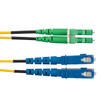
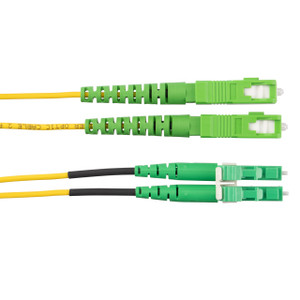
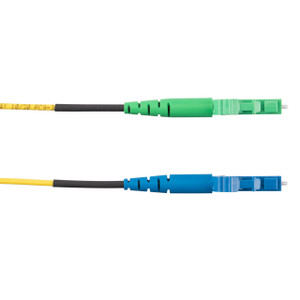
Panduit F92ELB1SNSNM020 Opti-Core™ 2-Fiber OS2 LC/APC to SC Duplex Patch Cord
The Panduit F92ELB1SNSNM020 Opti-Core™ patch cord delivers single-mode OS2 fiber connectivity for long-haul datacenter, campus backbone, and security infrastructure installations requiring reach beyond 550 meters. This 20-meter duplex cable terminates LC/APC connectors on one end and SC connectors on the other, bridging equipment with dissimilar connector types while maintaining the low return loss required for 10G/40G/100G Ethernet and CWDM/DWDM optical transport. The LSZH jacket meets plenum-equivalent fire safety standards for enclosed pathways without requiring metallic conduit.
Key Features
- OS2 single-mode 9/125µm fiber rated for distances up to 10 km at 10 Gbps, 40 km at 1 Gbps
- LC/APC (angled physical contact) green connectors on one end minimize back reflection to less than -60 dB for passive optical networks and analog RF-over-fiber
- SC duplex connectors on opposite end for compatibility with legacy SAN storage, fiber channel switches, and older enterprise network cores
- 1.6 mm diameter cable jacket balances flexibility for tight-radius patch panel dressing with crush resistance for floor-crossing runs
- LSZH (Low Smoke Zero Halogen) jacket compliant with IEC 60754-1/2 and plenum fire ratings for air-handling spaces without metal conduit
- 20-meter (65.6 ft) length spans typical row-to-row datacenter distances or floor-to-floor vertical risers in 2-3 story buildings
- Yellow cable color per TIA-598-C standard for single-mode OS2 fiber, simplifying field identification during MAC work
- Standard insertion loss factory-tested and certified per IEC 61300-3-4
Single-mode OS2 fiber is the correct choice when link distances exceed the 550-meter OM4 multimode ceiling or when future-proofing for 40GBASE-LR4/100GBASE-LR4 over existing infrastructure. The 9-micron core diameter supports only a single light mode, eliminating modal dispersion and enabling transmission over distances up to 10 kilometers at 10 Gbps without amplification. The LC/APC connector's 8-degree end-face angle reduces Fresnel reflection to below -60 dB—critical for preventing interference in analog CCTV-over-fiber systems, PON (passive optical network) deployments, and high-bitrate DWDM (dense wavelength-division multiplexing) links where even -40 dB return loss from standard LC/UPC connectors can degrade bit error rate. The SC connector on the opposite end maintains backward compatibility with fiber channel storage arrays, legacy 1000BASE-LX switches, and building management system backbones installed before LC became the datacenter standard. The 1.6 mm cable diameter strikes a balance: thin enough to dress neatly in high-density patch panels without exceeding the bend radius minimum, yet robust enough to survive foot traffic when crossing raised-floor tiles or being pulled through vertical cable trays.
LSZH jacketing is specified by NFPA 70 (NEC Article 770) for fiber cables installed in air-handling spaces where PVC combustion byproducts—hydrochloric acid and dense smoke—pose life-safety and equipment risks during fire. LSZH compounds emit less than 0.5% hydrogen chloride by mass and produce light-transmission obscuration below 60% per IEC 61034-2 smoke density test, allowing safe egress and reducing corrosive damage to servers and network electronics. This 20-meter length is ideal for row-to-row connections in datacenter hot-aisle/cold-aisle layouts (typically 12-18 meters between row heads), floor-to-floor riser runs in 2-3 story buildings (3-4 meters per floor plus slack), or secure-area perimeter links where IP cameras and access controllers connect back to a centralized network closet. For surveillance installations, OS2 fiber eliminates ground-loop hum in analog camera-over-fiber converters, supports PoE++ media converters at the far end without voltage drop concerns, and provides complete electrical isolation between buildings—critical when linking detached guard stations or parking structures to a main security operations center.
Panduit Opti-Core™ patch cords ship with dust caps installed on all connectors and include serialized test reports documenting insertion loss, return loss, and end-face geometry per IEC 61300-3-35 standards. The yellow jacket color conforms to TIA-598-C single-mode identification standards, preventing accidental cross-connection with aqua OM3/OM4 multimode cables during maintenance windows. Each cord is individually bagged and ships in cartons of 10 for project-quantity ordering, with UPC 61305680541 enabling direct integration into asset management and inventory tracking systems.