Panduit F91ER1NB1SNM005 OS2 Single-Mode Fiber Optic Patch Cord
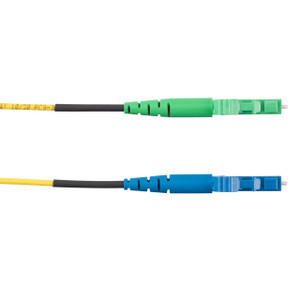
The Panduit F91ER1NB1SNM005 Opti-Core fiber patch cord delivers single-mode OS2 performance in a riser-rated 5-meter simplex configuration, purpose-built for datacenter interconnects, campus backbone extensions, and security/AV transport where low insertion loss and APC termination matter. The LC Simplex to LC/APC connector pair combines the industry-standard LC footprint with angle-polished physical contact termination on one end, reducing back-reflection to -60 dB or better—critical for high-bitrate transmission, coherent optics, and analog RF-over-fiber links where return loss degrades signal integrity. The 1.6mm jacketed single-fiber construction fits dense patch panels and breakout applications where 2.0mm duplex cables create congestion, and the riser (OFNR) flame rating meets NEC 770.154(A) for vertical pathways without conduit.
Key Features
- OS2 9/125 µm single-mode fiber supports 10G/40G/100G+ transmission over metropolitan and campus distances
- LC Simplex to LC/APC termination: standard UPC on one end, angle-polished contact (8° angle) on the other for <-60 dB return loss
- 1.6mm simplex cable diameter—40% smaller than 2.0mm duplex alternatives for high-density patch fields
- Riser (OFNR) flame rating per UL 1666 and NEC Article 770 for vertical cable runs between floors
- 5-meter (16.4 ft) factory-terminated length eliminates field termination labor and insertion-loss variability
- Standard insertion loss grade: ≤0.3 dB typical per mated pair, tested per IEC 61300-3-4
- Yellow PVC jacket for instant single-mode identification per TIA-598-C color coding
- Opti-Core brand heritage: Panduit's fiber platform with 25+ year installed base in Fortune 500 datacenters
Single-mode OS2 fiber operates at 9 µm core diameter with 125 µm cladding, propagating a single light mode that eliminates modal dispersion—the limiting factor in multimode links beyond 300 meters. This makes OS2 the only viable choice for runs exceeding 500 feet, including building-to-building campus links, datacenter row-to-MDA (main distribution area) trunks, and IP camera/access control backhaul where OM3/OM4 multimode would require midspan media converters. The F91ER1NB1SNM005's 5-meter length suits rack-to-rack interconnects within the same row, SAN fabric edge connections, and short-hop passive optical LAN (POL) drops from hallway splitters to telecom rooms. Simplex topology—one transmit or receive fiber rather than duplex TX/RX pairs—matches BiDi (bidirectional) transceiver applications, WDM (wavelength-division multiplexing) systems where upstream and downstream travel the same strand, and monitoring/test access points where a single fiber taps a live link.
The LC/APC termination asymmetry addresses a critical fieldbus architecture requirement: APC connectors on one end reduce Fresnel reflection at the glass-to-air interface by cleaving the ferrule endface at an 8-degree angle, deflecting back-reflected light into the cladding rather than back down the core. This cuts return loss from the -40 dB typical of standard UPC (ultra-physical contact) to -60 dB or lower, a 100× reduction in reflected power. Analog CATV/RF-over-fiber systems, DWDM metro rings, and coherent 100G/400G optics all demand APC to prevent laser instability and bit-error-rate degradation. The hybrid LC Simplex (UPC) to LC/APC design lets integrators deploy APC at the sensitive transceiver end—typically an OLT, DWDM mux, or headend transmitter—while maintaining cost-effective UPC at the passive patch panel or bulkhead, avoiding the 2–3× price premium of dual-APC cables for links where only one end is return-loss-critical. The 1.6mm jacket diameter, versus the 2.0mm standard for duplex zip-cord, saves 36% cross-sectional area: a fully populated 144-port LC panel with 1.6mm simplex cables occupies the same pathway fill as 104 ports of 2.0mm duplex, directly translating to fewer cable trays, tighter bend radii, and improved airflow in hot-aisle containment.
Riser (OFNR) flame rating per UL 1666 and NEC 770.154(A) permits installation in vertical shafts, risers, and ducts between floors without metallic conduit, a common requirement in multi-story office buildings, hospitals, and university facilities where fiber runs from basement server rooms to intermediate distribution frames (IDFs) on upper floors. OFNR-rated cables self-extinguish and limit flame spread to 5 feet per the UL 1666 test protocol, preventing fire from traveling floor-to-floor through cable pathways—a Code violation that triggers failed inspections and costly rework. Panduit's Opti-Core manufacturing includes automated polishing, interferometric end-face inspection, and insertion-loss testing on every connector, ensuring the standard IL grade (≤0.3 dB typical) claimed here reflects actual shipped performance rather than best-case lab data. The yellow jacket follows TIA-598-C Annex A color-coding (yellow = single-mode OS2, aqua = OM3/OM4 multimode), reducing misconnection errors during maintenance—plugging multimode into single-mode transceivers causes immediate link failure, while the reverse (single-mode fiber on multimode optics) works but wastes the fiber's distance capability.
Supplied in cartons of ten patch cords, the F91ER1NB1SNM005 suits project-scale deployments—datacenter POD commissioning, campus network upgrades, or security NOC buildouts—where bulk pricing and consistent lot-to-lot performance matter. EN 60332-1-2 certification (IEC vertical flame test) provides CE mark compliance for European or multinational installations, and the 61305680461 UPC enables inventory tracking through ERP systems and automated receiving workflows. This Opti-Core patch cord fits environments where the 5-meter length bridges the gap between rack-mount equipment and overhead cable trays, where APC return loss protects sensitive coherent optics or CATV distribution, and where riser rating keeps the installation code-compliant without the cost and labor of conduit—delivering the link budget, polarity management, and flame safety that define Panduit's fiber portfolio across 50,000+ enterprise and service-provider sites.