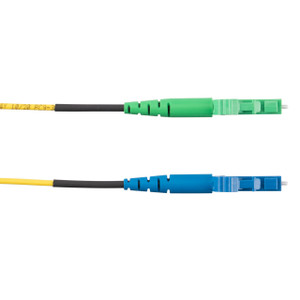
Panduit F91EL1NB1SNM006 Opti-Core OS2 Single-Mode Fiber Patch Cord
The Panduit F91EL1NB1SNM006 is a 6-meter OS2 single-mode fiber optic patch cord designed for long-haul datacenter interconnects and campus backbone extensions where you're bridging APC-polished equipment (typically newer DWDM, CWDM, or PON gear) to standard UPC-polished infrastructure. One end terminates in an LC Simplex connector with standard UPC polish; the other end uses LC Simplex with APC (Angled Physical Contact) polish. The 1.6mm simplex cable uses LSZH jacketing for plenum and riser compliance in regulated commercial spaces, and ships with Panduit's Opti-Core warranty covering insertion loss, return loss, and mechanical durability. This hybrid-polish configuration solves a common migration problem: you need to connect legacy LC patch panels or switches (UPC) to newer single-mode optics (APC) without adapter plates or gender-changers eating rack space and adding failure points.
Key Features
- OS2 single-mode fiber (9/125 micron) rated for 10G/40G/100G Ethernet and distances up to 10 km on standard optics, 40+ km on extended-reach modules
- Hybrid polish termination: LC Simplex UPC on one end, LC Simplex APC on the other, eliminating the need for costly APC-to-UPC adapter cassettes in mixed deployments
- 1.6mm simplex jacket in yellow (standard single-mode color coding per TIA-598-D) for easy visual identification in dense patch fields
- LSZH (Low Smoke Zero Halogen) outer jacket meets EN 60332-1-2 flame test and IBC plenum requirements—critical for installations in occupied ceiling spaces, vertical risers, and ASHRAE-compliant datacenters
- Standard Insertion Loss specification (typically ≤0.3 dB) across the 1260-1625 nm wavelength window, ensuring margin for 10GBASE-LR, 40GBASE-LR4, and 100GBASE-LR4 optics
- Factory-terminated and polished connectors with ceramic ferrules, individually tested and serialized—eliminates field termination labor and the risk of contamination or endface damage during install
- 6-meter (19.7-foot) length suits rack-to-rack connections within a row, cross-aisle links in small datacenters, or equipment-to-wall-port drops in telecom rooms
- Part of Panduit's Opti-Core fiber system, backed by application assurance and compatible with Panduit's FZ-series adapter panels, FAP cassettes, and patch-cord management accessories
OS2 single-mode fiber uses a 9-micron core diameter, roughly 1/6 the width of multimode OM4, which confines light to a single propagation mode and eliminates modal dispersion—the primary distance limit in multimode links. At 1310 nm (the wavelength used by 10GBASE-LR and most enterprise single-mode optics), OS2 fiber exhibits attenuation around 0.35 dB/km, allowing 10 km links with 6-7 dB total loss budget (3.5 dB for fiber, 2-3 dB for connectors and splices, leaving 2+ dB margin). The APC connector on one end of this cord uses an 8-degree angled endface polish, which reflects back-scatter out of the fiber core rather than straight back toward the source—critical for high-power DWDM lasers, PON ONTs, and coherent optics where return loss below -60 dB is required to prevent bit errors and laser instability. The UPC end uses a standard flat polish (return loss typically -50 dB), suitable for patch panels, switches, and older optics that don't require APC-grade isolation. In practice, this hybrid cord is your go-to when you're inserting a new DWDM mux, a GPON OLT, or a coherent 400G module into an existing infrastructure—connect the APC end to the sensitive optic, the UPC end to your legacy panel, and you've solved the polish-mismatch problem without re-terminating entire trunk runs or stocking costly transition modules.
The LSZH jacket is a hard requirement in European datacenters (EN 50173 mandate), increasingly common in U.S. builds under IBC 2021 plenum provisions, and specified by hyperscalers and colocation providers (Equinix, Digital Realty) to limit toxic gas release during fire events in occupied or high-airflow spaces. LSZH compounds use mineral fillers (aluminum hydroxide, magnesium hydroxide) instead of PVC or polyethylene, so combustion produces water vapor and inert ash rather than hydrochloric acid and dense smoke—critical for life safety in vertical risers and underfloor plenums where smoke spreads rapidly through HVAC return paths. The trade-off is slightly higher jacket stiffness and lower abrasion resistance compared to PVC, but in fixed patch-cord applications (not repeated flexing or cable tray pulls), LSZH durability is a non-issue. The 1.6mm simplex jacket diameter is small enough for high-density patch-cord managers (Panduit's FPDL-series or equivalent) but large enough to resist kinking during dress and route—particularly important in the 6-meter length, where mid-span sag and tight-radius bends around vertical organizers can stress the fiber if the jacket is too thin. Yellow color coding per TIA-598-D instantly distinguishes single-mode (yellow) from multimode OM3/OM4 (aqua) and OM5 (lime green), reducing the chance of plugging a 10GBASE-SR optic into a single-mode fiber and wondering why the link won't establish.
This 6-meter length hits the sweet spot for rack-to-rack links (up to 4 racks apart in a standard 42U row with rear-of-rack patching) and equipment-to-wall connections in telecom rooms where the MDF or IDF is across the room from the serving equipment. For longer runs—cross-building links, floor-to-floor risers—step up to 10 m, 15 m, or outdoor-rated armored trunk assemblies; for same-rack or adjacent-rack connections where slack management is tight, the 1 m, 2 m, or 3 m versions of this same hybrid APC/UPC configuration give you exactly the length you need without excess coil eating space in cable managers. The LC Simplex form factor is your only option when the optic or adapter panel uses a simplex (single-fiber) port—common in PON deployments, some DWDM mux cards, and older Cisco/Juniper single-fiber BX optics. If your gear uses duplex LC ports (the more common case for 10G/40G/100G), you'll want Panduit's duplex LC-to-LC APC/UPC hybrid cords instead, which bundle two fibers (transmit and receive) in a single zippered jacket and match the duplex clip spacing on SFP+/QSFP+/QSFP28 cages and duplex adapter panels—eliminating the need to dress two separate simplex cords and doubling the risk of polarity errors.