Optex SL-650QN Outdoor PIR Motion Detector
Overview
The Optex SL-650QN is a beam-based outdoor motion detector designed for long-range perimeter surveillance in industrial, warehouse, and enterprise security deployments. Part of the Optex Smart Line series, the SL-650QN (often searched as SL 650QN) delivers detection across 200 meters (650 feet)—a significant distance advantage for large outdoor areas where you need early warning capability before an intrusion reaches critical infrastructure.
Unlike passive infrared detectors with limited range, the SL-650QN uses quad high-power beams, meaning four independent detection paths are transmitted simultaneously. If any beam is interrupted, an alarm triggers. This architecture reduces false alarms from small animals or wind-blown debris because multiple conditions must align to generate an alert. The detector supports both wired and battery-operated installations, and includes a 2X magnification viewfinder for precise aiming during commissioning.
Key Features
- 650-foot detection range (200m): Covers expansive outdoor perimeters—warehouses, parking areas, or fence lines—without needing detector clusters. Fewer devices means lower installation labor and simpler wiring topology.
- Quad beam architecture: Four simultaneous beams reduce nuisance alarms triggered by insects, leaves, or small animals passing through a single detection zone. Multi-beam designs inherently require more energy to cross, filtering noise while maintaining legitimate threat sensitivity.
- Form C relay alarm output (30 VDC, 0.2 A max): Supports both normally-open (N.O.) and normally-closed (N.C.) contact configurations, allowing integration with third-party panels, recorders, or access control systems without additional relays. 0.2 A capacity is sufficient for logic inputs on most security controllers.
- Tamper output (N.C. contact, 30 VDC, 0.1 A): Opens when the cover is removed, triggering a tamper alarm independent of motion detection. Critical for outdoor deployments where physical tampering or vandalism is a realistic threat—you'll know immediately if someone attempts to defeat or disable the device.
- Dual intelligence algorithms: Includes D.Q. Output (Environmental Disqualification) to adapt detection sensitivity based on weather, fog, or seasonal changes, and A.T.C.P. (Automatic Transmit Power Control) to optimize beam intensity relative to ambient light and atmospheric conditions. This reduces weather-related false alarms without requiring manual recalibration.
- Slim body design with mounting flexibility: Four pole bracket options support standard 1.5" or 2" posts, walls, or corner installations. Slim profile reduces wind loading and visual prominence on fence lines or building perimeters.
- 2X magnification viewfinder: Aids precise aiming and target verification during installation. You can confirm beam patterns reach the intended zone before final commissioning.
- Battery-operated variant available: Wireless deployment option eliminates wiring, useful for temporary perimeter coverage or locations where running 24 VDC power is impractical. Reduces installation time in retrofit scenarios.
Integration & Compatibility
The SL-650QN outputs standard dry-contact relay signals (alarm and tamper). These integrate directly into any security control panel, NVR, or access control system that accepts logic-level inputs. No special drivers or IP integration required—it's a hardwired device, making it compatible with legacy systems and new installations alike. Wire distance recommendations are provided in the installation manual to ensure voltage drop doesn't degrade relay performance on long runs.
When to Choose a Different Model
If your perimeter is shorter than 200 meters, Optex's SL-350QN (100m / 350ft range) or SL-200QN (60m / 200ft range) within the same Smart Line family offer cost savings and reduced power consumption over equivalent distances. For indoor motion detection or short-range (<30m) applications, passive infrared detectors are more economical. If you require IP-based alarm transmission (Ethernet reporting to a cloud platform or remote NVR), you'll need a wired relay-to-IP gateway or a hybrid system; the SL-650QN itself is relay-only.
Frequently Asked Questions
Q: What's the difference between the SL-650QN and other detectors in the Smart Line series?
A: Detection range is the primary differentiator. The SL-650QN covers 200 meters (650ft), while the SL-350QN reaches 100 meters (350ft) and the SL-200QN covers 60 meters (200ft). All three share the same quad-beam architecture and tamper protection; choose based on your perimeter distance.
Q: Can I integrate the SL-650QN relay output into my security system?
A: Yes. The Form C relay (30 VDC, 0.2 A) outputs both N.O. and N.C. contacts compatible with any security panel, NVR, or access control system that accepts dry-contact alarm inputs. No special IP or Ethernet integration—it's hardwired.
Q: Does the SL-650QN work in fog or rain?
A: The A.T.C.P. (Automatic Transmit Power Control) algorithm adjusts beam intensity for weather conditions. However, extremely dense fog or heavy rain can reduce effective range below the rated 650 feet. Install the device with weather exposure in mind—overhangs or partial cover help.
Q: How does the tamper alarm work?
A: A switch inside the housing opens a normally-closed (N.C.) relay contact the moment the cover is removed. This triggers an independent tamper alert on your security panel, separate from motion alarms. It's hardwired and does not require power to function in alarm state.
Q: What mounting options are available?
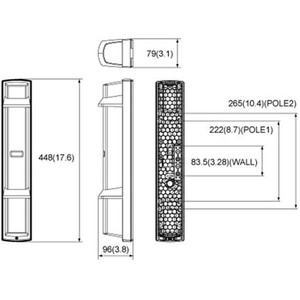
A: Four pole brackets support standard 1.5" or 2" posts. Wall and corner installations are also possible with the included hardware. The 83.5 mm pitch allows flexible spacing between transmitter and receiver units.
Q: Is a wired power supply required, or can I run it on batteries?
A: The SL-650QN is available in both wired (24 VDC) and battery-operated variants. Battery models simplify installation in remote areas or retrofit scenarios where running power is difficult.
James EverettPerspective based on aggregated IP Security Depot and affiliated engineering team experience.
The Optex SL-650QN's 200-meter range and quad-beam architecture represent a practical step up from shorter-range detectors when perimeter size demands it. The 650-foot coverage area means you're cutting detection device count—and associated wiring—versus clustering shorter-range units along a warehouse fence or industrial compound boundary.
Technical Highlights:
- Quad beam transmission: Four simultaneous beams filter nuisance alarms from small animals or wind-blown leaves; a single beam break isn't enough to trigger alarm, reducing false-positive calls to your security team or police.
- Form C relay (30 VDC, 0.2 A) and independent tamper contact (N.C., 0.1 A): Hardwired outputs integrate into any legacy or modern panel without protocol translation. Tamper alarm functions independently of motion detection—critical for outdoor vandalism scenarios.
- A.T.C.P. (Automatic Transmit Power Control): Adapts beam intensity to weather and ambient light, reducing recalibration when seasonal fog or rain is present. Not a cure for extreme conditions, but measurably reduces false weather-related alarms versus fixed-power designs.
Deployment Considerations:
- Beam alignment is critical: The 2X viewfinder helps, but at 650 feet you need clear line-of-sight between transmitter and receiver. Vegetation, walls, or obstacles in the beam path will trigger false alarms or dead zones. Site survey before installation is non-negotiable.
- Power supply distance matters: On long wiring runs, voltage drop degrades relay contact integrity. The manual specifies wire diameter and distance limits; respect them or install a mid-span relay booster.
- Relay-only output: If your design requires IP-based reporting (cloud logging, remote alerting), you'll need a separate IP gateway or wired-to-Ethernet relay interface. The SL-650QN itself does not connect to networks.
Position the SL-650QN for outdoor perimeters spanning 150+ meters where early detection prevents intrusion approach—warehouse compound fences, logistics facility boundaries, or critical infrastructure buffer zones. Its quad beams and weather-adaptive algorithms justify the cost over shorter-range alternatives when perimeter scale demands it.