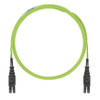
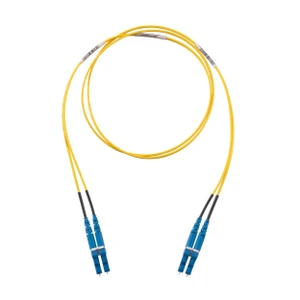
Panduit FW2ERQ1Q1NNF050 OM4 Multimode Fiber Patch Cable
The Panduit FW2ERQ1Q1NNF050 is a 50-foot duplex OM4 multimode fiber optic patch cable engineered for high-performance 40G/100G data center and enterprise network installations. This aqua-jacketed assembly features precision-terminated LC duplex connectors on both ends, manufactured to Panduit's exacting quality standards for consistent insertion loss below 0.35 dB and return loss exceeding 20 dB. Built on OM4 50/125-micron laser-optimized multimode fiber, it supports 10GBASE-SR applications up to 550 meters and 40/100GBASE-SR4 transmission up to 150 meters over MPO backbone infrastructure when used as equipment or cross-connect cabling. The plenum-rated OFNP jacket meets NEC Article 770 requirements for installation in air-handling spaces without conduit, eliminating the need for costly pathway modifications in raised-floor data centers or above drop-ceiling telecom rooms.
Key Features
- OM4 laser-optimized 50/125µm multimode fiber supports 40G/100G Ethernet and 32G Fibre Channel over extended distances
- Factory-terminated duplex LC connectors deliver consistent <0.35 dB insertion loss and >20 dB return loss per TIA-568.3-D
- 50-foot length bridges typical equipment row to end-of-row aggregation switch distances in structured data center deployments
- Plenum-rated OFNP jacket eliminates conduit requirement in air-handling spaces, simplifying pathway design and reducing material cost
- Aqua jacket provides instant visual identification of OM4 cabling per TIA-598-D color coding standard, reducing misconnection risk during MAC work
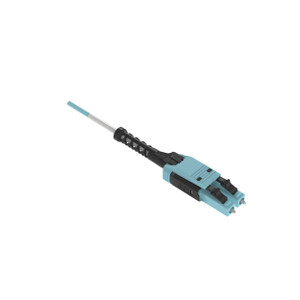
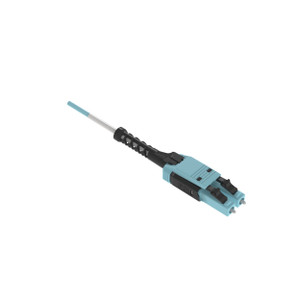
- Pull-proof strain relief boots protect connector-to-cable transition during repeated insertions and cable management stress
- RoHS compliant and manufactured in ISO 9001-certified facilities with full lot traceability for compliance documentation
OM4 fiber has become the de facto standard for new data center builds because it future-proofs physical layer infrastructure for 40G/100G migration without requiring costly re-cabling. Unlike OM3 fiber, which supports 100GBASE-SR4 only to 100 meters, OM4 extends that reach to 150 meters—enough headroom to span the 90-meter permanent link plus 10-meter equipment cord allocation in TIA-942 Tier III/IV data center architectures. This matters during forklift upgrades: when you swap 10G top-of-rack switches for 100G leaf switches, existing OM4 horizontal cabling remains viable, whereas OM3 installations often require selective replacement of longer runs. The FW2ERQ1Q1NNF050's 50-foot length is optimized for equipment-to-equipment connections within the same row or to adjacent MDA/HDA distribution points, falling well within the 100-meter aggregate channel limit while providing routing slack for proper bend radius maintenance around vertical cable managers and overhead ladder rack.
Panduit's manufacturing process ensures both physical endface geometry and optical performance meet the tighter tolerances required for 25G-per-lane signaling used in 100GBASE-SR4 applications. Each connector endface is inspected for geometry defects—scratches, pits, or contamination that cause insertion loss spikes—and undergoes interferometric inspection to verify sub-micron apex offset and radius of curvature. This attention to endface quality translates directly to link margin: a well-manufactured connector typically yields 0.25-0.30 dB insertion loss, leaving 2+ dB of margin against the IEEE 802.3bm 100GBASE-SR4 loss budget. Installers working on financial trading platforms or high-frequency computing clusters rely on this margin to absorb the accumulated loss from panel adapters, bulkhead transitions, and the inevitable degradation from dust ingress over a 10-year service life. For contracts specifying <0.35 dB per-connection loss in the SOW, factory-terminated assemblies like the FW2ERQ1Q1NNF050 provide the only practical path to first-time certification—field termination, even with skilled techs and fusion splice-on connectors, introduces too much variability to guarantee those numbers at scale.
The plenum-rated OFNP jacket addresses a common friction point in commercial build-outs: many jurisdictions require plenum cable for any installation in spaces used for environmental air circulation, including raised floors in data centers and drop ceilings in office telecom rooms. Using riser-rated (OFNR) or general-purpose (OFNG) cable in these spaces triggers a code violation that halts occupancy permit issuance, forcing expensive remediation. The FW2ERQ1Q1NNF050's plenum rating eliminates that risk, and the cost delta versus riser-rated assemblies is negligible when factored into total project cost. The aqua jacket color follows the TIA-598-D standard for OM4 identification: legacy OM1/OM2 (orange/gray) and current OM3 (aqua with black stripe or solid aqua depending on vintage) and OM4 (aqua or sometimes violet depending on manufacturer) all look similar under poor lighting, but the consistent aqua jacket on Panduit OM4 prevents the common error of patching OM3 equipment cords into an OM4 structured link—a mistake that doesn't cause immediate failure but costs you the bandwidth-distance advantage you paid for. During MAC work in live environments, color-coding becomes a safety mechanism: techs can visually confirm fiber type before making a connection, reducing the risk of wrong-fiber faults that take down production links.
Installation and handling discipline directly impacts long-term optical performance. OM4 fiber's 50-micron core is inherently more sensitive to macrobend loss than single-mode fiber; tight bend radii—anything below the 30mm minimum bend radius under tensile load or 50mm minimum bend radius in a static install—cause light to leak from the core into the cladding, spiking insertion loss by 0.5 dB or more. The FW2ERQ1Q1NNF050's strain relief boots protect the cable-to-connector transition, which is the highest-stress point during pulls through congested vertical managers or around tight corners in overhead ladder rack. When routing this assembly, maintain at least a 1.5-inch bend radius (approximately 40mm) in all planes, especially at panel transition points where cables make 90-degree turns into horizontal or vertical managers. Use Velcro cable ties rather than zip ties; over-tightening zip ties creates localized stress points that deform the cable jacket and induce microbend loss. For high-density patching scenarios—100+ connections in a single 19-inch panel—consider using right-angle LC boots on one end to reduce congestion at the panel face and ease future MAC work. Panduit offers right-angle variants under different MPNs, but integrators often mix straight and right-angle assemblies within the same deployment to optimize panel density and strain relief.
This patch cable is designed for indoor controlled-environment use; the OFNP jacket is not UV-stabilized for outdoor or direct-bury applications, and the LC connectors lack the additional sealing required for NEMA/IP-rated enclosures in industrial or outdoor telecom cabinets. For connecting indoor network equipment to outdoor cameras, wireless backhaul radios, or perimeter intrusion systems, specify armored or ruggedized cable assemblies with IP67-rated connectors and UV-resistant jackets. The FW2ERQ1Q1NNF050 is ideally suited for intra-rack and inter-rack connections in climate-controlled data centers, server rooms, telecom closets, and headend equipment rooms where ambient temperature remains within 0-50°C and relative humidity stays below 85% non-condensing. Panduit provides full test data sheets with each reel lot, documenting insertion loss, return loss, and fiber geometry for compliance with TIA-568.3-D Tier 1 performance requirements; retain these data sheets for post-installation certification records and future troubleshooting reference when link performance degrades over time.