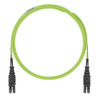
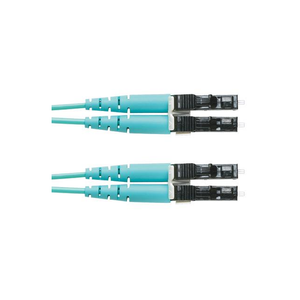
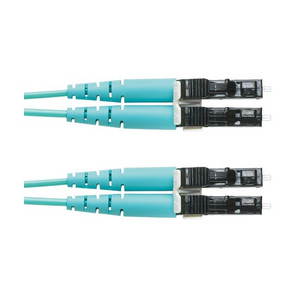
Panduit FW2ERQ1Q1NNF046 OM3 LC-LC Duplex Fiber Patch Cable
The Panduit FW2ERQ1Q1NNF046 is a 50/125 µm OM3 multimode fiber patch cable with duplex LC-to-LC connectors, engineered for 10 Gigabit Ethernet and Fibre Channel applications in enterprise networks, data centers, and storage area networks. This aqua-jacketed cable delivers the low insertion loss and high return loss performance required for high-speed optical links up to 300 meters at 10 Gb/s, with headroom for 40/100 GbE short-reach applications. The precision-polished LC connectors provide repeatable sub-0.3 dB insertion loss across the entire link, and the laser-optimized OM3 fiber core ensures modal bandwidth sufficient for IEEE 802.3ae compliance without the cost penalty of OM4 or single-mode infrastructure.
Key Features
- 50/125 µm OM3 laser-optimized multimode fiber rated for 10 Gb/s transmission up to 300 meters
- Duplex LC-to-LC connectors with ceramic ferrules, factory-terminated and 100% insertion-loss tested
- Aqua OFNR riser-rated jacket for vertical pathway compliance without plenum upcharge
- Guaranteed ≤0.3 dB insertion loss per connector, ≥20 dB return loss for minimal signal degradation
- 46-foot length optimized for cross-connect and horizontal distribution in enterprise wiring closets
- Tight bend-radius tolerance (7.5× cable OD minimum) for high-density patch-panel routing
Panduit's FW2 series fiber assemblies use laser-optimized OM3 fiber that meets or exceeds ISO/IEC 11801 and TIA-492AAAC modal bandwidth specifications—2000 MHz·km at 850 nm—sufficient for 10GBASE-SR Ethernet, 8/16 Gb Fibre Channel, and 40GBASE-SR4 parallel optics within the rated distance. The factory-terminated LC connectors are polished to physical-contact (PC) grade and inspected under interferometry for end-face geometry; each connector ships with a dust cap and is serialized for traceability. This eliminates the field-termination variability that plagues bulk-fiber deployments and ensures Day One compliance with ANSI/TIA-568.3-D insertion-loss budgets. In a typical 10 GbE deployment, you can allocate 2.6 dB for the fiber span (0.3 dB/connector × 4 connectors + 1.4 dB maximum channel loss), leaving margin for four mating cycles or one mid-span splice without exceeding the IEEE 802.3ae 2.6 dB channel limit.
The 46-foot (14-meter) length is deliberately chosen for intra-rack and cross-aisle connectivity in modular data centers and telco central offices where ceiling height, raised-floor depth, and horizontal cable-tray runs combine to create 12–15-meter pathways. Unlike rigid 5-meter or 10-meter jumpers that force daisy-chaining or wasteful coiling, this length handles single-pull routes from top-of-rack switches to middle-of-row aggregation switches, or from SAN directors in one cabinet to storage arrays three racks away, with 1–2 meters of service loop for future re-termination. The cable's 2.0 mm duplex zipcord construction and OFNR riser jacket meet NEC Article 770 for vertical riser pathways without requiring plenum-rated (OFNP) cable, a cost saving of 30–40% on deployments where fire-stopping is handled at the floor penetration rather than cable-by-cable. The aqua jacket color conforms to TIA-598-D coding for OM3/OM4 multimode fiber, enabling instant visual identification during MACs and preventing accidental cross-patching with OM1/OM2 (orange) or single-mode (yellow) links.
The LC duplex connector format—two simplex LC connectors in a side-by-side clip—is the de facto standard for enterprise networking and storage, offering twice the port density of SC connectors and better mechanical retention than ST bayonets. Panduit's LC ferrules are zirconia ceramic with a 125 µm bore tolerance of ±1 µm, concentricity error under 1.5 µm, and a polished end-face radius of 10–25 mm. The connector bodies include an internal strain-relief boot molded in aqua to match the cable jacket, and the duplex clip is keyed to prevent single-fiber reversal (critical for Tx/Rx pairing in bidirectional protocols). Each connector is tested for insertion loss at 850 nm and 1300 nm wavelengths; Panduit guarantees ≤0.3 dB insertion loss and ≥20 dB return loss per mated pair, measured per IEC 61300-3-4 and IEC 61300-3-6. In practice, most connectors in the FW2 series measure 0.15–0.25 dB insertion loss, leaving 0.05–0.15 dB margin below the 0.3 dB spec for dust accumulation or multiple mating cycles.
OM3 fiber's laser-optimized core profile uses a graded refractive index and tighter manufacturing tolerances than legacy OM1/OM2 fiber to reduce differential mode delay (DMD)—the phenomenon where different light modes arrive at the receiver at different times, smearing the signal and limiting bandwidth. At 850 nm (the wavelength used by VCSEL transceivers in 10 GbE SFP+ and 40 GbE QSFP+ modules), OM3 fiber supports an effective modal bandwidth (EMBc) of 2000 MHz·km, compared to 500 MHz·km for OM1. This quadrupling of bandwidth allows 10GBASE-SR links to span 300 meters over OM3 versus only 33 meters over OM1, eliminating the need for costly single-mode infrastructure in campus backbone and intra-building distribution scenarios. The same OM3 core also supports 40GBASE-SR4 (four parallel 10 Gb/s lanes) up to 100 meters and 100GBASE-SR10 (ten lanes) up to 100 meters, future-proofing the physical layer for incremental speed upgrades without a forklift fiber replacement.
The cable jacket is OFNR-rated (Optical Fiber Nonconductive Riser) per UL 1666, meaning it passed the UL vertical flame test and can be installed in vertical shafts and risers between floors without conduit, provided the floor penetrations are fire-stopped per local building codes. OFNR is the middle tier in NEC Article 770's hierarchy: OFNP (plenum) is required in air-handling spaces, OFNR in risers, and OFN (general purpose) in horizontal runs within a single floor. Many integrators default to OFNR for all non-plenum applications because it provides riser compliance at a lower cost than OFNP and eliminates the risk of an inspector red-tagging OFN cable found in a riser pathway. The jacket is also RoHS-compliant and halogen-free (LSZH chemistry optional in Panduit's FX series; this FW2 model uses standard PVC), with a 0.3 kN minimum tensile load rating and -20°C to +60°C operating temperature range. The 2.0 mm zipcord design allows the two fibers to be separated ("unzipped") for breakout patching or single-fiber troubleshooting without cutting the jacket.
Installation best practices for OM3 LC patch cables include inspecting both connector end-faces with a fiber microscope or video scope before the first insertion (Panduit ships connectors capped, but contamination can occur if caps are removed in a dusty environment), using a one-click cleaner (e.g., Panduit CFX-R) for any connector that has been mated previously, and maintaining a minimum bend radius of 15 mm (7.5× the 2.0 mm cable diameter) during pulls and dressing. Violating the bend radius can induce microbending loss—localized attenuation from fiber-core deformation—that may not appear in a simple power-meter test but will degrade link margin under temperature cycling or mechanical stress. When routing multiple duplex cables in a high-density panel, use horizontal cable managers with finger ducts or D-rings spaced no closer than 1U to prevent jackknifing the cables at panel entry. For long-term deployments, label both ends of the cable with the port ID and VLAN or zone assignment (Panduit's P1 label printer and TM-H heat-shrink labels are designed for fiber patch cords), and document the link in a DCIM tool or at minimum a cabinet-level spreadsheet with fiber end-face inspection dates.
This 46-foot length is particularly well-suited for point-to-point links in modular data centers where structured cabling is run overhead in cable tray and drops vertically into cabinets: a typical path from a top-of-rack switch at 42U in Cabinet A to a core switch at 30U in Cabinet D (three aisles away, 12 feet of aisle width) totals 6 feet vertical + 36 feet horizontal + 4 feet service loop = 46 feet. It also fits cross-connect scenarios in telco COs where FTTP distribution frames are wall-mounted 8 feet high and OLT shelves are at waist height in adjacent racks 30 feet away. The alternative—using a 50-foot cable and coiling 4 feet of slack—increases the risk of kinking, reduces airflow in dense bundles, and complicates future MAC work. Conversely, daisy-chaining a 30-foot and 15-foot cable introduces two additional connector pairs (0.6 dB insertion loss) and a failure point at the mid-span coupler. Panduit's FW2 series is available in 1-meter through 100-meter lengths in 1-meter increments for custom distances, but stocking the 46-foot length eliminates lead time for the most common cross-connect scenario in enterprise and colocation facilities.
The FW2ERQ1Q1NNF046 is backed by Panduit's standard fiber warranty, which covers insertion loss and return loss performance for the life of the installation provided the cable is not modified, crushed, or subjected to tensile loads exceeding 0.3 kN. Panduit maintains lot-level test records for all factory-terminated fiber assemblies, including insertion-loss histograms and end-face interferometry images, retrievable by serial number for audit or RMA purposes. The cable ships in individual poly bags with connector dust caps installed and a hang tag listing the part number, length, fiber type, and test date. For projects requiring certified test results, Panduit offers the FiberRunner system integration service, which provides per-cable insertion-loss certification traceable to NIST standards and pre-installation cleaning, at an upcharge of approximately 15% over standard catalog pricing. This is typically reserved for financial trading floors, medical imaging networks, or defense installations where link budgets are calculated to 0.01 dB precision and post-installation testing would be prohibitively expensive.