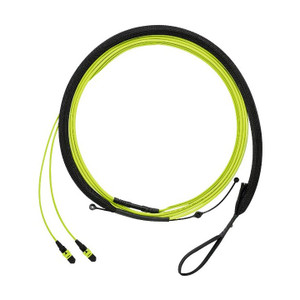
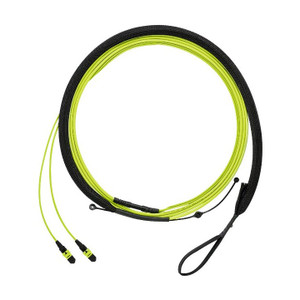
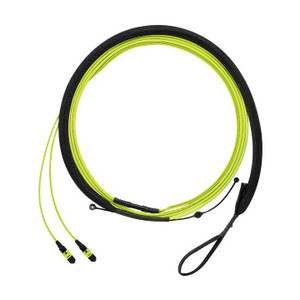
Panduit FWUYL7575LAM067 OM5 24-Fiber Trunk Cable Assembly
Pre-terminated OM5 SigCore trunk cable assembly engineered for high-density data center backbone deployments requiring extended reach and future-proof bandwidth scalability. This 67-meter (220-foot) PanMPO-to-PanMPO trunk delivers 24 fibers of wideband multimode capacity in a compact, low-smoke zero halogen jacket, eliminating field termination labor while enabling instant 100G/400G shortwave wavelength-division multiplexing (SWDM4) migration paths. Panduit's QuickNet platform combines ultra-low insertion loss performance with Method B polarity for seamless duplex LC breakout compatibility, and includes a pulling eye on one end to simplify installation through extended conduit runs or overhead cable tray routes in large enterprise data halls.
Key Features
- OM5 SigCore Wideband Multimode Fiber: 50µm core supports 100GBASE-SR4, 400GBASE-SR4.2, and emerging SWDM4 protocols up to 400 meters at 100G; backwards compatible with OM3/OM4 infrastructure for phased migration strategies
- 24-Fiber Pre-Terminated MPO Trunk: Factory-terminated PanMPO female connectors on both ends eliminate field splicing errors and reduce deployment time from hours to minutes in backbone cabling projects
- Ultra Insertion Loss Grade: Optimized connector endface geometry and fiber alignment deliver <0.35dB typical insertion loss per connection, maximizing link budget for extended reach or high-port-count switching fabrics
- Method B Polarity (HD Flex Transition): Straight-through fiber mapping aligns with TIA-568 Method B standard for predictable duplex LC breakout using standard Type B cassettes or harness adapters
- 67-Meter Length: Purpose-built for long intra-building backbone runs spanning large data halls, cross-connects between network rooms, or building-to-building campus links within OM5's extended reach envelope
- Low Smoke Zero Halogen (LSZH) Jacket: IEC 60332-compliant flame-retardant construction produces minimal smoke and no halogenated acids during combustion, meeting European EN 50173 and North American plenum-equivalent safety requirements for occupied spaces and critical infrastructure environments
- Integrated Pulling Eye: Securely molded attachment point on one trunk end allows direct connection to pull tape for tensioned installation through long conduit runs, reducing jacket stress and connector damage risk during deployment
- Compact HD Flex Cable Design: 30-40% smaller outer diameter than legacy 24-fiber trunks improves airflow in high-density cable management zones, reduces pathway fill ratios, and simplifies moves/adds/changes in congested racks
- Lime Green OM5 Color Coding: High-visibility lime jacket provides instant visual identification in mixed OM3/OM4/OM5 environments, preventing cross-connection errors during maintenance and ensuring ANSI/TIA-598-D color standard compliance
- QuickNet Ecosystem Integration: Designed for seamless interoperability with Panduit's Pre-Term fiber cassettes, MPO adapter panels, and LC breakout modules, enabling modular \"plug-and-play\" infrastructure expansion without specialized fiber technician labor
Panduit's OM5 trunk cable assemblies address the intersection of three critical data center challenges: bandwidth scalability, deployment speed, and physical space constraints. Traditional field-terminated fiber backbones introduce variability—connector endface quality depends on technician skill, environmental conditions during termination, and inspection rigor. Each polishing iteration adds schedule risk and potential for contamination. Pre-terminated trunks eliminate this variability by moving connector manufacturing to Panduit's controlled factory environment where automated polishing and 100% endface inspection ensure consistent sub-0.35dB insertion loss across all 24 fibers. The result is predictable Day 1 performance and elimination of the \"troubleshoot after turn-up\" cycle that plagues field-terminated deployments.
The OM5 fiber specification (ISO/IEC 11801 Category OM5, TIA-492-AAAD) extends effective modal bandwidth to 3500 MHz·km at 953nm, the key wavelength for shortwave wavelength-division multiplexing. This enables four 100G channels over a single duplex fiber pair using SWDM4 transceivers—a 4× density improvement over parallel optics approaches that require eight fibers per 400G link. For integrators planning 100G spine-leaf fabrics today with 400G roadmap requirements, OM5 trunks future-proof the physical layer without over-provisioning fiber count. The 67-meter length in this assembly spans typical enterprise data center backbone distances (row-to-row, end-of-row to core, or intra-building cross-connects) while remaining within OM5's specified reach for 100GBASE-SR4 (150m) and 400GBASE-SR4.2 (100m) protocols. Even in worst-case scenarios with multiple mated connections and aging loss margin, the ultra-low insertion loss grade preserves sufficient link budget for reliable 100G operation across the full 67-meter span.
Method B polarity management simplifies the transition from 24-fiber trunk to duplex LC patch cords at distribution points. In a typical deployment, this trunk connects an MPO patch panel in the main distribution area (MDA) to an MPO cassette at an intermediate cross-connect or end-of-row aggregation point. A standard 24-fiber Type B cassette (or three 8-fiber Type B cassettes) breaks out the trunk into twelve duplex LC ports with automatic polarity correction—Position 1 on the transmit connector aligns with Position 12 on the receive connector per TIA-568-C.0 Annex A. This allows use of straight-through (non-crossover) duplex LC patch cords for switch-to-cassette connections, avoiding the A/B cable confusion that plagues Method A deployments. Panduit's HD Flex transition designation indicates the trunk's internal fiber mapping matches this Method B scheme, and the female-to-female MPO configuration aligns with infrastructure best practices where patch panels and cassettes use female MPO adapters (key-up orientation) to mate with male MPO connectors on equipment cords.
The integrated pulling eye addresses a specific installation pain point: long horizontal or vertical cable runs through conduit or innerduct. Without a pulling eye, installers must improvise attachment methods—tape loops around the cable bundle, cable grips that risk crushing the jacket, or over-tightening pull strings that concentrate stress on the MPO boot. Panduit molds the pulling eye directly into the cable jacket at the factory, creating a load-rated attachment point that distributes tension across the cable's strength members rather than the fiber or connector. This matters on 67-meter pulls where cumulative friction in conduit bends can generate hundreds of pounds of tension. The pulling eye also simplifies overhead tray installations where the trunk must be \"fishing-poled\" across long spans—the installer can securely attach a hook or pull rope without improvising. Because the eye is only on one end, you maintain a low-profile MPO boot on the opposite end for tight-radius bend applications or high-density panel termination.
High-density cable design reduces pathway congestion by 30-40% compared to legacy 2.0mm or 3.0mm buffered fiber trunks. This trunk uses Panduit's HD Flex construction—likely a 1.6mm or smaller buffered fiber—which shrinks the overall cable outer diameter without sacrificing mechanical protection or bend radius performance. In a 4RU vertical cable manager serving 96 LC ports (four 24-port cassettes), the difference between 8mm and 5mm trunk diameter determines whether you can route cables without inducing sharp bends or whether you need to add a second vertical manager. Smaller diameter also improves thermal management: tightly bundled large-diameter cables create insulating \"blankets\" that trap heat near switch exhaust ports. The compact profile of HD Flex trunks allows more airspace between cables, reducing local hotspots and improving cooling efficiency in high-density racks. The lime green LSZH jacket meets IEC 60332-1-2 flame propagation limits and IEC 61034-2 smoke density limits (light transmittance >60%), satisfying European CPR Class Dca requirements and North American safety codes for air-handling spaces. During a fire event, LSZH cable produces less than 0.5% halogen acid gas by weight compared to >28% for PVC jacketed cables—critical in data centers where even small amounts of hydrochloric or hydrobromic acid can corrode servers, storage arrays, and optical transceivers hundreds of feet from the fire source.
Panduit specifies compliance with ISO/IEC 11801 Category OM5, TIA/EIA-568-C.3 cabling infrastructure, TIA-492-AAAD fiber performance, IEC 60793-2-10 Type A1a.3 fiber classification, and TIA-604-5 (FOCIS-5) MPO connector intermateability. These standards ensure this trunk integrates with multi-vendor environments—OM5 fiber from any manufacturer will mate with these MPO connectors, and the Method B polarity aligns with cassettes and breakout modules from Panduit, Corning, CommScope, or other TIA-compliant vendors. The 67-meter length falls within the structured cabling limit for permanent link backbone segments (90m horizontal + 300m backbone under TIA-568), and the UPC (ultra-physical contact) endface polish on the MPO connectors prevents back-reflection issues that degrade BiDi or CWDM optics. For integrators building 100G leaf-spine fabrics in large data centers, this trunk provides the physical layer foundation for scalable, repeatable, and standards-compliant backbone connectivity that will support 400G migration without rip-and-replace.