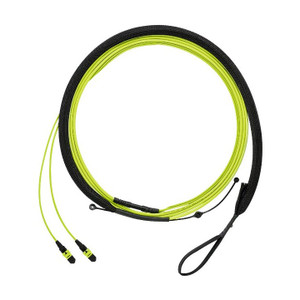
Panduit FWUYL7575LAM031 QuickNet OM5 24-Fiber Trunk Cable Assembly
The Panduit FWUYL7575LAM031 is a factory-terminated 24-fiber OM5 trunk cable assembly engineered for high-density data center backbone installations where deployment speed, physical space constraints, and future-proof bandwidth matter. This 31-meter (101.7 ft) lime-jacketed trunk runs PanMPO female connectors on both ends, supports twelve duplex 100G/400G links via Method B polarity, and delivers Ultra insertion loss performance across all 24 strands. The HD Flex cable construction and integrated pulling eye let you route through tight pathways and overhead trays without field termination — eliminating fusion-splicing labor, connector-loss variability, and the install-time risk of damaging OM5's wideband-optimized 50-micron core. Data center managers deploying leaf-spine fabrics, storage-area networks, or shortwave-WDM infrastructure will recognize this as the direct path from MDA patch panel to EDA switch — one pull, two clicks, zero field work.
Key Features
- OM5 wideband multimode fiber — 50-micron core optimized for 850-953 nm SWDM transmission, supporting 4-lane 100GBASE-SR4 to 100 m and 400GBASE-SR16 to 70 m per TIA-492-AAAD
- 24-fiber PanMPO-to-PanMPO trunk — female connectors both ends, twelve duplex channels in a single assembly, compatible with Panduit Opti-Core cassettes and breakout modules
- Method B polarity — straight-through key-up-to-key-down pinout for direct connection between cassettes or HD modules without polarity-flip adapters
- Ultra insertion loss grade — factory testing guarantees ≤0.20 dB typical IL per mated pair, preserving link budget on 400G-SR8 and BiDi applications where every tenth-dB counts
- HD Flex cable jacket — 30-40% smaller OD than legacy round trunk designs, 25 mm minimum bend radius, reduces pathway fill and allows sharper turns at ladder-rack corners
- LSZH outer jacket (lime) — IEC 60332-3 flame-rated, low-smoke zero-halogen compound for plenum-equivalent installations and international building codes
- Integrated pulling eye — factory-installed lug on one end accepts standard pull rope, eliminates need for cable-grip socks on long horizontal or vertical runs
- 31-meter fixed length — pre-measured for typical row-to-EOR distances in modular data centers; no field cutting, stripping, or length waste
- QuickNet factory certification — each assembly ships with individual insertion-loss and return-loss test report traceable to trunk serial number
- Full standards compliance — meets TIA-568-C.3, ISO/IEC 11801, TIA-604-5 (FOCIS-5), and RoHS; compatible with Cisco/Arista/Juniper 400G-SR8 QSFP-DD optics
Data center infrastructure moves in two directions: higher lane speeds and denser port counts. The FWUYL7575LAM031 addresses both by pairing OM5's 953 nm shortwave-WDM capability with a 24-strand trunk that consolidates what used to require six 12-fiber LC duplex patch cords. In a leaf-spine topology, this trunk becomes your vertical riser or horizontal cross-connect — one cable from the main distribution area (MDA) fiber panel to the equipment distribution area (EDA) top-of-rack switch, breakout via Opti-Core cassette to twelve LC duplex drops. You eliminate twelve individual patch cords, twelve opportunities for bend-radius violation, and twelve documentation points. The Ultra IL spec ensures that when you populate all twelve channels with 100G-SR4 or mix in 400G-SR8 BiDi optics, your worst-case fiber pair stays inside the IEEE 802.3cm power budget with margin for future cassette swaps or additional mated connections.
OM5 fiber was standardized specifically to let shortwave VCSELs use coarse WDM — four wavelengths (850/880/910/953 nm) over a single MMF pair instead of four parallel pairs. The practical result: 100GBASE-SR4's four-lane 25G optic can be replaced with a single-lane 100G SWDM optic using only two fibers instead of eight, or a 400G-SR8 transceiver can run over eight fibers instead of sixteen. Panduit's OM5 core is manufactured to TIA-492-AAAD's tighter effective modal bandwidth (EMB) spec across that full 850-953 nm window, and the Ultra IL termination process holds each MTP pin-to-ferrule offset to ≤0.20 dB. In deployment terms, that means you can light this trunk today with 100G-SR4 optics (eight fibers active, sixteen dark) and migrate those same eight fibers to 100G-SWDM transceivers later without re-cabling — the OM5 core and low-loss terminations support both modulation schemes to the same 100-meter distance. For new 400G spine uplinks, the trunk provides all 24 fibers a single 400G-SR8 transceiver needs (sixteen active + eight spare) in one pull.
The HD Flex cable construction is where install labor visibly compresses. Traditional round 24-fiber trunk assemblies measure 8-10 mm OD and require 50 mm bend radius; Panduit's flat ribbon-style HD Flex drops that to ~6 mm height and 25 mm bend radius. In a 4-inch-wide vertical cable tray running ten trunks, you recover roughly 35% of the usable width — enough to add three more trunks without upsizing the pathway or violating NEC 40% fill ratio. The flat profile also means the cable naturally lays in the tray without rolling, and at ladder-rack 90-degree turns you can fold it over the rung edge without kinking. The factory pulling eye is bonded to the strength member at one end; thread your pull rope, secure it, and pull the full 31 meters through conduit or overhead J-hooks in one motion. Compare that to pulling twelve individual duplex LC cords one-by-one or trying to keep a field-term trunk's exposed ferrules clean during a 100-foot pull. The time-to-light savings show up as same-day backbone deployment instead of multi-day termination and testing cycles.
Method B polarity is the straight-through pinout: fiber 1 on end A lands on fiber 1 on end B, fiber 12 on fiber 12, and so on, with one connector keyed up and the other keyed down. This is the dominant polarity scheme for trunk-to-cassette architectures. Plug the key-up end into your MDA Opti-Core cassette (which has an internal crossover) and the key-down end into your EDA cassette; the two cassettes' LC duplex ports will have transmit-to-receive mapping without needing a Type B-to-Type A adapter or field crossover module. If you're connecting two HD switch modules back-to-back (EDA switch to SAN director, for instance), the same Method B trunk works directly because both modules expect the key-orientation flip. The alternative — Method A trunks with key-up on both ends — requires a physical polarity adapter or cassette swap, adding insertion loss and an extra failure point. Panduit ships this trunk as Method B because it matches the installed base of their Opti-Core and Signature Core cassette systems; if your data center standardized on that architecture three years ago, this trunk drops in with zero polarity mapping.
LSZH jacketing is increasingly required by international mechanical and electrical codes (IEC, CENELEC), and many U.S. hyperscale operators specify it even in non-plenum spaces to reduce toxic-gas risk during fire. The lime color is OM5's TIA-598 identification standard, making it visually distinct from aqua OM3, OM4's violet, and older OM1/OM2 orange during moves-adds-changes. In a multi-generation data center where you're running 10G on OM3, 40G on OM4, and 100G/400G on OM5, the color-coding prevents accidental cross-patching that would either fail link negotiation or leave performance on the table. The LSZH compound is also lighter and more flexible than traditional PVC, contributing to the overall small-diameter advantage and easier handling on overhead installs where installers are working from ladders.
This trunk is factory-certified and serialized. Each assembly ships with a printed test report listing insertion loss and return loss for all 24 fibers, measured at 850 nm per TIA-568-C.3 test procedures. That report becomes part of your as-built documentation and gives you a baseline for future troubleshooting — if a link fails certification two years later, you can compare current IL to the factory number and determine whether the trunk degraded or the issue is in a field-added mated connection. The QuickNet program also includes a web portal where you can retrieve test data by serial number, useful during audits or when the paper report goes missing. For contractors bidding on jobs with TIA-942 Rated-3 or Rated-4 tier requirements, factory-certified trunks with serialized traceability often satisfy the structured-cabling performance verification clause without requiring you to test every fiber pair in the field.
Deploy this trunk in scenarios where 24-fiber density, pre-term reliability, and OM5 future-proofing align: leaf-spine fabrics in 100G/400G Ethernet networks, Fibre Channel SAN backbones running 32GFC or 64GFC, hyperconverged infrastructure clusters requiring low-latency east-west traffic, or modular data centers with pre-defined MDA-to-EDA distances. The 31-meter length fits the majority of single-row or adjacent-row deployments; for longer spans, Panduit offers the same trunk in 46 m, 61 m, and custom lengths. Pair it with Opti-Core HD cassettes (12-fiber MTP-to-LC breakout modules) at each end for a complete channel, or terminate into Signature Core panels if you're building a permanent cross-connect field. The pulling eye, LSZH jacket, and Ultra IL spec mean this trunk will install faster, meet stricter codes, and perform closer to theoretical limits than any field-terminated alternative — and in data center economics, the delta between one-day and three-day backbone deployment is measured in opportunity cost, not just labor hours.