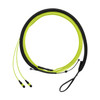
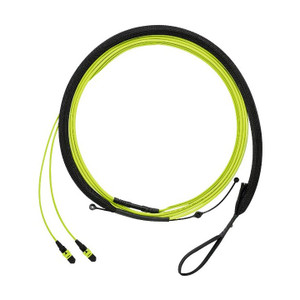
Panduit FWUYL7575KAM085 QuickNet 24-Fiber OM5 Trunk Cable Assembly
The Panduit FWUYL7575KAM085 is an 85-meter, 24-fiber OM5 trunk cable assembly engineered for high-density data center backbone installations requiring extended reach and future-proof bandwidth. Terminated with PanMPO female connectors on both ends and built on Panduit's HD Flex low-profile cable platform, this LSZH-rated trunk delivers Method A polarity and ultra insertion loss performance across 12 duplex channels. The lime jacket provides instant OM5 identification in mixed-fiber environments, while the integrated pulling eye simplifies installation through congested pathways and overhead cable trays.
Key Features
- OM5 wideband multimode fiber supports 100G/400G Ethernet via SWDM (Short Wavelength Division Multiplexing) over extended distances up to 440m at 100GBASE-SR4
- 24-fiber PanMPO female to PanMPO female termination enables 12 duplex LC breakout channels or 24 bi-directional parallel optics connections
- Method A polarity alignment simplifies integration with standard duplex adapter panels and cassette modules without on-site re-termination
- Ultra insertion loss specification (<0.35 dB typical) preserves link budget for multi-tier spine-leaf architectures and long campus runs
- HD Flex cable construction reduces trunk diameter by 30-40% compared to standard round cable, maximizing airflow and cable tray fill capacity
- LSZH (Low Smoke Zero Halogen) jacket meets IEC 60332-3-24 flame propagation and EN 50399 CPR Euroclass standards for international installations
- Factory-terminated and tested to TIA-568-C.3 ensures Phase 1 polarity verification and eliminates field termination labor and test equipment costs
- Lime cable jacket provides instant visual identification per TIA-598-C OM5 color coding in retrofit or hybrid fiber deployments
- Integrated pulling eye on one end supports assisted installation through conduit, j-hooks, and vertical risers without damaging connectors
- 85-meter length spans typical row-to-EOR (End of Row) or MDA-to-HDA (Main to Horizontal Distribution Area) distances in large colocation facilities
- Pre-installed MTP connector boots protect ferrule end-faces during handling and provide bend radius relief at patch panel interfaces
- RoHS compliant construction eliminates lead, mercury, and restricted substances for disposal and recycling compliance
OM5 fiber represents the latest generation of 50/125 µm wideband multimode technology, optimized for short-wavelength division multiplexing (SWDM) transmission at 850 nm, 880 nm, 910 nm, and 940 nm. Unlike OM3 and OM4 fiber designed for single-wavelength VCSEL transmission, OM5's controlled chromatic dispersion across the 850-950 nm window enables four parallel wavelengths over a single fiber pair—quadrupling effective bandwidth without additional fiber infrastructure. For 100GBASE-SR4 applications, OM5 extends reach to 440 meters (versus 150m on OM4), making the FWUYL7575KAM085's 85-meter length well within the performance envelope for 100G, 200G, and 400G Ethernet deployments. This extended reach matters in large data centers where spine switch aggregation layers may be located in separate fire compartments or across hot-aisle/cold-aisle rows requiring longer cross-connects. The 24-fiber count provides 12 full-duplex channels when broken out to LC duplex connections via MTP-to-LC cassettes, supporting twelve 100G QSFP28 or six 400G QSFP-DD transceivers in a single trunk pull. In parallel optics applications (100G SR4, 400G SR8), the trunk delivers the full 24-fiber infrastructure needed for eight transmit + eight receive lanes plus spares, ensuring compatibility with next-generation 800G and 1.6T optics roadmaps without re-cabling.
The PanMPO connector system is Panduit's implementation of the IEC 61754-7 / TIA-604-5 (FOCIS-5) multi-fiber push-on interface, fully compatible with generic MTP and MPO connectors while maintaining Panduit's tighter mechanical tolerances for insertion loss and return loss performance. Method A polarity—implemented via a key-up to key-down fiber mapping with female connectors on both ends—aligns with TIA-568-C.0 Annex B standard polarity schemes, ensuring that fiber position 1 at end A maps to position 1 at end B without crossover. This straight-through mapping simplifies deployment when using Method A cassettes or adapter panels, as the trunk requires no field flipping or gender-changing adapters. Ultra insertion loss performance (typically <0.35 dB per connector, well below the 0.75 dB TIA maximum) is critical in multi-tier Clos or spine-leaf topologies where a signal may traverse four to six connectorized interfaces between server NIC and top-of-rack uplink. The pulling eye, integrated onto one trunk end, threads through 1/4-inch pull cord or rope and distributes tensile load across the cable jacket rather than concentrating stress on the connector backshell—essential when routing through horizontal j-hook pathways, vertical cable managers, or conduit transitions exceeding the cable's 110 N maximum pulling tension. Installers should always pull from the eye end and leave adequate service loop (minimum 1 meter) at patch panels to accommodate future re-termination or repair without replacing the entire 85-meter trunk.
The LSZH jacket formulation substitutes traditional PVC compounds with halogen-free polymers that emit <0.5% hydrogen chloride gas and produce limited smoke (<40% light obscuration) during combustion, meeting IEC 60332-3-24 Category C vertical flame propagation and EN 50399 CPR Euroclass B2ca,s1a,d1a1 requirements. LSZH is mandatory in European Union installations under the Construction Products Regulation (CPR 305/2011) for cables installed in escape routes, plenums, and vertically-routed pathways. In North American jurisdictions, LSZH provides an alternative to CMP-rated plenum cable where local AHJs (Authorities Having Jurisdiction) permit performance-based specifications in lieu of NEC Article 770 listings—common in mission-critical data centers, laboratories, and healthcare facilities prioritizing occupant safety during fire evacuation. The lime jacket color, specified in TIA-598-C for OM5 fiber identification, provides instant visual differentiation from aqua OM3, purple OM4, and legacy orange OM1/OM2 infrastructure during retrofit projects or staged migrations. HD Flex cable construction uses a reduced-diameter central strength member and tighter buffer tube packing to achieve 4.8 mm nominal outer diameter—compared to 7.2 mm for equivalent round trunk cables—reducing cable tray and conduit fill by 30-40% and improving airflow in underfloor and overhead pathways where thermal load impacts cooling efficiency.
This trunk ships factory-terminated, end-to-end tested, and serialized with insertion loss and return loss test data traceable to NIST-certified reference standards, eliminating the need for field fusion splicing, polishing, or Tier 1 certification testing. Compliance with TIA-568-C.1 generic cabling, TIA-568-C.3 optical fiber cabling, ISO/IEC 11801-1 generic cabling for customer premises, and TIA-492-AAAD OM5 fiber performance specifications ensures interoperability with multi-vendor active equipment and supports structured cabling warranty programs from Panduit and third-party system integrators. The 85-meter length addresses typical main distribution area (MDA) to horizontal distribution area (HDA) distances in colocation facilities, campus data centers, and large enterprise server rooms where equipment rows may span 60-70 meters of horizontal pathway plus 15-20 meters of vertical riser—common in raised-floor environments with overhead cable tray transitions or multi-floor IDF-to-MDF links in mid-rise buildings.