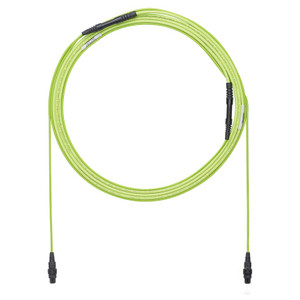
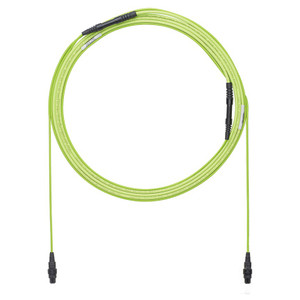
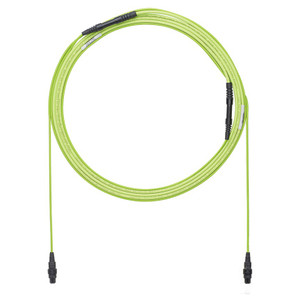
Panduit FWTYL7575LNM014 QuickNet™ 12-Fiber OM5 Trunk Cable Assembly
The Panduit FWTYL7575LNM014 is a QuickNet™ 12-fiber OM5 wideband multimode trunk cable assembly engineered for high-density data center backbone installations where cabinet space and airflow are at a premium. This 14-meter (46-foot) pre-terminated assembly uses small-diameter construction to achieve 30-40% footprint reduction compared to traditional trunk cables, directly addressing pathway fill and cooling challenges in modern hyperscale and enterprise environments. OM5 lime green jacketing provides instant visual identification while supporting both legacy 10/40/100G applications and emerging short-wavelength division multiplexing (SWDM) architectures that enable 400G and beyond over multimode infrastructure.
Key Features
- 12-fiber OM5 (50/125μm) wideband multimode for current 10/40/100G networks and future 400G SWDM migration
- Small-diameter trunk construction reduces pathway fill by 30-40%, improving airflow and simplifying cabinet management
- Factory-terminated QuickNet™ cassettes eliminate field termination labor and deliver guaranteed insertion loss performance
- LSZH (Low Smoke Zero Halogen) jacketing meets IBC/NEC plenum and riser requirements for occupied spaces
- 14-meter length suits typical riser runs between equipment room and IDF, or cross-connect to zone distribution
- TIA-568-C.3 and ISO/IEC 11801 compliant, certified to TIA-492-AAAD and IEC 60793-2-10 A1a.3 fiber specifications
- Lime green jacket color per TIA-598-D standard for instant OM5 identification during adds/moves/changes
- Pre-tested and serialized at the factory with performance documentation included
QuickNet™ trunk cable assemblies solve the three primary cost drivers in structured fiber deployments: installation time, pathway congestion, and performance uncertainty. Traditional bulk fiber installations require field termination, which introduces variability in insertion loss, return loss, and polarity—each a potential source of link budget failure in 100GBASE-SR4 or 400G-SR8 applications where margin is measured in tenths of a dB. The FWTYL7575LNM014 arrives pre-terminated with factory-fusion splicing and cassette integration, reducing a typical 12-fiber backbone installation from 4-6 hours of splice work to a 15-minute plug-and-verify operation. This labor compression is critical in phased data center builds where every hour of structured cabling delay pushes revenue-generating infrastructure commissioning further out. The small-diameter design compounds the advantage: in a 4-inch vertical riser conduit, you can route three FWTYL-series trunks in the same space that would accommodate two legacy assemblies, preserving pathway capacity for future expansion while maintaining NEC Chapter 3 fill ratio compliance.
OM5 wideband multimode fiber represents a strategic infrastructure decision for installations with 7-10 year refresh cycles. While OM4 handles 100GBASE-SR4 at 100 meters, OM5's extended bandwidth window (minimum 3500 MHz·km at 850nm, 1850 MHz·km at 950nm per TIA-492-AAAD) enables four-wavelength SWDM transmission that quadruples effective capacity without rewiring—turning each 12-fiber trunk into a 48-lane fabric when paired with SWDM transceivers. In hyperscale environments where port density and power consumption drive total cost of ownership, this future-proofing allows graceful migration from 100G to 400G optics on the same physical layer. The 14-meter length bridges typical floor-to-floor vertical rise or equipment-room-to-meet-me-room horizontal distances in multi-tenant data centers, while staying well within OM5's 440-meter SWDM budget at 400G-SR4.2. Deploy FWTYL7575LNM014 trunks as your backbone today with 100G BiDi or SR4 optics, then swap transceivers to 400G-SR4.2 SWDM when compute density demands it—zero rewiring, zero downtime, zero change orders. Each fiber in this assembly supports 28Gbps per lane today, with headroom to 100Gbps per lane as transceiver technology matures, giving you a minimum 4× capacity expansion path on day-one infrastructure investment.
LSZH jacketing addresses the most stringent fire and life safety codes for occupied structures and high-value equipment spaces. Unlike PVC-jacketed cables that produce dense black smoke and corrosive hydrochloric acid when burning, LSZH compounds emit minimal smoke and zero halogens, preserving visibility for egress and preventing secondary damage to active electronics from acid deposition. This matters in below-grade data centers, mixed-use buildings with shared HVAC, and any installation subject to IBC Section 2702 or NFPA 75 clean-agent suppression requirements where cable flammability can trigger insurance exclusions. Panduit's LSZH formulation meets the IEC 60332-1 vertical flame test and IEC 61034 smoke density limits, clearing both NEC Article 770 riser (OFNR) and plenum (OFNP) ratings depending on installation pathway. For integrators juggling AHJ approvals across multiple jurisdictions, the FWTYL7575LNM014's comprehensive UL and CSA listings eliminate the compliance ambiguity that stalls final inspections and certificate-of-occupancy sign-offs.
The 12-fiber count aligns with structured cabling best practices for MDA-to-HDA (main distribution area to horizontal distribution area) trunk applications in TIA-942 data center topology. Six duplex pairs provide capacity for redundant core switching fabrics, out-of-band management networks, and storage replication links without requiring a second trunk run—your initial conduit pull handles both production and business continuity requirements. QuickNet™ cassettes terminate to industry-standard MPO-12 or LC connectors depending on configuration, integrating directly into Panduit FHD, FHDX, or FAP fiber enclosures without adapter panels or patch-through losses. Polarity is method-B per TIA-568-C.0 Annex A, ensuring transmit-to-receive alignment when mating cassettes are installed in opposing enclosures—plug position 1 at end A maps to position 12 at end B, eliminating the cross-patch troubleshooting that burns hours during go-live cutovers. Installers verify link continuity with an OTDR sweep and label both ends per TIA-606-B, then move to the next trunk; no fusion splicer, no consumables inventory, no specialist labor markup.
Lime green jacketing is not decorative—it is the TIA-598-D mandated color code for OM5 fiber, providing instant visual differentiation from aqua OM3, erica violet OM4, yellow singlemode, and orange OM1/OM2 legacy infrastructure. In a cabinet with 40+ trunk cables spanning three fiber generations, color coding is the only reliable way to prevent accidental cross-patching that causes link failure or, worse, undetected performance degradation that surfaces as intermittent packet loss under load. When your night-shift technician is swapping a failed switch at 2 AM under pressure from a VP screaming about SLA credits, that lime jacket is the difference between grabbing the right trunk and creating a P1 incident by patching 400G optics into OM4 infrastructure that can't support the modulation format. For MAC (moves, adds, changes) operations across multi-year deployments where institutional knowledge walks out the door with every staff departure, color-coded infrastructure is self-documenting—the physical layer teaches the next integrator what the previous one intended, even when as-built drawings are three revisions stale.
Factory testing and serialization provide traceability that matters when troubleshooting intermittent errors or validating warranty claims. Each FWTYL7575LNM014 assembly ships with insertion loss and return loss test data for all 12 fibers, taken at 850nm and 1300nm wavelengths per TIA-568-C.3 requirements. These results represent the actual performance of your specific cable, not a batch average or spec-sheet maximum—you are buying known-good infrastructure with documented headroom against IEEE 802.3 link budgets. If a fiber later fails and the failure signature (sudden high loss at both test wavelengths, no wavelength dependence) points to mechanical damage rather than manufacturing defect, the serial number and test record let Panduit engineering reconstruct the production batch and rule out systemic issues. For installations subject to commissioning acceptance testing per TIA-942-B Tier III/IV requirements, factory test data accelerates the certification process—your testing vendor performs verification sweeps rather than full characterization, reducing on-site labor by 60-70% while still delivering the Tier certification your customer's insurance underwriter demanded in the RFP.
Deploy the FWTYL7575LNM014 in data center backbone applications where installation speed, pathway efficiency, and future bandwidth scaling are design constraints. This assembly is purpose-built for integrators who specify infrastructure in lanes-per-rack-unit and watts-per-Gbps, who design to 80% conduit fill limits and 15-year amortization schedules, and who recognize that the $600 labor premium you avoid on day one by field-terminating bulk fiber becomes a $6,000 change order on day 400 when the customer needs to double backbone capacity and your conduits are full. QuickNet™ trunks with OM5 fiber and LSZH jackets are the infrastructure decision that keeps options open—compliance options for AHJs enforcing smoke-generation limits, capacity options for CTOs facing exponential data growth, and schedule options for project managers whose bonus depends on hitting substantial completion before the lease incentive expires.