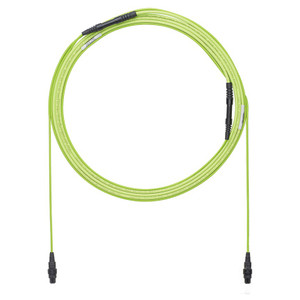
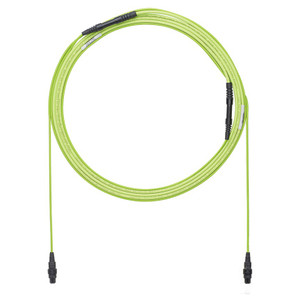
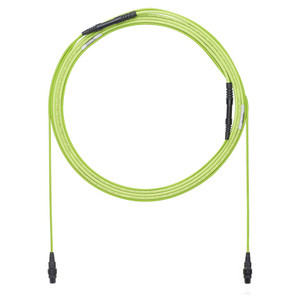
Panduit FWTYL7575LAM090 OM5 12-Fiber 90m Trunk Cable Assembly
The Panduit FWTYL7575LAM090 is a 90-meter OM5 fiber trunk cable assembly engineered for high-density data center deployments requiring extended reach and future-proof bandwidth capacity. This 12-fiber trunk features PanMPO female connectors on both ends with Method B polarity, LSZH jacketing for enclosed-space compliance, and Ultra Insertion Loss performance grading. The integrated pulling eye on one end streamlines installation through congested pathways and overhead cable trays. Part of Panduit's QuickNet infrastructure system, this trunk cable supports 100GBASE-SR4, 40GBASE-SR4, and short-wavelength division multiplexing (SWDM) applications while maintaining full backwards compatibility with OM3/OM4 networks at 10G and 25G speeds. The HD Flex Transition cable design reduces trunk diameter by 30-40% compared to legacy assemblies, directly addressing pathway fill constraints in retrofit installations and high-density new builds.
Key Features
- OM5 wideband multimode fiber supports SWDM transmission up to 100Gb/s over 850nm to 953nm wavelength range
- 12-fiber PanMPO female to PanMPO female configuration with Method B (key-up to key-down) straight-through polarity
- 90-meter length spans cross-row and end-of-row data center architectures without intermediate patch points
- Ultra Insertion Loss grading delivers ≤0.35 dB maximum per connection for multi-tier structured cabling link budgets
- HD Flex Transition cable design reduces bend radius and uses 30-40% less pathway space than standard trunk cables
- Low Smoke Zero Halogen (LSZH) jacket meets IEC 60332-1 and IEC 60754 for enclosed-space fire safety compliance
- Lime green jacket and boots provide instant OM5 fiber type identification per TIA-598-D color coding standards
- Integrated pulling eye on one end enables efficient installation through cable trays, j-hooks, and ladder rack
- PanMPO connectors deliver six times the fiber density of duplex LC in the same panel footprint
- Factory-terminated and tested assembly eliminates field termination labor and performance variability
OM5 fiber extends the performance envelope of 50µm multimode fiber by supporting short-wavelength division multiplexing (SWDM) transmission. Where OM3 and OM4 fiber operate exclusively at 850nm, OM5 supports four distinct wavelengths (850nm, 880nm, 910nm, 953nm) transmitted simultaneously over a single fiber pair. This enables 40GBASE-SR BiDi and 100GBASE-SR BiDi applications to achieve 40Gb/s and 100Gb/s speeds using only two fibers instead of eight or twenty, dramatically reducing fiber count and connector density in spine-leaf and leaf-server architectures. The 90-meter length of this trunk assembly covers typical cross-row distances in data centers with 12-meter to 15-meter row spacing, eliminating intermediate consolidation points that add insertion loss and increase troubleshooting complexity. For installations requiring longer reach, OM5 supports 100GBASE-SR4 at 150 meters and 40GBASE-SR4 at 150 meters, providing headroom for future topology changes without cable replacement.
The PanMPO connector system delivers reliable multi-fiber connectivity in a compact form factor optimized for high-density patching environments. Each 12-fiber PanMPO interface occupies the same panel space as a single duplex LC connector while terminating six times the fiber count, directly addressing rack space constraints in colocation facilities and enterprise data centers. Method B polarity (also called straight-through or key-up to key-down) aligns with TIA-568 structured cabling guidelines for trunk cable assemblies connecting distribution points to consolidation points or array connectors to array connectors. In a typical deployment, this trunk cable runs between fiber enclosures in the main distribution area (MDA) and intermediate distribution areas (IDA), or between top-of-rack switches and end-of-row aggregation switches in a leaf-spine topology. The key-up to key-down orientation ensures that when this trunk is connected between two cassette modules or breakout panels, the transmit fibers on one end align with the receive fibers on the opposite end without requiring polarity-reversing jumpers.
Ultra Insertion Loss grading ensures that each of the 12 fiber connections meets a maximum insertion loss specification of 0.35 dB, with typical measured values below 0.25 dB. This performance headroom is critical in multi-tier cabling systems where cumulative insertion loss across multiple trunk segments, patch panels, cassette modules, and jumpers must remain below the IEEE 802.3 link loss budget. For 100GBASE-SR4, the maximum link loss budget is 1.9 dB over OM4 and 1.5 dB over OM5 at 100 meters. A typical three-tier architecture with two trunk cables, two cassette modules, and four duplex jumpers can accumulate 1.2 dB to 1.6 dB of insertion loss; using Ultra IL-graded components provides margin for connector cleaning cycles, environmental aging, and future adds/moves/changes without exceeding the link budget. Each trunk assembly is factory-terminated using Panduit's automated polishing and inspection process, eliminating the variability introduced by field termination and ensuring consistent sub-0.3 dB performance across all 12 fibers.
HD Flex Transition cable construction uses smaller-diameter tight-buffered fibers (900µm) and a flexible LSZH outer jacket to reduce the overall cable diameter by 30% to 40% compared to legacy 3.0mm tight-buffered 12-fiber trunk assemblies. This space reduction allows more trunk cables to fit in the same 4-inch ladder rack rung or 2-inch cable tray section, increasing effective pathway capacity in retrofit installations and greenfield builds constrained by pathway fill ratios per NFPA 70 Article 300.17 and TIA-569-E. For installations with 40% pathway fill limits, the smaller cable diameter translates to 50% to 65% more trunk cables in the same pathway cross-section. The reduced diameter also decreases the minimum bend radius, allowing tighter routing around obstacles and reducing the overall cable management footprint in congested vertical and horizontal pathways. The lime green jacket color provides instant visual identification of OM5 fiber per TIA-598-D Appendix D color coding standards, preventing cross-connection errors between OM3 (aqua), OM4 (erika violet), and OM5 (lime) fiber types during maintenance windows and adds/moves/changes.
The integrated pulling eye on one end of the trunk assembly allows installers to attach pull rope, cable grips, or carabiner hooks for horizontal and vertical runs through j-hooks, cable tray, innerduct, and ladder rack without stressing the PanMPO connector bodies or fiber terminations. During installation, tensile load is transferred to the aramid yarn strength members inside the cable jacket rather than to the fragile glass fibers or connector ferrules. This design detail reduces installation time by 20% to 30% compared to trunk cables without pulling eyes, where installers must fabricate temporary pull grips using tape or cable ties. The pulling eye end should be the leading end during cable pulls; after installation, the pulling eye can be secured to a j-hook or cable tray using a zip tie to provide strain relief at the vertical-to-horizontal transition points. For installations exceeding 50 meters of horizontal or vertical run, use intermediate support points every 5 to 7 meters to prevent excessive sag and tensile stress on the cable jacket.
Low Smoke Zero Halogen jacketing meets IEC 60332-1 flame spread, IEC 60754-1 halogen acid gas content, and IEC 61034 smoke density requirements for installations in enclosed spaces, return air plenums, raised floors, and international data centers where local building codes mandate LSZH materials. In a fire event, LSZH cables produce significantly less visible smoke (light transmittance >60% per IEC 61034 vs. <20% for PVC) and no corrosive halogen gases (chlorine, fluorine, bromine) that damage sensitive electronic equipment and impair visibility during evacuation. Halogen-free construction is mandatory in the European Union per CPR (Construction Products Regulation) Euroclass ratings, and is increasingly specified in North American hyperscale data centers as a risk mitigation measure for high-value server and storage equipment. The LSZH jacket on this trunk assembly is rated for 0°C to +60°C continuous operating temperature and meets UL 94 V-0 flammability classification.
This trunk assembly is manufactured and tested to TIA-568-C.3 performance requirements for OM5 fiber (effective modal bandwidth ≥3500 MHz·km at 850nm and ≥1850 MHz·km at 950nm), TIA-604-5 (FOCIS-5) physical contact connector geometry (radius of curvature 10-25mm, apex offset ≤50µm), ISO/IEC 11801-1 international cabling standards, and TIA-492-AAAD fiber specifications. Each PanMPO connector is inspected using automated interferometry to verify endface geometry, with rejection criteria for scratches >3µm, contamination particles >2µm in the core region, and fiber protrusion/undercut outside the -60nm to +300nm range. Compliance with RoHS Directive 2011/65/EU ensures restriction of lead, mercury, cadmium, hexavalent chromium, and brominated flame retardants for installations subject to European Union environmental regulations. The trunk assembly ships in a protective coil with dust caps installed on both PanMPO connectors; dust caps should remain in place until immediately before connection to prevent contamination of the ferrule endfaces.
For a complete QuickNet OM5 fiber infrastructure, pair this trunk cable assembly with Panduit FMT cassette modules (12-fiber PanMPO to 6x duplex LC breakout), FAP fiber adapter panels, and FQNSNSNSNXXXM duplex LC OM5 patch cords. Cassette modules provide the fanout from 12-fiber trunk cables to individual duplex LC server connections, with polarity type options (A, B, C) to match network equipment transmit/receive configurations. In a typical 40G or 100G deployment, two 12-fiber trunk cables connect to a single 24-fiber cassette module (Method B polarity), which breaks out to twelve duplex LC connections (six per trunk). For 10G and 25G applications, a single 12-fiber trunk cable can support six duplex LC connections using a 12-fiber cassette module. When migrating from OM3 or OM4 to OM5 infrastructure, existing LC patch cords and cassette modules are fully compatible; only the trunk cable assemblies and backbone fiber require replacement to achieve OM5 performance levels.