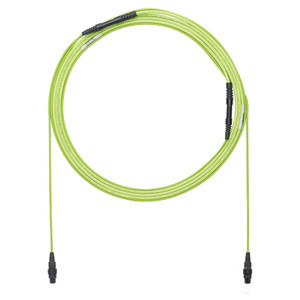
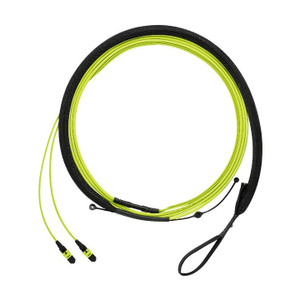
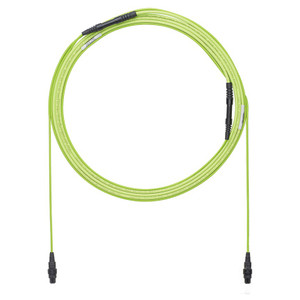
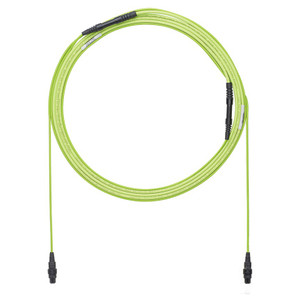
Panduit FWTYL7575LAM078 QuickNet™ 12-Fiber OM5 Trunk Cable Assembly
The Panduit FWTYL7575LAM078 delivers 78 meters of OM5 wideband multimode fiber in a pre-terminated, small-diameter trunk assembly engineered for high-density data center deployments where pathway space, deployment speed, and future bandwidth scalability converge as critical requirements. This 12-fiber QuickNet™ trunk leverages 50/125µm OM5 glass optimized for shortwave wavelength division multiplexing (SWDM), enabling 40GBASE-SR4 and 100GBASE-SR4 transmission over extended distances while consuming 30 to 40 percent less conduit and cable tray space than conventional trunk designs. The 255-foot length makes it ideal for inter-row backbone runs, cross-aisle links in larger colocation facilities, or vertical riser connections in multi-floor data halls where a single pre-terminated assembly eliminates field splicing labor and the performance variability that comes with on-site termination work.
Key Features
- OM5 wideband multimode fiber (50/125µm) supports SWDM technology for 40G/100G Ethernet and future 200G/400G migration paths over extended multimode distances
- 12-fiber count in MTP/MPO trunk configuration provides six duplex channels for spine-leaf architectures or backbone aggregation links
- 78-meter (255.91 ft) overall length suits mid-range inter-row, cross-aisle, or vertical riser runs in enterprise and colocation data centers
- Small-diameter trunk design reduces pathway fill by 30-40% compared to standard assemblies, improving airflow and simplifying moves/adds/changes in congested overhead and underfloor routes
- LSZH (Low Smoke Zero Halogen) jacket meets international flammability and toxicity standards for enclosed spaces and plenum-rated installations
- Factory-terminated QuickNet™ assembly with pre-installed connectors eliminates field termination labor, reduces deployment time by up to 80%, and ensures consistent insertion loss and return loss performance
- Lime cable jacket provides high-visibility color coding for OM5 infrastructure, simplifying moves/adds/changes and preventing cross-connection errors in mixed OM3/OM4/OM5 environments
- Meets TIA-568-C.3, ISO/IEC 11801, TIA-492-AAAD (OM5 fiber specification), IEC 60793-2-10 Type A1a.3, and RoHS compliance for global deployments
OM5 wideband multimode fiber represents the latest evolution in 50-micron multimode glass, engineered specifically to support shortwave wavelength division multiplexing (SWDM) technology that transmits multiple wavelengths simultaneously over a single fiber pair. While OM3 and OM4 multimode fibers are optimized for 850nm VCSEL (vertical-cavity surface-emitting laser) transmission, OM5 extends that optimization across four distinct wavelength windows—850nm, 880nm, 910nm, and 940nm—allowing SWDM-capable transceivers to quadruple effective bandwidth without requiring additional fiber pairs. In practical terms, this means a 12-fiber OM5 trunk like the FWTYL7575LAM078 can support the same aggregate bandwidth as a 48-fiber OM3 trunk when paired with SWDM optics, delivering massive space and cost savings in high-density 40G/100G leaf-spine fabrics. The 78-meter length exceeds OM4's 100GBASE-SR4 reach limit of 70 meters and approaches OM5's extended SWDM reach of 100+ meters for 100G applications, making this assembly suitable for larger enterprise data halls where a single pre-terminated trunk can span from an end-of-row distribution switch to a core aggregation point without requiring mid-span patch panels or splice enclosures. For integrators planning 200G or 400G migration paths, OM5's wideband performance ensures that this infrastructure investment remains viable as transceiver technology evolves—SWDM roadmaps already include 200GBASE-SR4 and 400GBASE-SR8 over OM5 at distances that would require singlemode fiber if deployed over OM3 or OM4 plant.
The small-diameter trunk construction is a critical differentiator in contemporary data center installations where overhead cable tray and underfloor conduit capacity has become a limiting factor in rack density and cooling efficiency. Traditional fiber trunk assemblies use individual simplex or duplex zipcord breakouts bundled inside a large-diameter outer jacket, resulting in an overall diameter that can exceed 25mm and consume significant pathway cross-sectional area. Panduit's small-diameter trunk design consolidates the 12 fibers into a tight-buffered, reduced-profile jacket that achieves a 30 to 40 percent reduction in overall diameter and pathway fill ratio, allowing integrators to deploy more fiber strands through the same conduit or cable tray without exceeding NEC Chapter 3 fill limits or creating airflow obstructions in overhead plenum spaces. In high-density leaf-spine deployments where 20 to 40 trunk assemblies converge at a single end-of-row aggregation switch, this space savings translates directly to cleaner cable management, improved separation between power and data cabling, and better thermal performance by maintaining unobstructed airflow paths around hot-aisle containment systems. The reduced diameter also simplifies pulling through tight bend-radius pathways—such as vertical riser conduits, seismic-zone cable tray with reduced clearances, or legacy conduit infrastructure being repurposed for fiber—where a conventional trunk assembly might require costly pathway modifications or additional pull points. For integrators managing moves, adds, and changes in live production environments, the smaller profile means less disruption to adjacent cabling when routing new trunks through congested overhead or underfloor runs, and faster installation times when pulling through shared pathways with limited working room.
The factory-terminated QuickNet™ approach eliminates the labor, skill variability, and performance inconsistency inherent in field termination workflows, which remain a common source of link failures and troubleshooting delays in fiber deployments. Field-terminated fiber—whether fusion-spliced pigtails or mechanical connectors—requires trained technicians, specialized equipment (fusion splicers, cleavers, OTDRs), and controlled environmental conditions (low dust, stable temperature) that are often unavailable or impractical on active data center floors. Even with experienced installers, field termination introduces variability in insertion loss, return loss, and end-face geometry that can degrade link budgets and cause intermittent errors at 40G and 100G data rates where optical margins are tighter. A pre-terminated trunk assembly like the FWTYL7575LAM078 arrives with connectors already installed and factory-tested to meet TIA-568-C.3 insertion loss (≤0.75 dB per mated pair) and return loss (≥-20 dB) specifications, ensuring that every link meets performance requirements before the cable even leaves the Panduit facility. Deployment time drops from hours per trunk (for field termination and testing) to minutes (pull cable, mate connectors, verify link with a simple light source and power meter), allowing a two-person crew to complete backbone cabling for an entire pod or row in a single shift rather than across multiple days. For integrators working under aggressive deployment schedules—such as rapid datacenter expansions, disaster recovery cutovers, or colocation customer onboarding with contractual service-level deadlines—the labor savings and schedule compression from pre-terminated trunks often justify the incremental cost premium over bulk cable and field termination kits, particularly when factoring in the reduced risk of costly rework or service-impacting failures traced back to termination errors.
The LSZH jacket specification is a non-negotiable requirement for installations in enclosed spaces, international facilities, and any environment where fire-safety and occupant-protection standards prohibit PVC-jacketed cables. When exposed to fire, PVC jackets release dense smoke and halogenated gases (hydrogen chloride, hydrogen fluoride) that obscure egress routes and cause respiratory injury; LSZH formulations produce significantly lower smoke density and zero halogen emissions, improving survivability in fire scenarios and reducing corrosive damage to sensitive electronic equipment in adjacent spaces. Many European and Asian markets mandate LSZH cabling in all commercial buildings, and an increasing number of North American hyperscale and colocation operators have adopted LSZH-only procurement policies to align with corporate ESG goals and insurance underwriter requirements. The 78-meter length of the FWTYL7575LAM078 fits the sweet spot for mid-range data center deployments: long enough to eliminate mid-span connections in typical inter-row or cross-aisle runs (most pod-based designs keep leaf-to-spine distances under 80 meters), but short enough to avoid the excess coiling and service-loop bulk that comes with over-provisioned assemblies. For integrators deploying leaf-spine fabrics in facilities with 10- to 15-meter row depths and 50- to 60-meter cross-aisle spans, this assembly provides a near-perfect fit for direct leaf-to-spine uplinks without requiring custom-length orders or field modifications. Full compliance with TIA-568-C.3, ISO/IEC 11801, TIA-492-AAAD (the OM5 fiber performance standard), and IEC 60793-2-10 Type A1a.3 ensures that this trunk meets the requirements for structured cabling warranties, insurance underwriter approvals, and customer acceptance testing in mission-critical environments where every link must be traceable to a standards-compliant design.