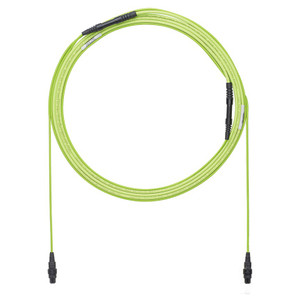
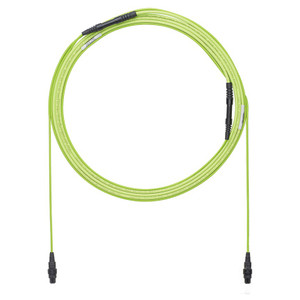
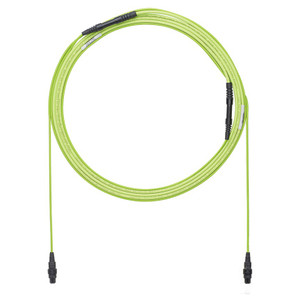
Panduit FWTYL7575LAM061 QuickNet 12-Fiber OM5 Trunk Cable Assembly
Panduit's FWTYL7575LAM061 is a factory-terminated 12-fiber OM5 trunk cable assembly engineered for high-density data center backbones where 40/100GbE short-wave WDM transmission and tight pathway management intersect. At 200 feet (61 meters), this lime LSZH-rated assembly bridges floor-to-floor vertical risers or cross-connects in enterprise campus environments without field splicing, eliminating insertion-loss variability and cutting deployment time to minutes. OM5 wideband multimode fiber supports four-lane 100GBASE-SR4 and emerging SWDM applications across 850–953 nm, future-proofing your infrastructure for 400G migrations while the reduced-diameter QuickNet construction reclaims 30–40% pathway space compared to legacy 12-strand designs—critical when rack density pushes 45U Cabinet limits and hot-aisle containment leaves no room for over-specification.
Key Features
- OM5 wideband multimode fiber (50 μm core) qualified for short-wave division multiplexing (SWDM) at 850–953 nm wavelengths, enabling 4× capacity increase over OM4 on identical 100m reach budgets
- 12-fiber trunk configuration suits spine-leaf architectures, SAN storage fabrics, and vertical building backbones where pre-terminated assemblies eliminate field fusion splicing and associated OTDR certification cycles
- 200-foot (61-meter) length covers typical floor-to-floor rises in 3–5 story structures or intra-building cross-connects, with sufficient service loop for pathway routing and future MACs
- Low-smoke zero-halogen (LSZH) jacket meets IEC 60332-3-24 flame propagation and toxic fume restrictions for installation in occupied plenums, under-floor distributions, and international projects where PVC is prohibited by local fire codes
- Lime outer jacket provides instant visual differentiation in mixed-media environments—assign by application (OM5 = 40/100G tier, aqua OM3 = 10G access) or by zone to reduce mis-patching during MACs
- QuickNet small-diameter construction uses tight-buffered 900 μm subunits in place of 2–3 mm loose-tube designs, reducing bundle OD by 30–40% to maximize fill ratio in 4-inch backbone conduits and overhead ladder rack
- Factory-terminated and 100% insertion-loss tested at 850/1300 nm before shipment, guaranteeing ≤0.35 dB connector loss per TIA-568-C.3 and eliminating the 0.5–1.0 dB field-termination penalty that eats into your 100GBASE-SR4 power budget
- RoHS-compliant materials and TIA-492-AAAD fiber geometry ensure interoperability with Cisco, Arista, Juniper, and Dell transceiver modules without mode-conditioning or launch-condition workarounds
- Single-unit packaging simplifies job-site logistics—no carton consolidation, no loose breakout legs to inventory separately
OM5 wideband multimode is purpose-built for the short-wave WDM transmission schemes that let 40/100/400GBASE-SR transceivers push four or eight wavelengths down a single fiber pair, quadrupling effective bandwidth without quadrupling fiber count. Where a legacy 40GBASE-SR4 link consumes eight fibers (four TX, four RX), emerging 100G-SWDM4 runs on just two fibers by splitting the signal across 850, 880, 910, and 940 nm channels. Panduit's OM5 cable meets the tighter overfilled launch bandwidth specs (4700 MHz·km at 953 nm per TIA-492-AAAD) that these wavelength plans demand, so your 200-foot backbone supports today's parallel optics and tomorrow's WDM upgrades without a rip-and-replace. The 12-fiber count fits modular spine-leaf fabrics where each leaf uplinks via a single 12-strand trunk to a spine switch running 100G breakout optics, and the 61-meter length bridges typical 15–20 foot floor heights across three stories with service loop to spare—long enough to route through overhead cable tray, down a wall penetration, and across to your end-of-row aggregation cabinet without mid-span slack boxes that add failure points and labeling overhead.
LSZH jacketing is no longer optional in multi-tenant commercial real estate, healthcare campuses, or any installation where the fiber pathway shares plenum space with HVAC return air. During a fire event, PVC jackets release hydrochloric acid and dense black smoke that obscures egress routes and corrodes active electronics; LSZH formulations produce minimal visible smoke and no halogenated gases, keeping the space tenable for occupant evacuation and first-responder access. Beyond life-safety compliance, LSZH is often mandated by European EN 50173 and international building codes, so specifying it now avoids costly change orders when your corporate standard gets applied to overseas data halls. The lime color-coding integrates cleanly into TIA-606-C administration schemes—dedicate lime to your 40/100G OM5 tier, reserve aqua for 10G OM3 access, and use yellow singlemode for out-of-building links. Installers identify the right trunk at a glance during MACs, and your DCIM patch-panel documentation stays synchronized because there's no ambiguity about which cable tier serves which application layer. QuickNet's reduced-diameter construction becomes critical when you're filling 4-inch backbone conduit with six or eight 12-fiber trunks between floors; a 30% OD reduction translates to 50–60% more cross-sectional area available for additional pulls, letting you add a spine-leaf tier or SAN fabric without ripping out walls to upsize the pathway. In overhead ladder rack, the smaller bundle profile reduces sag between supports and keeps the assembly below the 4-inch maximum-stack-height threshold that triggers NEC 300.6(C) derating for bundled current-carrying capacity—important when your fiber and copper pathways share the same support structure.
Factory termination delivers insertion loss ≤0.35 dB per connection, verified at 850 and 1300 nm under controlled cleanliness and polish conditions impossible to replicate in the field with portable fusion splicers and consumable epoxy. That 0.35 dB connector budget—versus the 0.75–1.0 dB you'd see from field-installed MPO connectors—preserves 0.4–0.65 dB of your link's power budget for additional interconnects, patch-cord wear, or future optics with tighter receiver sensitivity. On a 100GBASE-SR4 link limited to 2.6 dB total channel loss, every tenth of a dB you save at the backbone lets you add another equipment-cord transition or stretch the reach from the TIA's conservative 100-meter spec to 125–150 meters in practice. The assembly ships as a single pull-ready unit, so your install crew stages it on a cable reel, pulls it through the pathway in one continuous motion, and dresses the connectors into the patch panel—no mid-span breakout boxes, no on-site fusion splicing, no OTDR certification of 12 individual strands. A traditional field-terminated backbone might require four hours of splicing and test time per floor; this QuickNet assembly cuts that to 30 minutes of pull-and-dress labor, letting a two-person crew complete a three-floor backbone in a single shift instead of three days. RoHS compliance ensures the assembly clears customs and procurement in EU, UK, and APAC markets without exemption paperwork, and conformance to ISO/IEC 11801 Ed. 2.2 and TIA-568-C.3 guarantees interoperability with every standards-compliant 40/100G transceiver from Cisco QSFP-100G-SR4-S to Intel E810 NICs—no vendor lock-in, no mode-conditioning patches, no launch-condition fine-tuning to make the link train.