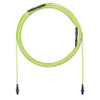
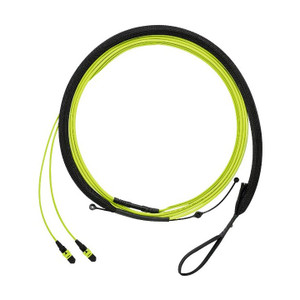
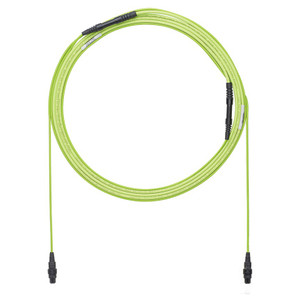
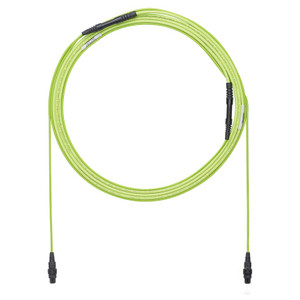
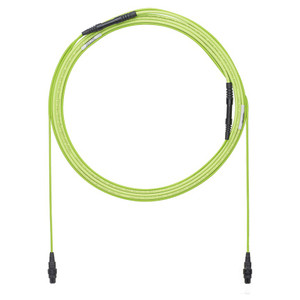
Panduit FWTYL7575LAM025 OM5 12-Fiber Trunk Cable Assembly
Datacenter operators deploying 40G/100G/400G architectures face a persistent challenge: how to deliver high-bandwidth connectivity in congested pathways while maintaining headroom for future speed upgrades and meeting stringent fire safety codes. The Panduit FWTYL7575LAM025 QuickNet trunk cable assembly addresses this with OM5 wideband multimode fiber, 12 fibers in a space-saving trunk form factor, LSZH jacket for fire compliance, and factory termination that eliminates field work. At 25 meters (82 feet), this trunk fits the majority of intra-datacenter runs—top-of-rack to end-of-row aggregation switches, middle-of-row patch positions to entrance rooms, or vertical risers between floors—while the integrated pulling eye on one end simplifies installation through conduit or along cable trays without risking connector damage.
Key Features
- OM5 wideband multimode fiber supporting short wavelength division multiplexing (SWDM) for 40/100/400 Gbps transmission
- 12 fibers provide six duplex channels or two MTP12 breakout paths in a single compact trunk
- PanMPO female connectors on both ends with Method B polarity for switch-to-switch trunk applications
- HD Flex Transition technology enables tighter bend radius and easier routing in congested vertical cable managers
- Ultra Insertion Loss specification delivers <0.35 dB typical per connector, maximizing available link budget
- LSZH (Low Smoke Zero Halogen) jacket meets fire safety requirements for enclosed equipment rooms and international installations
- Integrated pulling eye on one end allows conduit pulls and tray installations without damaging opposite end connector
- 25 meter length (82 feet) covers intra-row, row-to-row, and floor-to-floor datacenter spans
- Factory-terminated and 100% tested—no field polish, no epoxy cure time, immediate deployment
- Lime cable jacket color per TIA-568 OM5 standard for instant visual identification
- Meets TIA-568-C.3, ISO/IEC 11801, TIA-604-5 (FOCIS-5), TIA-492-AAAD, IEC 60793-2-10 A1a.3, and RoHS
OM5 Wideband Multimode: Future-Proofing Your Infrastructure
OM5 fiber represents a generational leap in multimode technology. Unlike OM3 and OM4, which are optimized for 850 nm laser transmission, OM5 is a wideband fiber engineered to support short wavelength division multiplexing (SWDM) across four distinct wavelengths: 850 nm, 880 nm, 910 nm, and 940 nm. This capability allows a single fiber pair to carry four independent data streams simultaneously, effectively quadrupling capacity without adding physical fibers. For datacenter operators, this means an OM5 infrastructure can support 100GBASE-SR4 today and migrate to 400GBASE-SR4.2 tomorrow using the same installed cabling—no forklift upgrade, no downtime, no pathway congestion from additional cables. The 50 micron core diameter maintains compatibility with existing OM3/OM4 transmission equipment while providing the spectral headroom that future generations of transceivers will exploit. When you install OM5 today, you're not just meeting current bandwidth requirements; you're eliminating a future cabling project.
The FWTYL7575LAM025 trunk leverages Panduit's SigCore fiber technology, which delivers consistently low attenuation and high bandwidth across the entire OM5 spectrum. This is critical for SWDM applications: uneven attenuation across wavelengths degrades the weakest channel and limits overall link performance. SigCore's manufacturing process ensures tight control of refractive index profile and core geometry, resulting in modal bandwidth exceeding 3500 MHz·km at 850 nm—well above the 4700 MHz·km OM5 minimum—and equally strong performance at the 880/910/940 nm wavelengths. In practical terms, this means maximum reach for every speed grade: 100 meters for 40GBASE-SR4, 100 meters for 100GBASE-SR4, and the full OM5-specified distances for emerging 200G and 400G applications. The lime jacket color provides instant visual distinction from OM3 (aqua) and OM4 (erika violet) in mixed-generation installations, reducing the risk of patching errors that could limit link speeds or cause outages.
PanMPO Connectivity and Method B Polarity
The trunk terminates with PanMPO female connectors at both ends. PanMPO is Panduit's enhanced implementation of the industry-standard MPO (Multi-fiber Push-On) connector, incorporating tighter manufacturing tolerances and improved guide pin retention to deliver superior insertion loss repeatability—critical when a single connector mates and unmates dozens of times over its service life. Each PanMPO connector houses all 12 fibers in a single rectangular ferrule, and the ferrule's guide pin holes allow it to mate with a pinned (male) connector for precise fiber-to-fiber alignment. The female designation means this trunk requires pinned adapters or pinned jumpers at patch points, which is standard practice in structured cabling systems where the trunk represents permanent infrastructure and the patch cords are consumable items.
Method B polarity is engineered for switch-to-switch trunk applications, which represent the vast majority of datacenter backbone links. In a Method B trunk, fiber position 1 at connector A maps to fiber position 12 at connector B, position 2 maps to 11, and so on—a complete reversal. This polarity flip allows you to use straight-through (key-up-to-key-up) pinned adapters at both patch panels and still achieve the transmit-to-receive crossover that duplex links require. The alternative, Method A polarity, would require a crossover adapter at one end, adding cost and complexity. For operators deploying 40G/100G links using parallel optics (where transmit uses fibers 1-4 and receive uses fibers 5-8, or similar lane assignments), Method B ensures that switch A's transmit lanes correctly align with switch B's receive lanes through simple key-aligned patching. The FWTYL7575LAM025's Method B configuration eliminates a common source of deployment errors: polarity mismatches that cause links to stay dark until someone troubleshoots and swaps adapters or flips a connector. Install this trunk with standard pinned adapters at both ends, patch with key-up-to-key-up jumpers, and the link lights up on first attempt.
HD Flex Transition: Routing in High-Density Pathways
Datacenter cable pathways are congested. Vertical cable managers in racks, overhead ladder trays, underfloor conduits, and horizontal wireways behind patch panels all present tight-radius bends that standard trunk cables struggle to navigate without exceeding minimum bend radius limits—and violating bend radius damages fibers, increases attenuation, and shortens service life. Panduit's HD Flex Transition technology addresses this by engineering the trunk's internal structure to support significantly tighter bends than conventional MPO trunk cables. The result: you can route the FWTYL7575LAM025 through sharp U-turns in vertical managers (common when feeding both sides of a two-post rack), make tight 90-degree turns exiting patch panels, and snake through congested overhead trays without violating the cable's minimum bend radius or stressing the PanMPO connectors.
This flexibility is especially valuable in retrofit scenarios where existing pathways were sized for lower fiber counts and now must accommodate higher-density trunks. A traditional 12-fiber trunk might require a 6-inch bend radius; HD Flex Transition technology can cut that in half, allowing routing paths that would otherwise be impossible without adding new pathways—an expensive and time-consuming proposition in a live datacenter. The technology also reduces the risk of installation-induced attenuation spikes: when installers are forced to violate bend radius to complete a route, microbending and macrobending increase loss and reduce margin. With HD Flex, the cable's bend tolerance matches the real-world geometry of datacenter infrastructure, so proper installation is achievable without heroic effort or creative rule-bending.
Ultra Insertion Loss and Link Budget
Every fiber optic link has a power budget: the difference between the transmitter's output power and the receiver's minimum sensitivity. That budget must cover the loss from every connector pair, every splice, and the fiber span itself, with margin remaining for aging, temperature variation, and future repairs. In high-speed parallel optics (40G/100G/400G SR variants), the power budget is often tight—especially at maximum distance—so minimizing connector loss is critical. The FWTYL7575LAM025 trunk meets Panduit's Ultra Insertion Loss specification, which guarantees <0.5 dB maximum insertion loss per connector pair and typically delivers <0.35 dB in production. For comparison, industry standards allow up to 0.75 dB for MPO connectors. That 0.25 dB difference might seem small, but in a link with four connector pairs (two at near end, two at far end), the cumulative savings is 1 dB—enough to extend reach by 10-15 meters in a loss-limited OM5 link, or to provide margin that accommodates an additional patch point or future repair splice.
Ultra IL performance comes from tight control of ferrule geometry, fiber protrusion (the distance each fiber extends beyond the ferrule endface), and endface polish quality. Each connector is factory-terminated using automated processes that eliminate the variability inherent in field termination, then tested at 850 nm and 1300 nm to verify compliance before leaving the factory. The result is a trunk that performs to spec out of the box, with no field touch labor, no consumable epoxy or polish film costs, and no risk that an undertrained technician's work will compromise your link budget. When you're lighting up a 100-meter 100GBASE-SR4 link that has only 1.9 dB total budget (per IEEE 802.3), every tenth of a dB matters. Ultra IL trunks turn theoretical maximum distances into achievable, reliable deployments.
LSZH Jacket: Fire Safety and Regulatory Compliance
In a fire, cable jacketing can be a significant source of toxic smoke and corrosive gases. Traditional PVC (polyvinyl chloride) jackets release hydrochloric acid and dense black smoke when burned, obscuring exit paths and damaging sensitive electronic equipment even in areas the fire doesn't directly reach. LSZH (Low Smoke Zero Halogen) jacketing is formulated to produce minimal smoke and no halogen gases when exposed to flame, making it the required choice for enclosed equipment rooms, underfloor pathways, and above-ceiling spaces in many jurisdictions—particularly outside North America, where LSZH is often mandated by building codes and insurance requirements. Even in the U.S., LSZH is increasingly specified for datacenters, telecom central offices, and other mission-critical facilities where fire safety and equipment protection are paramount.
The FWTYL7575LAM025 trunk's LSZH jacket complies with IEC 60332-1 (flame propagation) and IEC 61034-2 (smoke density) standards, ensuring that in the event of a fire, the cable self-extinguishes and produces less than 50% light obscuration—well below the threshold that impairs visibility in evacuation scenarios. The zero-halogen formulation also eliminates the corrosive gases that can destroy millions of dollars in servers, switches, and storage arrays in adjacent racks, even if those racks never see flame. For facility managers and insurance underwriters, LSZH cabling reduces both life-safety risk and property loss exposure. For integrators, specifying LSZH ensures that your installation meets current codes and won't require replacement when regulations tighten—a significant advantage given the disruption and cost of recabling a live datacenter.
It's worth noting that LSZH jackets are slightly less flexible than PVC at low temperatures and can be more susceptible to abrasion during rough handling, so installers should avoid dragging LSZH trunks across sharp edges or pulling them through conduit with excessive force. The integrated pulling eye on the FWTYL7575LAM025 addresses this: by distributing pull tension along the cable's strength members rather than concentrating it at the connector boot, the pulling eye allows controlled, high-force pulls through conduit without damaging the jacket or stressing the internal fibers. When combined with proper cable lube and reasonable pull lengths, this design enables LSZH trunk installation in pathways that would otherwise require armored or ruggedized cables.
Deployment Scenarios and Installation Considerations
At 25 meters (82 feet), the FWTYL7575LAM025 is sized for the most common datacenter backbone runs. In a typical row-based architecture, this length connects top-of-rack switches at one end of a 15-rack row to end-of-row aggregation switches—accounting for vertical rise to overhead tray, horizontal run along the tray, and drop down to the aggregation rack, with slack for service loops at both ends. It also fits middle-of-row to entrance room runs in facilities where the main distribution area (MDA) is centrally located relative to equipment rows. For multi-story datacenters, 25 meters covers floor-to-floor vertical riser runs (typically 12-15 feet per story) with enough length for pathway routing and patch panel dress. The key is that this single SKU eliminates the need for custom-length orders in the majority of installations, reducing lead time and simplifying inventory management.
The pulling eye on one end (the end without the eye remains a standard PanMPO connector with protective dust cap) is your installation advantage when running through conduit, along J-hooks in overhead tray, or vertically through ladder rack. Attach a pull string to the eye, apply appropriate tension (Panduit specifies maximum pull force in the installation guide—typically 100-150 lbs for a 12-fiber trunk), and pull smoothly without jerking. The cable's strength members—Kevlar or aramid yarn surrounding the fiber bundle—carry the load, while the fibers themselves remain unstressed. This is a night-and-day difference from trying to pull a trunk by taping to the connector boot or jacket, which concentrates force at the termination point and risks separating the connector from the cable or crushing fibers. Once the trunk is in place, coil the excess pulling-eye end into a service loop and secure it; that end becomes your A-side connection, with the standard connector end as your B-side.
For patching, you'll need MTP/MPO pinned adapters (male pins) at both patch panels, since this trunk has female connectors. Panduit offers a range of adapter panels—from standalone MTP adapter plates that mount in any standard 19-inch rack to high-density cassette-based systems that integrate adapters, slack management, and breakout capability in a single 1U enclosure. If your architecture calls for breaking the 12-fiber trunk into individual LC duplex connections (common when connecting to 10G SFP+ optics that predate 40G/100G parallel standards), use MTP-to-LC breakout cassettes at one or both ends: the trunk plugs into the cassette's MTP adapter, and 6 or 12 LC duplex ports emerge on the front for patching to individual switch ports. Method B polarity on the trunk ensures that these breakout cassettes (also Method B) deliver the correct transmit-to-receive pairing on every LC port.
Standards Compliance and Quality Assurance
The FWTYL7575LAM025 trunk cable assembly is manufactured and tested to meet or exceed TIA/EIA-568-C.3 (optical fiber cabling components standard), ISO/IEC 11801 (international structured cabling standard), TIA-604-5 FOCIS-5 (fiber optic connector intermateability standard for MPO connectors), TIA-492-AAAD (OM5 fiber performance specification), and IEC 60793-2-10 Type A1a.3 (multimode fiber category specification). These standards define the performance parameters—insertion loss, return loss, fiber geometry, connector endface quality—that the trunk must meet to ensure interoperability with any standards-compliant transceiver, adapter, or patch cord. Compliance isn't just a checkbox; it's your assurance that this Panduit trunk will work seamlessly with Cisco optics, Juniper switches, Arista transceivers, or any other vendor's equipment that adheres to the same standards. No proprietary lock-in, no compatibility gotchas, no expensive trial-and-error to find a combination that works.
Every FWTYL7575LAM025 trunk is 100% factory-tested before shipment. Insertion loss and return loss are measured at 850 nm and 1300 nm for every fiber in the cable, and the results are recorded. Panduit's manufacturing process includes automated visual inspection of connector endfaces using interferometry, which detects defects (scratches, pits, contamination) that could degrade performance or cause premature failure. This level of quality control is impossible to replicate in field termination, where environmental conditions, technician skill, and time pressure all conspire against perfection. By choosing a factory-terminated trunk, you're buying tested, documented performance that you can trust on day one and verify against baseline measurements throughout the cable's service life. If a link fails to come up or shows marginal performance, you can rule out the trunk as the culprit and focus your troubleshooting on transceivers, patch cords, or switch configuration—saving hours of diagnostic time and avoiding unnecessary component swaps.
RoHS compliance (Restriction of Hazardous Substances) ensures that the trunk contains no lead, mercury, cadmium, hexavalent chromium, or other restricted materials above allowable thresholds, making it suitable for sale and installation in the European Union and other regions with strict environmental regulations. For enterprises with corporate sustainability goals or government and defense installations with environmental mandates, RoHS compliance is a non-negotiable requirement. The FWTYL7575LAM025 meets that requirement out of the box, with certification documentation available to support your procurement and audit processes. When you're building or expanding a datacenter that must operate for 10-15 years, choosing components that meet current and foreseeable environmental standards protects your investment from obsolescence and avoids costly retrofit projects down the road.