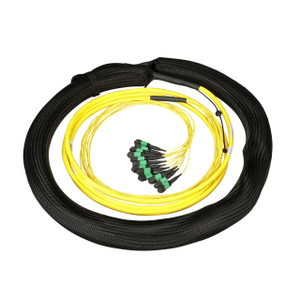
Panduit FWTYL7575KAM100 OM5 QuickNet 12-Fiber Trunk Cable Assembly
The Panduit FWTYL7575KAM100 is a 100-meter OM5 SigCore trunk cable assembly engineered for high-density data center deployments requiring extended reach and rapid infrastructure scaling. This 12-fiber assembly terminates with PanMPO female connectors on both ends, configured in Method A polarity for straightforward backbone installations between MDA and HDA enclosures or switch-to-switch connectivity. The HD Flex transition design delivers a bend radius up to 50% tighter than standard trunk cables, enabling routing through congested cable trays and zero-U vertical managers without kinking. OM5 wideband multimode fiber supports short-wavelength division multiplexing (SWDM) for 40GBASE-SR4, 100GBASE-SR4, and future 400G applications over extended distances compared to OM3/OM4. The ultra insertion loss grade ensures <0.35 dB per connector pair, critical for maintaining link budgets in multi-tier architectures or long horizontal runs. A factory-installed pulling eye on one end simplifies installation through innerduct or conduit without stressing the connector bodies. Low Smoke Zero Halogen (LSZH) jacketing meets IEC 60332-1 and 60754 requirements for enclosed spaces where PVC combustion byproducts pose evacuation risks.
Key Features
- OM5 wideband multimode fiber supporting SWDM transmission up to 400G at 850nm wavelength
- 12-fiber count with PanMPO female-to-female connectors in Method A polarity for direct trunk applications
- Ultra insertion loss grade (<0.35 dB per mated pair) for low-loss backbone installations
- HD Flex cable construction with 30-40% smaller diameter than legacy designs, reducing pathway congestion
- 100-meter (328-foot) length supports extended horizontal or backbone runs in large facilities
- LSZH jacket rated IEC 60332-1 for data centers, telecom closets, and above-ceiling installations
- Factory-installed pulling eye on one end for damage-free conduit pulls
- Lime cable jacket for rapid OM5 visual identification per TIA-598-C color coding
- Meets TIA-568-C.3, ISO/IEC 11801, and TIA-492-AAAD fiber geometry standards
- QuickNet sub-brand backed by Panduit's structured cabling warranty program
OM5 Fiber Technology for Next-Generation Data Rates: OM5 extends the capabilities of 50/125 µm multimode fiber by optimizing performance across the 850nm to 953nm spectrum. Unlike OM3 and OM4, which are designed primarily for 850nm VCSELs, OM5's wideband specification enables short-wavelength division multiplexing—transmitting four wavelengths simultaneously over a single fiber pair. This quadruples effective bandwidth without requiring additional fibers. In practice, SWDM allows 100GBASE-SR4 to run over two fibers instead of eight, and 400GBASE-SR4.2 to run over eight fibers instead of thirty-two. The FWTYL7575KAM100's 12-fiber count supports three 100G SWDM links or one 400G link with spares, future-proofing backbone infrastructure as switch fabrics migrate from 40G to 100G and beyond. For legacy applications, OM5 maintains full backward compatibility with OM3/OM4 transmission distances—100 meters for 40GBASE-SR4, 150 meters for 100GBASE-SR4—while extending 400GBASE-SR4.2 reach to 100 meters versus OM4's 70-meter limit.
High-Density Cable Design and Installation Advantages: The HD Flex cable construction uses a reduced-diameter jacket and tight-buffered fibers to achieve 30-40% space savings compared to standard round trunk cables. This directly addresses the pathways congestion crisis in hyperscale and colocation facilities where rack density has outpaced cable tray capacity. The smaller outer diameter allows more trunk cables to coexist in 4-inch ladder rack or vertical cable managers without exceeding 40% fill ratio per TIA-569 guidelines. The flexible jacket tolerates bend radii down to 10× cable diameter during installation and 5× cable diameter under static load, enabling 90-degree turns through 2RU horizontal managers and tight routing around structural obstacles. The factory-installed pulling eye on one end distributes tensile load across the entire cable assembly rather than concentrating stress at the connector boot. This is critical when pulling through long conduit runs or multiple 90-degree sweeps—standard practice is to lubricate the conduit, attach the pulling eye to fish tape or pull string, and maintain tension below 50 pounds to avoid fiber microbending. The opposite end's PanMPO connector can be protected with the included dust cap during the pull, then mated immediately upon termination without field polishing.
Method A Polarity and PanMPO Connector System: The FWTYL7575KAM100 uses Method A polarity, the most common trunk cable configuration for parallel optics applications. In a Method A trunk, fiber positions mirror straight through—position 1 on connector A maps to position 1 on connector B, position 2 to position 2, and so forth. When connecting two switches or a switch to a cassette, this requires an external polarity flip via a Type B cassette (which crosses transmit and receive pairs) or a Method B cross-over trunk. The advantage of Method A is universality: it works with any standard duplex patch cord polarity when combined with appropriate cassettes, and it simplifies testing since OTDR traces follow predictable fiber paths. The PanMPO connector platform is Panduit's implementation of the MPO/MTP multi-fiber interface, featuring a metal guide pin housing for durability and alignment precision. Female connectors (no guide pins installed) mate with male connectors or cassettes, with the guide pins ensuring <0.5 µm lateral offset between ferrule faces. The ultra insertion loss designation guarantees <0.35 dB per mated connector pair, achieved through precision ferrule geometry and factory end-face polishing to <50nm surface roughness. This headroom is essential in multi-tier architectures where a single channel may traverse three mated pairs (patch panel to trunk, trunk to cassette, cassette to patch cord) and still maintain <1.5 dB total insertion loss.
LSZH Flammability Rating for Critical Infrastructure: The Low Smoke Zero Halogen jacket formulation meets IEC 60332-1 flame propagation and IEC 60754-1/-2 halogen acid gas emission limits, making it the required cable type for enclosed data centers, telecommunications rooms, and above-ceiling plenum spaces in many international markets and U.S. government facilities. During combustion, PVC-jacketed cables release hydrochloric acid gas, which reduces visibility to near-zero within minutes and causes respiratory distress even in low concentrations. LSZH compounds substitute halogen-free polymers that produce minimal smoke (light transmittance >60% per IEC 61034) and no corrosive gases. This matters during fire evacuation—occupants can navigate escape routes, and sensitive electronics in adjacent spaces avoid acid gas corrosion damage. Note that LSZH is not a plenum rating under U.S. National Electrical Code; for above-ceiling installations in North America requiring NEC compliance, verify local AHJ acceptance or specify OFNP-rated cable instead. In spaces governed by IBC or IFC rather than NEC—such as data centers under NFPA 75 or telecom central offices under NFPA 76—LSZH often satisfies flame propagation requirements without requiring plenum rating. The lime jacket color provides instant visual differentiation from OM3 (aqua) and OM4 (magenta/violet) cables per TIA-598-C, reducing mis-patching risk during moves/adds/changes.
Applications and Deployment Scenarios: This 100-meter trunk length is optimized for horizontal runs in large data centers (MDA to perimeter HDA enclosures), inter-building backbone links on enterprise campuses, or vertical riser runs in multi-story facilities. A typical deployment uses the FWTYL7575KAM100 as the permanent backbone between floors or zones, with breakout cassettes at each end converting the 12-fiber trunk to six duplex LC ports. Pair this with Panduit's FAP or FPPE QuickNet cassettes rated for the same ultra insertion loss grade to maintain end-to-end performance. For 40GBASE-SR4 or 100GBASE-SR4 applications, each cassette serves one switch port (8 fibers active, 4 fibers spare). For 100G SWDM applications using BiDi or dual-wavelength optics, each cassette can serve three switch ports (2 fibers per port). The 12-fiber count also supports 2×10GBASE-SR or 2×25GBASE-SR links with future expansion capacity, a common design pattern in hyperconverged infrastructure where storage and compute fabrics run over separate fiber pairs. In co-location or multi-tenant environments, the trunk can be split across tenants—install a 12-port FAP panel, assign ports 1-6 to tenant A and 7-12 to tenant B, and use the panel's shutter doors to enforce physical access control. The pulling eye enables direct installation into underground innerduct between manholes or through conduit risers in high-rise buildings, eliminating the need for intermediate pull boxes on runs up to 100 meters with proper lubrication and tensile load management.
Standards Compliance and Interoperability: The FWTYL7575KAM100 meets TIA-568-C.3 optical fiber cabling component requirements, TIA-492-AAAD fiber geometry specifications for 50/125 µm OM5, ISO/IEC 11801 Edition 3 generic cabling standards, and TIA-604-5 (FOCIS-5) physical connector interface specifications. Factory testing verifies insertion loss, return loss, and fiber geometry per TIA-568.3-D Annex B test procedures using calibrated OTDRs and interferometers. Each cable ships with a serialized test report documenting per-fiber insertion loss at 850nm and 1300nm wavelengths, verifying compliance with OM5's <2.6 dB/km attenuation ceiling. The PanMPO connectors are dimensionally compatible with standard MPO/MTP connector footprints, allowing interoperability with third-party cassettes, adapters, and test equipment—though mixing connector brands may degrade insertion loss performance below the ultra-loss threshold if ferrule geometries are mismatched. RoHS compliance ensures the cable contains no lead, mercury, cadmium, or restricted flame retardants, meeting EU Directive 2011/65/EU and its amendments for electronic equipment sold in European markets. The QuickNet sub-brand is covered by Panduit's 25-year system warranty when installed as part of a complete Panduit Unified Physical Infrastructure (UPI) solution with matching patch cords, cassettes, and panels.
The Panduit FWTYL7575KAM100 delivers the performance, density, and installation flexibility required for mission-critical fiber backbones supporting 40G/100G/400G data rates in space-constrained environments. Its combination of OM5 wideband fiber, ultra insertion loss connectors, and LSZH safety compliance makes it the appropriate choice for hyperscale data centers, telecom central offices, and enterprise campus networks where bandwidth scalability and pathway efficiency directly impact operational costs and deployment timelines.