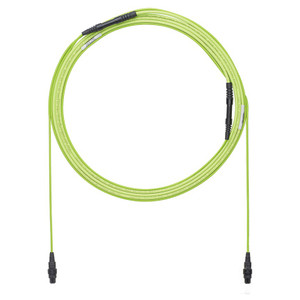
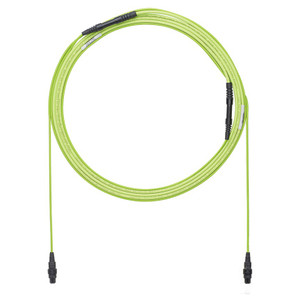
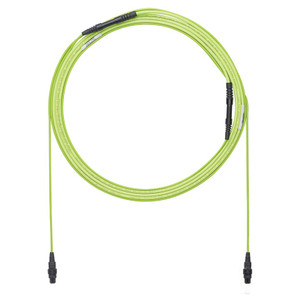
Panduit FWTYL7575KAM040 QuickNet 12-Fiber OM5 Trunk Cable Assembly
The Panduit FWTYL7575KAM040 delivers a factory-terminated 12-fiber OM5 trunk cable assembly engineered for data centers and network environments demanding extended reach, high density, and rapid deployment. This 40-meter (131.2-foot) QuickNet assembly eliminates field termination labor while providing wideband multimode fiber performance that supports both legacy 10G/40G applications and emerging 100G/400G shortwave wavelength division multiplexing (SWDM) architectures. The lime-green LSZH jacket meets plenum-equivalent safety standards for enclosed spaces, and the reduced-diameter construction saves 30 to 40 percent of pathway fill compared to conventional trunk cables—critical when you're managing hundreds of fiber strands in congested overhead trays or under-floor conduits.
Key Features
- OM5 wideband multimode fiber (50/125 μm) supports SWDM for 100G/400G over extended distances
- 12-fiber trunk configuration with factory-installed connectors—zero field termination required
- 40-meter overall length handles rack-to-rack, end-of-row, or floor-to-floor connections in enterprise data centers
- LSZH (Low Smoke Zero Halogen) jacket for fire safety compliance in occupied spaces and international markets
- Small-diameter design reduces pathway congestion by 30–40% compared to standard trunk assemblies
- Pre-tested at the factory to TIA-568-C.3 insertion loss and return loss limits
- Lime green jacket color for instant OM5 identification per TIA-598-D fiber color coding standards
- Compliant with ISO/IEC 11801, TIA/EIA-568-C.3, TIA-604-5 (FOCIS-5), IEC 60793-2-10 A1a.3, and RoHS
OM5 fiber represents the current generation of laser-optimized multimode fiber, offering backward compatibility with OM3 and OM4 networks while adding support for shortwave wavelength division multiplexing. Unlike earlier multimode grades that transmit on a single 850 nm wavelength, OM5 is optimized across four distinct wavelengths (850, 880, 910, and 940 nm), enabling SWDM transceivers to carry four parallel data streams over a single duplex fiber pair. For integrators planning 100GBASE-SR4 or 400GBASE-SR8 migrations, OM5 extends reach to 150 meters at 100G and 100 meters at 400G—50 to 100 percent farther than OM4 in the same applications. This 40-meter assembly fits comfortably within those distance budgets, making it suitable for top-of-rack to end-of-row switching fabrics, distributed storage SANs, or backup replication links that span multiple cold aisles.
The QuickNet factory-termination approach delivers three tangible deployment advantages. First, every connector is polished, inspected, and insertion-loss tested under controlled cleanroom conditions—eliminating the variability introduced by field termination kits, especially in dusty or temperature-extreme telecom rooms. Second, pre-terminated trunks arrive with pull-resistant breakout boots and labeled legs, so your installation crew can land a 12-fiber trunk in the time it would take to epoxy and polish two duplex connectors by hand. Third, factory test reports ship with each assembly, providing documented proof of TIA-568-C.3 compliance for customer acceptance testing or ISO 9001 quality audits. When you're standing up a new data hall under a fixed-day penalty clause, swapping field labor for factory precision often represents the difference between on-time substantial completion and liquidated damages.
The LSZH jacket compound is formulated to meet IEC 60754 halogen-free requirements and IEC 61034 smoke-density limits, making this assembly code-compliant for occupied floor installation in most international jurisdictions. LSZH jackets release 0.5 percent hydrogen chloride by mass (versus 20+ percent for standard PVC) and generate one-tenth the smoke density during combustion, preserving egress visibility and reducing corrosive byproduct damage to adjacent IT equipment. While U.S. NEC Article 770 traditionally requires OFNP (plenum) rated cable for air-handling spaces, many global enterprise standards—particularly in Europe, Asia-Pacific, and the Middle East—mandate LSZH for all indoor horizontal and riser installations. Specifying LSZH trunk assemblies at the design stage ensures one bill of materials for multi-region rollouts, avoiding the logistics complexity of maintaining separate plenum and LSZH inventory SKUs.
Reduced-diameter trunk cable construction uses smaller-profile buffer tubes and tighter jacketing tolerances to achieve a 30 to 40 percent reduction in cross-sectional area compared to legacy loose-tube or distribution-style assemblies. In a congested 4-inch overhead ladder rack carrying 200+ fiber strands, every square millimeter of fill capacity matters. Smaller trunk cables mean higher strand count before you trip NEC Chapter 3 Table 1 conduit fill limits (typically 40 percent for new work, 53 percent for rewire). They also reduce the pull tension and sidewall bearing pressure during installation—particularly relevant for long horizontal runs with multiple 90-degree bends—extending the usable pathway distance before you need to insert an intermediate pull box. For hyperscale and colocation operators running 144-fiber or 288-fiber spines between distribution frames, the fill savings from small-diameter trunks can eliminate an entire parallel conduit run.
Lime green jacket color conforms to TIA-598-D Annex F, which assigns aqua to OM3, erika violet to OM4, and lime green to OM5. Color-coding prevents accidental cross-patching between fiber grades—critical because plugging an OM5-calibrated 100GBASE-SR4 transceiver into an OM3 backbone limits your reach to 70 meters instead of the expected 100 meters, potentially causing intermittent frame loss on longer spans. Visual differentiation also simplifies MAC (move-add-change) work orders in mixed-generation data centers where OM3, OM4, and OM5 coexist during multi-year refresh cycles. Label every breakout leg with a unique circuit ID, but rely on jacket color for first-pass fiber-grade identification during after-hours emergency troubleshooting.
The 12-fiber count in this assembly aligns with common aggregation switch uplink configurations—six duplex LC ports or three breakout MTP-12 modules. Trunk cables typically ship with fan-out breakout kits or consolidation cassettes, allowing you to transition from a single 12-fiber MTP backbone connector to twelve individual simplex LC connectors at the patch panel. This architecture minimizes patch-cord clutter in the front-access zone of your rack while keeping the high-fiber-count backbone confined to the rear cable-management fingers. For 40GBASE-SR4 links (which consume eight fibers per duplex connection), a 12-fiber trunk provides one 40G circuit with four fibers reserved for future expansion or out-of-band management links. For 100GBASE-SR4 (which also uses eight fibers in a parallel optics configuration), the same trunk delivers one 100G uplink plus a four-fiber reserve.
Installation best practices for pre-terminated trunk assemblies center on protecting the factory-polished connector endfaces during the pull. Use the integrated pull-eye or lacing cord to apply tension to the cable strength members, never the breakout legs or connector bodies. Maintain the cable's minimum bend radius (typically ten times the overall diameter for multimode trunk cables, or about 100 mm for reduced-diameter assemblies) throughout the pull and at every support point. Exceeding minimum bend radius induces microbending loss—microscopic deformations in the fiber core that scatter light and degrade the link budget by 0.1 to 0.5 dB per bend. Secure the trunk to the ladder rack or cable tray with hook-and-loop straps at 1.5-meter intervals, avoiding over-tightening that compresses the jacket and creates localized attenuation spikes. Coil any slack length in a service loop with a radius no tighter than twelve inches, and secure the loop to prevent it from unraveling during subsequent pathway additions.
Connector cleaning before every mating cycle is non-negotiable for multimode fiber systems. A single dust particle, skin oil residue, or alcohol evaporation streak on the ferrule endface can introduce 0.3 to 1.0 dB of loss—enough to push a marginal 100-meter OM5 link below the receiver sensitivity threshold. Use lint-free one-click cleaners for LC connectors and MTP cleaning sticks or cassettes for array connectors, following the manufacturer's recommended stroke count (typically one click for LC, five passes for MTP). Inspect every endface with a 200x or 400x fiber microscope before mating, verifying the core and cladding are free of scratches, pits, and contamination per IEC 61300-3-35 pass/fail criteria. Budget fifteen minutes of cleaning and inspection time per trunk assembly during installation, and enforce the same discipline for every re-patch during MAC work orders.
Standards compliance for this assembly spans the full stack of international fiber optic infrastructure requirements. ISO/IEC 11801 defines generic cabling for customer premises, including multimode fiber grades and performance classes. TIA-568-C.3 specifies optical fiber cabling components and transmission performance for commercial buildings, setting insertion loss limits (≤ 0.75 dB for OM5 at 850 nm), return loss minimums (≥ 20 dB), and polarity schemes for duplex and array connectors. TIA-604-5 (FOCIS-5) governs LC connector intermateability and ferrule geometry. IEC 60793-2-10 Type A1a.3 defines the fiber itself—50 μm core, 125 μm cladding, numerical aperture, bandwidth, and attenuation characteristics. RoHS compliance restricts lead, mercury, cadmium, and hexavalent chromium to below 0.1 percent by weight, meeting EU Directive 2011/65/EU for equipment sold or installed in European Union member states. These certifications provide the documentation trail required for LEED v4.1 Materials and Resources credits, government GSA contract deliverables, and third-party data center commissioning acceptance tests.
This assembly is best suited for greenfield data center builds or major refresh projects where you control the full horizontal pathway from core to distribution to access layer. If you're extending fiber into an existing campus backbone with unknown installed cable types, verify that your legacy infrastructure supports OM5 transceivers—older OM1 or OM2 fiber will bottleneck SWDM applications to OM1/OM2 distance limits regardless of the new trunk cable grade. For mixed-mode environments, consider deploying OM5 only on net-new spine-and-leaf fabrics while leaving legacy three-tier aggregation on OM3 or OM4 until the next forklift upgrade cycle. The lime green jacket provides the visual cue your operations team needs to separate current-generation SWDM-ready links from legacy SR4-only infrastructure, reducing the risk of misconfiguration during after-hours emergency circuit provisioning.