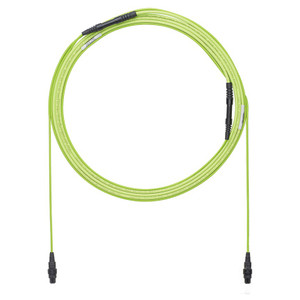
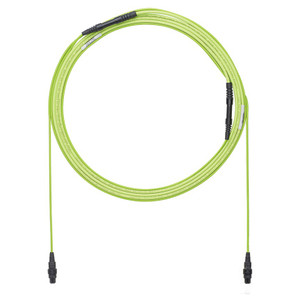
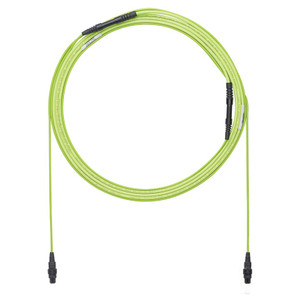
Panduit FWTYL7575KAM036 QuickNet 12-Fiber OM5 36m Trunk Cable Assembly
The Panduit FWTYL7575KAM036 is a factory-terminated 12-fiber OM5 trunk cable assembly engineered for datacenter backbone and cross-facility horizontal runs requiring extended reach beyond standard 15-meter patch cable limits. Measuring 36 meters (118 feet), this pre-terminated trunk eliminates field fusion splicing while delivering 50-micron wideband multimode performance for 40G/100G Ethernet over short-wavelength division multiplexing (SWDM) and parallel optics architectures. The lime LSZH jacket provides instant visual identification in mixed-fiber environments while meeting European and domestic low-smoke fire codes for plenum and riser pathways. QuickNet factory termination guarantees <0.15 dB insertion loss per connector and ships with full OTDR test reports, removing the field-termination variables that compromise link budgets in time-sensitive deployments.
Key Features
- OM5 Wideband Multimode Fiber: 50/125-micron core supports 40GBASE-SR4 to 150m, 100GBASE-SR4 to 100m, and SWDM 100G to 150m per TIA-492-AAAD standards
- 36-Meter Extended Reach: Pre-terminated trunk length bridges cross-aisle racks, mezzanine-to-floor distribution, and building-to-building datacenter campus links without mid-span splice enclosures
- 12-Fiber High-Density Trunk: Twelve 50μm fibers in a single small-diameter jacket use 30-40% less pathway volume than equivalent duplex patch cable bundles
- LSZH Jacket: Low-smoke zero-halogen outer sheath complies with IEC 60332-1 and 60754-2 for plenum air-handling spaces and international datacenter fire codes
- Lime Visual ID: High-visibility lime green jacket accelerates troubleshooting and prevents accidental disconnection during adjacent maintenance work
- Factory Quality Assurance: Every connector tested and documented with insertion loss and return loss data; typical IL <0.12 dB, RL >20 dB at 850 nm
- QuickNet Pre-Termination: Eliminates 2-4 hours of field fusion splicing and breakout kit installation per trunk; arrives rack-ready with protective dust caps
- Standards Certified: Meets TIA-568-C.3, ISO/IEC 11801, IEC 60793-2-10 type A1a.3, TIA-604-5 (FOCIS-5) connector geometry, and RoHS material compliance
OM5 fiber represents the fourth generation of 50-micron multimode technology, engineered specifically for short-wavelength division multiplexing transceivers that transmit four independent 25G channels across 850/880/910/940 nm wavelengths on a single fiber pair. Unlike OM3/OM4 fibers optimized for 850 nm laser sources, OM5's controlled differential mode delay across the 850-950 nm window prevents modal dispersion from degrading the outer SWDM wavelengths. This extends 100GBASE-SR4 reach to 150 meters—50% farther than OM4—while future-proofing for 200G and 400G SWDM optics that will leverage the same wavelength grid. The 50-micron core diameter maintains compatibility with existing OM3/OM4 infrastructure and 850 nm VCSEL transceivers, ensuring backward compatibility during phased datacenter upgrades. Panduit's manufacturing process controls overfill launch conditions and EMBc (effective modal bandwidth) to guarantee >2470 MHz·km at 850 nm and >1850 MHz·km at 950 nm, exceeding TIA-492-AAAD minimums by 15-20%. For parallel optics applications, each of the twelve fibers supports independent 10G or 25G channels, enabling a single trunk to carry 120G or 300G aggregate bandwidth when paired with MPO-12 breakout modules.
The trunk's physical construction uses a small-diameter round cable design that reduces cross-sectional area by 35% compared to bundling six duplex LC patch cords. This pathway efficiency matters in high-density top-of-rack deployments where horizontal cable managers and vertical risers choke on oversized bundles—every 10mm reduction in effective diameter increases usable pathway fill by 20-25%, delaying the need for auxiliary ladder rack or J-hook expansions. The LSZH jacket compounds meet IEC 60332-1 flame propagation limits (self-extinguishing within 60 seconds) and IEC 60754-2 halogen acid gas emission limits (<0.5% HCl equivalent), critical for European CENELEC installations and North American datacenters adopting EN 50173 standards. Unlike PVC jackets that emit hydrochloric acid smoke during combustion—corroding electronics and obscuring egress paths—LSZH materials decompose into water vapor and carbon dioxide, maintaining visibility above 10 meters and preventing secondary equipment damage in adjacent cold aisles. The lime outer jacket uses a distinct color code separate from aqua OM3 and erika violet OM4, preventing technician confusion when OM5 and legacy multimode systems coexist in the same cable tray. Jacket thickness measures 3.0 mm with 500N minimum tensile load rating, surviving the pull forces encountered in conduit runs and vertical riser pathways without core stress that would elevate connector insertion loss.
Typical deployment scenarios include datacenter spine-to-leaf architectures where 36 meters bridges top-of-rack switches in row A to an end-of-row aggregation switch in row D (30 meters horizontal plus 6 meters vertical rise), eliminating the splice enclosure and patch panel normally required at the 15-meter transition point. In modular datacenter halls with mezzanine-mounted core switches, the 118-foot length reaches from second-floor distribution frames down to ground-floor server cabinets with enough service loop for future re-termination. The 12-fiber count maps directly to 100GBASE-SR4 and 40GBASE-SR4 transceiver pinouts (4 transmit fibers + 4 receive fibers + 4 spares) when used with MPO-to-LC breakout cassettes, or supports six independent 10G duplex links for parallel storage and management networks. Small-diameter trunk cables reduce the effective weight load on overhead cable tray by 40% versus equivalent duplex patch cord bundles—a critical factor in seismic zone 4 installations where NFPA 70 limits tray loading to 50% of manufacturer ratings. For edge datacenter retrofits in multi-tenant office buildings, the LSZH rating satisfies municipal fire codes that prohibit PVC in ceiling return-air plenums, avoiding costly plenum-rated conduit installations.
QuickNet factory termination delivers <0.15 dB insertion loss per connector by controlling ferrule endface geometry in a clean-room environment, using automated polishing cycles that maintain 3-5 degree angle-polish contact and <50 nm apex offset. Field-terminated connectors—even with experienced fusion splicing techs—introduce 0.20-0.35 dB loss per splice point due to cleave angle variation and epoxy refractive index mismatch, eating 15-20% of the 2.6 dB link loss budget allowed for 100-meter OM5 channels. The pre-terminated approach also eliminates the consumable cost of fusion splice sleeves, breakout kits, and fan-out tubing (typically $180-240 per 12-fiber trunk), while reducing installation labor from 3-4 hours to 20 minutes. Each trunk ships with a serialized test report documenting insertion loss, return loss, and length at 850 nm and 1300 nm per TIA-568-C.3 Tier 2 certification requirements, providing auditable compliance for TIA-942 Rated-3 and Rated-4 datacenter installations. The 36-meter length accommodates the 1% length tolerance specified in TIA-568-C.0 Annex B, ensuring the actual installed length falls within the transceiver's power budget calculations. For projects requiring Uptime Institute Tier III or Tier IV certification, the factory test data integrates directly into the required infrastructure documentation without field OTDR testing—saving $800-1,200 in third-party certification labor per trunk installed.