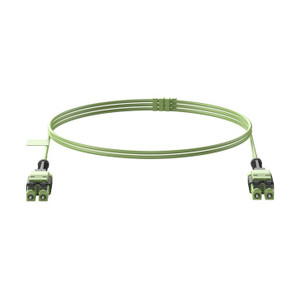
Panduit FW2RLU1U1NNM003 Opti-Core OM5 Fiber Patch Cord
The Panduit FW2RLU1U1NNM003 is a 3-meter OM5 wideband multimode fiber patch cord engineered for high-density data center and enterprise network deployments requiring 40/100/400 Gigabit Ethernet capacity. Built on Panduit's Opti-Core platform, this duplex jumper features LC Uniboot UPC connectors at both ends—a space-saving design that reduces port congestion by 50% compared to traditional duplex LC assemblies in switch fabric, storage area network (SAN), and aggregation-layer applications. The 2mm LSZH (Low Smoke Zero Halogen) jacket meets European CPR and international fire safety mandates for plenum-equivalent installations where toxic smoke emission during combustion is a disqualifying risk. Standard polarity and factory-terminated connectors eliminate field-termination labor and the insertion-loss variability that comes with on-site cleave-and-crimp assembly.
Key Features
- OM5 wideband multimode fiber (50/125 µm) supporting 100GBASE-SR4 over 150 m and 400GBASE-SR4.2 over 100 m
- LC Duplex Uniboot UPC connectors both ends—50% smaller footprint vs. legacy duplex LC
- 2mm LSZH jacket compliant with IEC 60332-1-2 for low-smoke, zero-halogen fire performance
- 3-meter (9.84 ft) length optimized for rack-to-rack and intra-row switch interconnects
- Standard (Type A) polarity—transmit on fiber 1, receive on fiber 2 per TIA-568.3-D
- Lime green jacket for instant visual identification of OM5 cabling plant per TIA-598
- Factory-terminated and tested to standard insertion loss specifications (typical <0.3 dB)
- Push-pull uniboot design with field-reversible polarity for A-to-B trunk corrections
- UPC endface polish delivering >50 dB return loss for 25G-per-lane optics
OM5 fiber—ratified as ISO/IEC 11801-1 Amendment 1 and TIA-492AAAE—extends the wideband multimode standard introduced with OM4 by adding short-wave division multiplexing (SWDM) support across four wavelength lanes (850/880/910/940 nm). This enables 100 Gbps and 400 Gbps transmission using cost-effective VCSEL (vertical-cavity surface-emitting laser) transceivers over medium-reach distances, eliminating the need for expensive single-mode optics or bulky 8-fiber/12-fiber MPO trunk assemblies in applications under 150 meters. The uniboot connector design consolidates both transmit and receive fibers into a single compact housing with an integrated push-pull boot, cutting patch-panel density requirements in half compared to dual-boot duplex LC cables. In 1U top-of-rack switches and blade server environments where every millimeter of vertical cable-management space counts, the reduced connector footprint allows higher port utilization without exceeding minimum bend-radius limits. Panduit's boot geometry incorporates a polarity-reversal key; rotating the connector body 180 degrees swaps fiber positions without re-termination, simplifying Type A-to-Type B crossover corrections during MACs (moves, adds, changes).
The UPC (Ultra Physical Contact) endface polish maintains fiber-core alignment within the IEC 61755-3-1 (formerly TIA-604-10-D FOCIS-10) geometry standard, ensuring physical contact across the full core diameter and minimizing air-gap reflections. Factory polishing achieves typical insertion loss under 0.3 dB and return loss better than -50 dB—critical performance thresholds for 25 Gbps-per-lane BiDi and PAM4 optics, which are intolerant of back-reflection noise. Panduit's automated termination process eliminates the human-error variables inherent in field installations: inconsistent cleave angles, contaminated endfaces, improper epoxy cure cycles, and out-of-spec ferrule protrusion. Each cord ships with protective dust caps over both connectors and undergoes end-of-line insertion-loss verification before packaging, reducing the failure rate and troubleshooting overhead during deployment.
This 3-meter length sits in the optimal range for intra-rack and adjacent-rack interconnects—long enough to route cleanly through vertical cable managers, over-the-top horizontal pathways, and around hot-aisle/cold-aisle obstructions without excessive service loop, yet short enough to avoid the signal-budget waste of over-provisioned jumpers. In converged IP surveillance and physical security networks, OM5 backbone links between aggregation switches and NVR storage arrays future-proof the infrastructure for 4K/8MP camera migrations; a single 100 Gbps duplex fiber can aggregate thousands of simultaneous H.265 streams or tens of thousands of high-transaction-rate access-control events without introducing latency or packet loss. Data center operators deploying leaf-spine fabrics benefit from OM5's SWDM capabilities when scaling from 10/25 Gbps edge optics to 100/400 Gbps spine uplinks—existing OM5 cabling supports the upgrade path without a forklift rip-and-replace, protecting the fiber investment across multiple hardware refresh cycles.
The LSZH jacket is mandatory in European Union installations per CPR (Construction Products Regulation) Euroclass Cca or B2ca ratings, and increasingly specified in North American healthcare, education, transportation, and government facilities where building codes or occupant-safety policies prohibit PVC-jacketed cables in air-handling spaces. Under fire conditions, LSZH compounds produce significantly lower smoke density and emit negligible hydrogen chloride and other corrosive halogens compared to conventional PVC or plenum-rated FEP jackets—reducing both occupant incapacitation risk during egress and post-fire equipment damage from acidic residue. IEC 60332-1-2 certification verifies that the jacket self-extinguishes and resists vertical flame propagation when tested per the single-cable vertical flame test, meeting the baseline requirement for riser and plenum applications in international markets. The lime green color follows TIA-598-D Appendix A recommendations for OM5 identification, preventing accidental cross-patching with OM3 (aqua) or OM4 (eero/violet) infrastructure during MACs—a common error that can limit link distance or prevent autonegotiation on multi-rate optics.
Factory termination and testing deliver measurable cost and performance advantages over field-installed connectors. Panduit's controlled manufacturing environment maintains sub-micron tolerances on ferrule endface geometry, achieving concentricity and apex offset values that field techs cannot consistently replicate with portable polishing equipment. The result: lower insertion loss, lower return loss, and fewer link failures during acceptance testing or post-deployment troubleshooting. Each FW2RLU1U1NNM003 cord ships as a single unit (package quantity: 1) in cartons of 10, balancing inventory flexibility with cost efficiency for integrators stocking common jumper lengths. For projects deploying leaf-spine fabrics, storage replication links, or multi-gigabit surveillance backbones, this cord delivers the bandwidth headroom and future-proofing of next-generation OM5 fiber in a standards-compliant, space-efficient uniboot form factor—no re-cabling required when you migrate from 10G/25G SFP28 to 100G QSFP28 or 400G QSFP-DD optics over the infrastructure's 15-20 year service life.