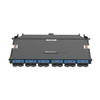
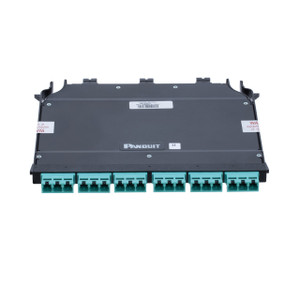
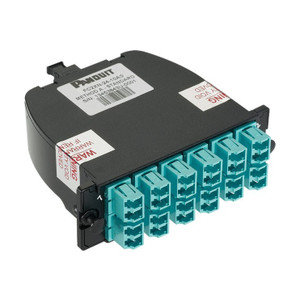
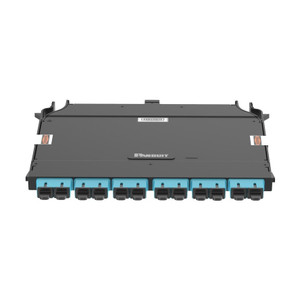
Panduit FHCZO-20F-10A HD Flex OM4 Fiber Optic Cassette Module
The Panduit FHCZO-20F-10A is a high-density fiber cassette engineered for 40GBASE-SR4 and 100GBASE-SR4 datacenter deployments where port density and guaranteed insertion loss budgets are non-negotiable. This pre-terminated module breaks out a single 24-fiber female MPO trunk connector into twelve LC duplex ports, delivering factory-tested performance across twenty active OM4 50/125µm multimode fibers. Designed for spine-leaf architectures, storage area networks, and high-performance computing clusters, the cassette eliminates field termination labor while supporting 100G Ethernet transmission up to 150 meters. Method A straight-through polarity integrates with standardized trunk cable infrastructure, and the HD Flex form factor consolidates 24 fibers into a single-wide cassette slot for maximum 1RU enclosure utilization.
Key Features
- OM4 laser-optimized 50/125µm multimode fiber rated for 100GBASE-SR4 up to 150m and 10GBASE-SR beyond 400m per IEEE 802.3
- 1x 24-fiber female MPO input connector to 12x LC duplex output adapters in aqua HD Flex cassette body
- Method A (straight-through) polarity for simplified trunk-to-equipment patching with standard crossover patch cords
- Twenty active fibers within 24-fiber MPO interface—supports ten duplex 10G links, five 40G links, or two 100G links per cassette
- Pre-terminated and factory-tested with documented insertion loss <0.35dB per mated pair, guaranteeing margin for 1.5dB channel budgets
- HD Flex single-wide modular design fits Panduit FAP/FMP enclosures and compatible 1RU/2RU fiber panels—144 LC ports per 1RU with six-cassette population
- Aqua cassette body and boot color provides instant OM4 fiber-type identification during MAC operations
- Removable dust caps on all twelve LC duplex adapters and MPO interface to prevent contamination during storage and installation
- Ceramic split-sleeve LC adapters deliver repeatable <0.15dB mated connector loss across thousands of insertion cycles
- Complies with IEC 61754-7 (MPO), IEC 61754-20 (LC), TIA-492AAAD (OM4 fiber), and IEEE 802.3ba (40G/100G Ethernet) standards
Panduit's OM4 fiber in the FHCZO-20F-10A offers an effective modal bandwidth of 4700 MHz·km at 850nm, enabling 100GBASE-SR4 parallel optics links to reach the full 150-meter distance specified in IEEE 802.3ba. This bandwidth headroom is critical in datacenter environments where you're designing spine-to-leaf links with 100G QSFP28 transceivers operating at -1.5dBm minimum launch power and requiring a 1.9dB loss budget including connector pairs, splice points, and fiber attenuation. The cassette terminates twenty of the twenty-four available fibers in the MPO connector—the four unused positions provide spares for future re-termination or accommodate non-standard fiber counts without requiring a different trunk cable. On the output side, twelve aqua LC duplex adapters present the fiber pairs in a standard 1x12 horizontal array, matching the port layout of most 1RU fiber enclosures and allowing dense patch cord management in vertical cable managers.
Method A polarity maps fiber position 1 on the MPO connector to position 1 on the LC output, position 2 to position 2, and so forth in a straight-through configuration. This polarity scheme pairs with Method A MPO trunk cables (straight-through pinning on both ends) and requires Method B crossover patch cords at the equipment interface to swap transmit and receive pairs. The advantage of Method A cassettes in large-scale deployments is standardization: every trunk cable in your vertical riser or horizontal distribution uses identical pinning, reducing the risk of polarity errors during installation or expansion. When you're deploying a leaf-spine network with 48-port leaf switches connecting to four spine switches, you can pre-install Method A trunks from each leaf to the spine aggregation point, then use this cassette at the leaf end to break out individual 100G links. At the spine, you use a matching Method A cassette or direct MPO-to-QSFP breakout, and handle transmit/receive swaps with your patch cords or transceiver polarity configuration.
Factory termination delivers insertion loss predictability that field splicing and field-installed connectors cannot match. Panduit tests every fiber pair in the cassette and includes performance documentation showing actual insertion loss values, typically in the 0.25dB to 0.35dB range per mated connection. When you're engineering a 100G link with a 1.9dB loss budget, a 0.3dB cassette insertion loss leaves 1.6dB for trunk cable attenuation (0.0024dB/m × 150m = 0.36dB), patch cord loss (0.15dB per cord), and margin for future splices or repairs. Contrast this with field termination, where MPO connector installation requires specialized tooling, end-face inspection with a fiber microscope, and per-connector testing—and even then, you're unlikely to achieve the consistency of a controlled factory environment. The FHCZO-20F-10A also eliminates the 30 to 45 minutes of labor per cassette required for field splicing twelve LC connectors, compressing installation schedules in time-sensitive datacenter cutovers where every hour of downtime costs thousands in lost revenue.
The HD Flex form factor uses a single-wide cassette slot to house 24 fibers, doubling the density of traditional cassette designs that consume two slots for the same fiber count. In a 1RU enclosure configured for six HD Flex cassettes, you achieve 144 LC duplex ports (288 fibers) in a single rack unit—enough to support 72 duplex 10G server connections, 36 40G switch uplinks, or 14 100G spine interconnects per enclosure. This density is essential in leaf-switch aggregation scenarios where you're connecting 48 or 96 server ports per switch and need to consolidate patch panel real estate without expanding into additional rack units. Installation is tool-free: the cassette slides into an HD Flex adapter panel or enclosure slot, latches with a snap-fit mechanism, and mates with the MPO trunk cable via a push-pull connector. The modular design supports incremental deployment—populate cassettes as switch ports go live rather than pre-installing all infrastructure and risking dust contamination on unused LC adapters.
OM4 fiber is backward compatible with OM3 systems, so the FHCZO-20F-10A integrates into mixed-generation datacenters where you're migrating legacy 10GBASE-SR links to 40G or 100G speeds. If your existing infrastructure uses OM3 trunks rated for 100m at 100G, you can replace them with OM4 trunks and this cassette to extend reach to 150 meters—often the difference between single-floor and multi-floor connectivity in vertical campus networks. The aqua jacket and cassette body provide visual confirmation of fiber type during moves, adds, and changes, reducing the risk of accidentally patching an OM3 patch cord into an OM4 channel and failing the insertion loss budget. LC adapters use ceramic split-sleeve alignment, which centers the ferrule to within 1 micron and ensures repeatable performance across thousands of mating cycles—critical in production environments where you're frequently re-patching servers or troubleshooting link errors.
The female MPO connector on the cassette input includes guide pins in positions 1 and 12, designed to mate with male MPO connectors (with guide-pin holes) on trunk cables. This pin/hole configuration ensures correct alignment during connector mating and prevents accidental damage to fiber end-faces. MPO connectors are push-pull latching types, so you can install and remove them in tight enclosure spaces without needing a specialized extraction tool. Twenty active fibers in the cassette support multiple network topologies: configure as ten duplex 10GBASE-SR links for server connectivity, five duplex 40GBASE-SR4 links using parallel optics (eight fibers per 40G link), or two duplex 100GBASE-SR4 links (eight fibers per 100G link). The four unused fiber positions in the 24-fiber MPO give you flexibility for future re-termination if a fiber pair fails or if you need to repurpose the cassette for a different application.
Panduit's HD Flex cassette system is optimized for environments where you route MPO trunk cables through overhead ladder rack, underfloor conduit, or vertical riser pathways, then break out to individual switches, servers, or storage arrays at the distribution level. In a spine-leaf deployment, you run 24-fiber OM4 trunks from leaf switches (located at the top of each server rack row) up to spine switches (in a central aggregation row or end-of-row position), then use this cassette at each end to present twelve LC duplex ports. At the leaf, you patch 100G QSFP28 transceivers with standard aqua LC patch cords; at the spine, you do the same. The Method A cassette polarity means your patch cords handle the transmit/receive swap, so you don't need to track different trunk cable types or cassette pinouts across hundreds of fiber runs. This standardization reduces installation errors and simplifies documentation—your fiber infrastructure consists of identical trunks and cassettes, with patching variations handled at the easily accessible and replaceable patch cord layer.
The FHCZO-20F-10A ships with insertion loss test results for all twelve LC duplex ports, documenting performance at the time of manufacture. This data provides a baseline for future troubleshooting: if a link fails after installation, you can compare your field insertion loss measurement to the factory baseline to determine whether the issue is connector contamination, patch cord damage, or a trunk cable fault. The cassette's <0.35dB insertion loss specification includes the MPO-to-LC transition and all internal fiber routing within the module, so you account for this loss once in your channel budget rather than tracking separate values for connectors, adapters, and internal splices. For 100GBASE-SR4 links with -1.5dBm transmitter launch power and a receiver sensitivity of -9.5dBm, the 1.9dB loss budget breaks down as: 0.3dB cassette at source, 0.36dB trunk fiber, 0.3dB cassette at destination, 0.15dB patch cord at source, 0.15dB patch cord at destination, leaving 0.64dB margin for aging, repairs, and measurement uncertainty. This margin is essential in mission-critical environments where you cannot afford link flapping or reduced throughput due to borderline optical power levels.
Panduit's OM4 multimode fiber meets TIA-492AAAD specifications for 50/125µm laser-optimized fiber, with a maximum attenuation of 3.0dB/km at 850nm and 1.0dB/km at 1300nm. The 50µm core diameter supports reliable coupling with VCSEL (vertical-cavity surface-emitting laser) transceivers used in 10G/40G/100G Ethernet applications, and the 4700 MHz·km modal bandwidth minimizes modal dispersion over the 150-meter distances typical of intra-building datacenter links. The fiber is housed in aqua-colored tight-buffered 900µm jacketing inside the cassette, with bend-radius protection to prevent kinking during installation or service. The cassette body is a rigid plastic housing with flanges for mounting in HD Flex enclosures, and the LC adapters are secured in a metal sub-plate to prevent movement under patch cord insertion force. This mechanical design ensures that the cassette maintains its performance specifications even after years of MAC activity in high-vibration or temperature-cycling environments.