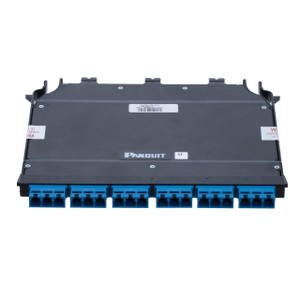
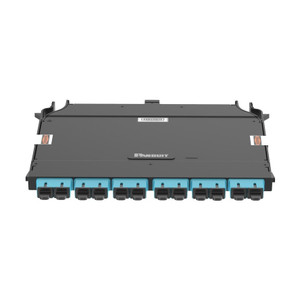
Panduit FHCZO-36-C3U HD Flex 36-Fiber OM4 MPO Cassette
The Panduit FHCZO-36-C3U is a double-width HD Flex fiber cassette delivering 36 fibers of OM4 connectivity in a single module for high-density datacenter and enterprise backbone deployments. Three MPO-12 male connectors on the front interface accept pre-terminated trunk cables, breaking out to eighteen duplex unterminated CS ports on the rear for field termination with LC, SC, or ST connectors per site requirements. Universal polarity architecture supports Type A, B, and C polarity schemes without module reconfiguration, simplifying migration from 10G to 40G/100G Ethernet. Optimized insertion loss performance and laser-optimized OM4 fiber ensure headroom for 550-meter 10GBASE-SR or 150-meter 100GBASE-SR4 links.
Key Features
- 36-fiber OM4 (50/125μm) multimode capacity in double-width form factor
- 3× MPO-12 male connectors on front; 18× duplex unterminated CS ports on rear
- Universal polarity design supports Type A, B, and C configurations without rewiring
- Optimized insertion loss for extended reach and multi-tier spine-leaf architectures
- Unterminated rear ports allow field installation of LC, SC, or ST connectors per site standard
- HD Flex chassis compatibility fits standard Panduit modular enclosures and panels
- Polycarbonate housing withstands high-density rack environments and frequent reconfigurations
- 50-micron laser-optimized OM4 fiber rated for 40GBASE-SR4, 100GBASE-SR4, and 400G applications
The FHCZO-36-C3U uses three MPO-12 male connectors (12 fibers each) to interface with pre-terminated MPO trunk cables, a standard architecture for structured cabling systems where backbone fiber is pulled from main distribution areas (MDAs) to horizontal distribution areas (HDAs) or equipment rooms. Each MPO-12 connector supports a single 12-fiber ribbon, and the cassette internally routes those 36 strands to eighteen duplex (2-fiber) CS ports on the rear. The unterminated design gives you the flexibility to field-terminate with LC, SC, or ST connectors based on your active equipment's interface requirements—critical when deploying mixed-generation switches, storage arrays, or converged infrastructure that may use legacy SC or newer LC connectors. This eliminates the need to stock multiple pre-terminated cassette SKUs and reduces lead times when specifications change mid-project.
Universal polarity is the key differentiator for mixed 10G/40G/100G deployments. TIA-568 defines three polarity methods (Type A, B, and C) to ensure transmit fibers on one end align with receive fibers on the other across duplex and MPO connections. Traditional cassettes lock you into a single polarity scheme, forcing costly rewiring or adapter modules during technology migrations—such as when moving from 10GBASE-SR duplex links to 40GBASE-SR4 MPO-based links. The FHCZO-36-C3U's internal fiber routing supports all three polarity types through key-position alignment on the MPO connectors, so you can deploy Type B polarity for your initial 10G duplex fabric, then migrate to Type C for 40G/100G parallel optics without pulling new trunk cables or swapping cassettes. This future-proofing is essential in spine-leaf datacenter topologies where leaf switches may upgrade from 10G access ports and 40G uplinks to 25G access and 100G uplinks over the facility's lifespan.
OM4 fiber is laser-optimized 50/125μm multimode rated for 550 meters at 10 Gb/s (10GBASE-SR), 150 meters at 40 Gb/s (40GBASE-SR4), and 100 meters at 100 Gb/s (100GBASE-SR4) per IEEE 802.3 standards. The 50-micron core diameter and 4700 MHz·km effective modal bandwidth (EMBc) at 850 nm support VCSEL-based transceivers commonly used in enterprise and datacenter environments, delivering lower cost per port than singlemode solutions for campus backbone and intra-building links. The cassette's optimized insertion loss—typically below 0.35 dB per mated connector pair for Panduit's HD Flex line—preserves your loss budget in multi-tier architectures. For example, a two-tier spine-leaf design with cassette breakouts at both spine and leaf aggregation points will accumulate roughly 1.4 dB total insertion loss (four mated connections @ 0.35 dB each), leaving ample margin within the 2.6 dB IEEE 10GBASE-SR budget for splice loss, trunk cable attenuation, and aging. This headroom is critical for adds/moves/changes over a 15–20 year structured cabling lifecycle.
The double-width form factor occupies two slots in a standard Panduit HD Flex chassis or patch panel, delivering 36 fibers in the same footprint where traditional cassettes provide 12 or 24. In a fully populated 1U HD Flex enclosure with six double-width slots, you achieve 216-fiber density (6 cassettes × 36 fibers each), reducing rack unit consumption by 50% compared to single-width 12-fiber cassettes. This density matters in colocation environments with per-RU charges, or in enterprise equipment rooms where rack space is constrained by HVAC, power distribution, or seismic bracing requirements. The unterminated rear ports terminate into a rear cable management tray or slack spool, allowing you to dress breakout cables neatly and maintain the minimum bend radius (typically 30 mm for OM4 tight-buffered cable, 50 mm for distribution cable) to prevent attenuation spikes or fiber damage during installation and subsequent reconfigurations.
Field termination workflow involves stripping the rear CS ports' buffer tubes, cleaving the fibers, and installing LC, SC, or ST connectors using either adhesive/polish methods or mechanical splice connectors. Mechanical splice connectors (such as Panduit's Opti-Crimp or 3M Hot Melt) reduce termination time to under two minutes per duplex pair and eliminate the consumable costs and hazardous waste associated with epoxy. Once terminated, each duplex pair is tested for insertion loss and return loss using an OLTS (optical loss test set) or OTDR (optical time-domain reflectometer) per TIA-568.3-D requirements—maximum 0.75 dB channel insertion loss for OM4, minimum 20 dB return loss. The unterminated design also allows you to fusion-splice the cassette's rear fibers directly to premises fiber plant in retrofit scenarios where existing duplex infrastructure is being consolidated into MPO trunking, avoiding the added loss of an LC-to-CS adapter.
Polycarbonate construction provides impact resistance and dimensional stability across the 0°C to 60°C operating range typical of HVAC-controlled equipment rooms and the occasional hot-aisle spike during cooling system maintenance. The material is non-conductive and self-extinguishing (UL 94 V-0 rating), meeting NEC Article 770 and UL 1651 requirements for optical fiber cables and raceways in plenum and riser applications (note that the cassette itself is installed in enclosed equipment; plenum rating applies to the trunk and breakout cables connected to it). The black housing minimizes light bleed from active fiber cores during troubleshooting with visual fault locators, and the front labeling area accepts adhesive or write-on labels for circuit identification—critical for MAC-D (moves, adds, changes, and disconnects) work orders in multi-tenant or large campus networks.
The HD Flex platform integrates with Panduit's broader structured cabling ecosystem, including pre-terminated MPO trunk assemblies (MTP Elite or standard MPO), fiber enclosures (wall-mount, rack-mount, and floor-mount), and cable management accessories. For example, you can deploy a complete MDA-to-HDA link using Panduit FX8M trunk cable (eight MPO-12 connectors, 96 fibers) from the core switch to a 2U HD Flex enclosure, populate the enclosure with four FHCZO-36-C3U cassettes (144 fibers total), terminate the rear ports with LC connectors, and patch to 72 duplex distribution switches—all while maintaining TIA-568.3-D performance and preserving documentation through Panduit's color-coded fiber types (aqua for OM4) and labeling schemes.
Universal polarity and unterminated rear ports future-proof this cassette for data rate migrations and equipment changes that occur multiple times over a structured cabling system's lifespan. As your network evolves from 10G SR duplex to 40G SR4 or 100G SR4 parallel optics, the same trunk infrastructure and cassette modules remain in place—only the patch cords and transceiver types change at the equipment interface. This reduces capital expenditure for technology refresh cycles and minimizes the service-affecting downtime associated with re-cabling equipment rooms. The modular HD Flex architecture also supports incremental deployment: start with two cassettes in a chassis to serve immediate connectivity needs, then add cassettes as switch port counts grow, without disrupting existing circuits or requiring a forklift upgrade of the entire distribution frame.
TIA-568.3-D and ISO/IEC 11801 standards compliance ensures interoperability with multivendor infrastructure components and active equipment. The cassette's MPO-12 male interface adheres to IEC 61754-7 geometry specifications, guaranteeing proper alignment with MPO female connectors on trunk cables regardless of manufacturer. The 50-micron OM4 fiber meets TIA-492AAAD and IEC 60793-2-10 A1a.2 specifications for core diameter, cladding diameter, numerical aperture, and attenuation, validated through third-party testing for IEEE 802.3 10/40/100 Gigabit Ethernet applications. This standards-based approach protects your investment by ensuring that the cassette will interface correctly with future generations of transceivers, switches, and cabling components as the industry migrates toward 200G and 400G Ethernet.