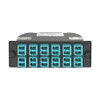
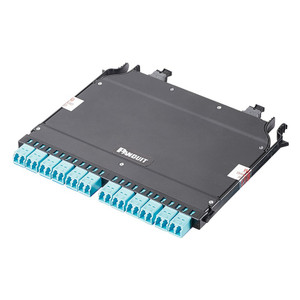
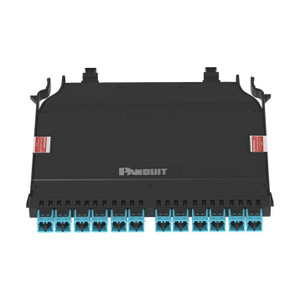
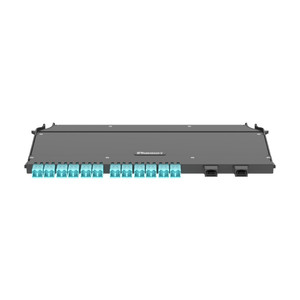
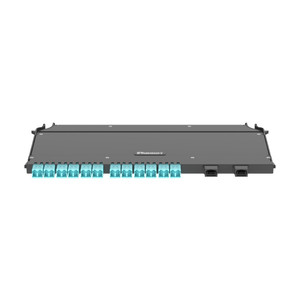
Panduit FC2ZA-24-10U OptiCom™ OM4 MPO-LC Fiber Cassette
The Panduit FC2ZA-24-10U OptiCom™ fiber cassette delivers a pre-terminated, factory-tested breakout solution for 40G/100G backbone-to-horizontal transitions in enterprise datacenters and high-density network closets. This OM4 cassette converts two 12-fiber MPO trunk connectors into twelve duplex LC ports, supporting 24 fibers total with ultra-low insertion loss and universal polarity—eliminating field polarity troubleshooting during moves, adds, and changes. The black polycarbonate housing integrates directly into Panduit fiber enclosures and accepts industry-standard MPO trunk cables on the rear while presenting aqua-colored LC duplex connectors on the front panel for immediate 10G/40G server or switch connections. Designed for installers managing multi-tier architectures where structured MPO backbones feed distributed access layers, this cassette reduces installation time by 60-70% compared to field-terminated LC solutions while maintaining <0.35 dB insertion loss across all 24 fibers.
Key Features
- OM4 50µm multimode fiber rated for 10GBASE-SR (400m), 40GBASE-SR4 (150m), and 100GBASE-SR4 (150m) per IEEE 802.3 standards
- Universal polarity method compatible with all three TIA-568 polarity schemes (Method A, B, C) without cassette swaps or adapter changes
- Two 12-fiber MPO male connectors (rear) to twelve duplex LC connectors (front) in compact 1U-compatible form factor
- Ultra-low insertion loss specification (<0.35 dB typical) with factory testing and serialized performance documentation
- Black polycarbonate housing with integrated strain relief and snap-in mounting for Panduit FHD, FAP, FMT enclosures
- Aqua LC connector boots for instant OM4 identification per TIA-598 color coding standards
- Pre-routed internal fiber management eliminates bend radius violations and maintains <7.5mm minimum bend radius throughout signal path
- Field-swappable design allows cassette replacement in under 90 seconds without disrupting adjacent circuits
This cassette solves the core challenge of migrating from centralized 40G/100G spine switches with MPO interfaces down to distributed 10G edge switches and servers using duplex LC—the dominant enterprise datacenter topology since 2018. The universal polarity implementation means you stock one cassette SKU regardless of whether your MPO trunks use Method A (straight-through array), Method B (key-up to key-down flip), or Method C (pairs flip). During MAC operations, technicians can swap cassettes between enclosures without consulting polarity maps or carrying Type-A/Type-B adapter inventories. The two MPO-12 male connectors on the rear mate with standard female MPO trunk cables; the twelve front-facing LC duplex ports appear as traditional duplex connections to patch cords, eliminating the need to retrain staff on MPO handling procedures for horizontal distribution. Internal routing maintains the 7.5mm minimum bend radius required by TIA-568.3-D across all 24 fibers, even under full cable pull tension, preventing the long-term attenuation creep common in field-assembled breakout solutions. The cassette ships with protective dust caps on all MPO and LC ports and includes a serialized test report showing insertion loss and return loss for each fiber pair, traceable to NIST-referenced calibration standards.
Physical integration is straightforward: the cassette dimensions match Panduit's FHD high-density enclosures, FAP angled adapter panels, and FMT modular enclosures, with snap-in retention tabs that lock without tools yet release under thumb pressure for fast swaps. The 24-fiber capacity suits typical leaf-spine fabrics where each 40GBASE-SR4 uplink (consuming 8 fibers via MPO) breaks out to four 10GBASE-SR duplex links, or 100GBASE-SR4 spines (consuming 8 fibers) break to ten 10G leaf connections. A single cassette in a 1U FHD enclosure can support six 40G-to-4×10G breakouts or three 100G-to-10×10G distributions, fitting 72-144 fiber terminations in a single rack unit compared to 24-48 terminations with traditional duplex-only patch panels. The polycarbonate housing withstands the 20+ insertion/extraction cycles typical of a five-year datacenter refresh without cracking, and the black finish matches standard rack aesthetics while providing UV resistance if installed in telecom rooms with window exposure. Aqua LC connector boots conform to TIA-598-D color coding (OM4 = aqua/cyan), allowing instant visual confirmation during audits and eliminating the orange-vs-aqua confusion that causes 10G-over-OM3 distance violations.
OM4 50µm multimode fiber delivers 10 Gb/s links to 400 meters (1,312 feet), covering 95% of intra-building datacenter runs and most campus backbone distances under 350 meters. For 40GBASE-SR4 and 100GBASE-SR4 parallel optics, the effective distance is 150 meters (492 feet)—sufficient for row-to-row spine connections in facilities up to 80,000 sq ft. The <0.35 dB insertion loss per connector pair leaves substantial link budget margin: a typical 10GBASE-SR link budget is 7.3 dB, and a 300m OM4 cable with two cassette breakouts consumes only ~2.5 dB (2×0.35 dB connectors + 1.8 dB cable attenuation at 3 dB/km × 0.3 km), preserving 4.8 dB margin for future splices, bulkhead adapters, or OTDR testing. This margin is critical in environments where you cannot re-pull cable after initial installation—military datacenters, hospital HIPAA-secure server rooms, and financial trading floors. Return loss exceeds 20 dB across all wavelengths (850 nm OM4 operating window), preventing reflections that degrade BER performance in 25G-per-lane 100GBASE-SR4 links where signal integrity margins are tighter than legacy 10G systems.
The universal polarity method works by using key-up MPO connectors on both trunk ends and relying on the cassette's internal fiber routing to achieve the necessary A-to-B fiber mapping for duplex transmit/receive pairing. In a Method-B deployment (the most common, per TIA-568.0-E recommendation), you install key-up-to-key-up MPO trunks in the backbone, insert this cassette at each end, and the internal routing automatically maps Fiber 1→12, 2→11, 3→10, etc., so that duplex LC Port 1's TX aligns with the far-end Port 1's RX. If you later move the cassette into a Method-A system (key-up to key-down trunk), the universal design adapts without hardware changes. This eliminates the #1 cause of fiber deployment failures—polarity mismatches that require truck rolls, tone-and-trace troubleshooting, or overnight re-terminations. For integrators managing multi-tenant colocation facilities or enterprise campuses with mixed polarity schemes inherited from successive build-outs (2010-era Method A, 2015-era Method B, 2020-era Method C), stocking a single universal cassette SKU reduces inventory carrying cost by 66% and prevents the job-site "we have Type-A cassettes but this trunk is Type-B" failures that blow SLA windows.
Deployment fits standard structured cabling practices: run 12-fiber or 24-fiber MPO trunk cables (Panduit PAN-12-###-## or third-party equivalents) from your main distribution area (MDA) to intermediate distribution areas (IDA) or equipment distribution areas (EDA), terminate trunks into FHD enclosures populated with these cassettes, then jumper from cassette LC ports to switch/server LC interfaces using standard duplex LC patch cords (Panduit FXUYP###, Corning, or Leviton). A 288-fiber MDA-to-IDA backbone (24 twelve-fiber MPO trunks) breaks out into 144 duplex LC ports via twelve FC2ZA-24-10U cassettes, fitting into two 1U FHD enclosures and providing 144 10G circuits or 36 40G circuits in 2U of rack space. This density is unachievable with discrete LC terminations: an equivalent 144-port duplex LC panel occupies 3-4U and requires 144 individual field terminations, each introducing 0.5-0.75 dB loss and a 2-5% failure rate during initial testing. The factory pre-terminated cassette shifts quality control to Panduit's manufacturing process—automated polishing, interferometric end-face inspection, and serialized testing—so your field success rate approaches 99.8% on first light-up.
The FC2ZA-24-10U ships in cartons of 10 units, suited for large datacenter builds and campus fiber overhauls where you're deploying 50-500 cassettes in a single project phase. The per-cassette packaging includes protective foam inserts, MPO and LC dust caps (installed), and a serialized test report with insertion loss and return loss data for all 12 duplex LC ports and both MPO interfaces. This documentation satisfies TIA-526-14-C Tier-1 testing requirements for acceptance testing without requiring you to OTDR every fiber—you reference the factory test serial number in your as-built documentation and archive the report with your O&M manuals. For retrofit projects in operational datacenters, the cassette supports hot-swap installation: disconnect MPO trunk, remove old cassette (or install new cassette in empty slot), snap new cassette into enclosure, reconnect MPO trunk, jumper LC ports—total service interruption under 3 minutes per cassette, often achievable during a 5-minute maintenance window without triggering SLA violations.
Compliance and standards alignment are inherent: OM4 fiber meets ISO/IEC 11801 OF-500 and TIA-492AAAD specifications for 50µm laser-optimized multimode fiber; LC connectors conform to IEC 61754-20 and TIA-604-10-D (FOCIS-10) physical-contact interface geometry; MPO connectors meet IEC 61754-7 and TIA-604-5-D (FOCIS-5) multi-fiber push-on interface standards; and the cassette assembly complies with Telcordia GR-326-CORE generic requirements for singlemode and multimode fiber optic connectors. The polycarbonate housing is RoHS-compliant and meets UL 94 V-0 flammability rating, required for plenum-adjacent equipment rooms under NEC Article 770. For federal integrators, the cassette supports GSA schedule deployments and aligns with the Telecommunications Industry Association's Telecommunications Infrastructure Standard for Data Centers (TIA-942-B) structured cabling tier classifications—commonly specified in DOD, VA, and civilian agency datacenter RFPs.