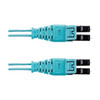
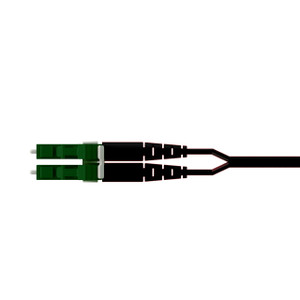
Panduit FZ2ELQ1Q1SNM030 Opti-Core 30m OM4 LC Duplex Fiber Patch Cord
The Panduit FZ2ELQ1Q1SNM030 is a 30-meter OM4 multimode fiber optic patch cord engineered for high-density data center and telecom room interconnects. Featuring precision-polished LC duplex connectors on both ends and laser-optimized 50-micron OM4 fiber, this aqua-jacketed cable delivers verified 10GBASE-SR performance to 550 meters and supports 40/100GBASE-SR4 applications up to 150 meters. The low-smoke zero-halogen (LSZH) jacket meets international fire-safety mandates for enclosed spaces, while factory termination and serialized test reports eliminate field polish variability. Integrators deploy this length for cross-connect runs between main distribution area (MDA) patch panels and horizontal distribution aggregation switches, or for backbone links in multi-row equipment layouts where pre-terminated reliability and insertion-loss consistency are non-negotiable.
Key Features
- OM4 Laser-Optimized 50/125µm Fiber: Supports 10GBASE-SR to 550m, 40GBASE-SR4 and 100GBASE-SR4 to 150m, backward-compatible with OM3/OM2 infrastructure for phased migration to 40/100G networks.
- LC Duplex Push-Pull Connectors: Industry-standard small form-factor interface with positive latching mechanism; fits 24-port LC panels in 1U rack space for maximum port density in confined telecoms and IT closets.
- 30-Meter Engineered Length: Bridges typical data center row-to-row distances (80-100 feet) with margin for cable management pathways, overhead ladder rack routing, and vertical rise to top-of-rack switches without mid-span splicing.
- LSZH Outer Jacket: Low-smoke zero-halogen compound complies with IEC 60332-1/-3 flame propagation and IEC 61034 smoke density limits; required for European EN 50173 installations and recommended for any enclosed or poorly ventilated equipment room.
- Factory-Terminated and Tested: Each cable ships with serialized insertion loss and return loss test data; typical IL ≤ 0.35 dB, RL ≥ 20 dB per TIA-568-C.3 Tier 1 limits, eliminating field termination risk and speeding deployment.
- Aqua Color Coding: OM4 industry-standard jacket color per TIA-598-D allows instant visual identification during troubleshooting and ensures technicians don’t cross-patch OM3 (aqua) with OM2 (orange) fibers in mixed-mode environments.
- Opti-Core Quality Assurance: Panduit’s Opti-Core line undergoes automated interferometric end-face inspection (IFI) at the factory; every connector is verified for geometry (radius of curvature, apex offset, fiber height) and cleanliness (scratch/dig per IEC 61300-3-35) before packaging.
- Pull-Proof Strain Relief: Aramid yarn reinforcement and crimp-boot retention tested to 100N pull force prevent fiber pistoning (connector endface recess changes under tension) that degrades return loss during installation and cable management.
OM4 fiber is the backbone of modern 40G and 100G short-reach optics. Unlike OM3 (2000 MHz·km modal bandwidth at 850nm), OM4 delivers 4700 MHz·km effective modal bandwidth, which translates to lower intersymbol interference and reduced bit-error rates when driving high-speed VCSELs at full lane rates. For a 30-meter link, this headroom matters when you’re running parallel optics (QSFP+ SR4, QSFP28 SR4) that split a 40G or 100G signal across four fiber pairs simultaneously—any modal dispersion on one lane can force the receiver’s forward error correction (FEC) into overdrive, adding latency. The FZ2ELQ1Q1SNM030’s laser-optimized core profile keeps differential mode delay (DMD) below 0.15 ps/m, ensuring all four lanes arrive within the IEEE 802.3ba timing budget. The LC duplex form factor is the de facto standard for 10/40/100G optics; each duplex connector houses two ferrules (transmit and receive) in a single push-pull body, so one patch cord completes a bidirectional link. At 30 meters you’re typically bridging separate fire zones or connecting a core switch in an MDA to distribution switches in horizontal DAs two rows away. The LSZH jacket becomes critical here: PVC jackets release hydrochloric acid and dense black smoke when burning, which corrodes electronics and reduces visibility during evacuations. LSZH compounds use magnesium hydroxide or aluminum trihydrate flame retardants that decompose endothermically (absorbing heat) and release only water vapor and inert metal oxides. European data centers and any facility targeting LEED or BREEAM certification mandate LSZH for all intra-building cabling; even in North America, insurance underwriters and local fire marshals increasingly require it for critical infrastructure rooms lacking dedicated HVAC smoke evacuation.
Typical deployment: In a three-tier leaf-spine fabric, spine switches in the MDA connect to leaf (top-of-rack) switches in each equipment row via OM4 backbone trunks. A 30-meter duplex patch cord is the right length when your rows are 20-25 meters apart and you need an additional 5-10 meters for vertical cable management (floor-to-overhead ladder rack is often 3-4 meters), horizontal tray runs with service loops, and strain relief at both patch panels. Integrators prefer pre-terminated patch cords over field-term solutions because factory polish delivers consistent endface geometry—critical when you’re chasing every 0.1 dB of loss budget on a 100GBASE-SR4 link (IEEE 802.3ba allocates only 1.9 dB for two mated connections plus 30m of fiber; a single poorly polished connector can eat 0.5 dB and push you out of spec). Panduit’s Opti-Core line uses automated curve-polish machines that hold angularity to ±0.2° and undercut (fiber recess) to within 50 nanometers, then inspects every endface with white-light interferometry. You get a printed test report with IL/RL values and a serial number that maps to the production batch—essential for change-management documentation and warranty claims. The aqua jacket color is more than cosmetics: TIA-598-D specifies aqua for OM4, which lets you visually distinguish it from OM3 (also aqua, but earlier standard) and OM2 (orange). In a mixed-mode installation where you’re migrating from 1G to 10G to 40G over several years, color coding prevents a technician from accidentally patching a 100G QSFP28 SR4 transceiver (which expects OM4) into an old OM2 backbone trunk (which will fail the link budget and cause intermittent errors). The LC duplex connector’s push-pull tab is field-replaceable if damaged, but the aramid yarn strain relief and boot crimp are designed to survive hundreds of insertion cycles without loosening—Panduit tests to 500 plug/unplug cycles per IEC 61754-20, far beyond the 200-cycle minimum.
Standards compliance anchors every spec: ISO/IEC 11801 defines the global generic cabling standard for commercial buildings and data centers (OM4 is recognized in Edition 2.2 Amendment 2 as Class OM4); TIA-568-C.3 is the North American equivalent (OM4 appears in the 2008 standard and receives performance updates in subsequent addenda). TIA-604-3 (FOCIS-3) governs SC connector endface geometry, and TIA-604-10 (FOCIS-10) covers LC endface requirements, including radius of curvature (7-25 mm), apex offset (≤50 µm), and fiber height (-300 to +200 nm for multimode). The FZ2ELQ1Q1SNM030 ships with test data proving conformance to all four standards, which satisfies third-party commissioning requirements (BICSI DCDC, Uptime Institute Tier III/IV) and simplifies warranty claims with transceiver and switch vendors who will reject out-of-spec cabling as the root cause during troubleshooting. For commercial integrators managing multi-building campus networks or colocation providers provisioning customer cages, the 30-meter length hits the sweet spot between the 10-15m intra-rack jumpers and the 50-100m inter-buildingOM4 trunks, giving you a single SKU for the majority of MDA-to-DA and DA-to-EDA horizontal distribution runs without excess cable coiling that adds insertion loss and clutter to already congested overhead trays.