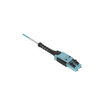
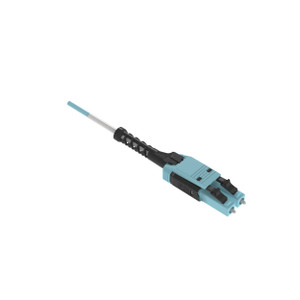
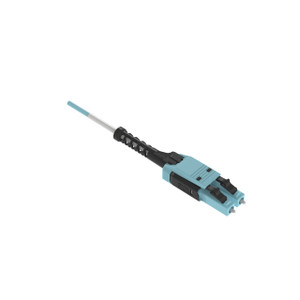
Panduit FS2RLU1U1NNM5.5 OM4+ LC Uniboot Duplex Fiber Patch Cable
The Panduit FS2RLU1U1NNM5.5 is a 5.5-meter duplex OM4+ multimode fiber patch cable engineered for high-density data center and enterprise network deployments running 10GBASE-SR, 40GBASE-SR4, or 100GBASE-SR10 over 850nm wavelength. Built with Panduit Signature Core™ fiber and terminated with space-saving LC Uniboot connectors on both ends, this cable delivers ultra-low insertion loss performance in a compact 2.0mm LSZH jacket. The Uniboot design consolidates two fibers into a single pull-tab boot, cutting patch panel port congestion by half compared to standard duplex LC cables while simplifying polarity reversal during MACs (moves, adds, changes). Designed for structured cabling professionals managing blade server fabrics, SAN storage arrays, or spine-leaf architectures where every RU of rack space and every tenth of a dB matters.
Key Features
- OM4+ Signature Core™ multimode fiber rated for 10G to 550m, 40G to 150m, 100G to 150m at 850nm
- LC Uniboot connectors with integrated polarity flip tab—no re-termination required for A-to-B or crossover configurations
- Ultra-low insertion loss design maximizes link budget headroom in multi-tier data center topologies
- 2.0mm diameter cable reduces pathway fill by 60% vs. 3.0mm zip-cord duplex jumpers
- LSZH (Low Smoke Zero Halogen) jacket meets IEC 60332-1 and 60332-3C flame test requirements for enclosed spaces
- 5.5-meter length suits mid-row to end-of-row runs in 42U racks or cross-aisle connections in hot-aisle containment
- Pull-tab boot design allows single-handed insertion and extraction in high-density 144-port panels
- Aqua jacket color-coding per TIA-598-D standard for instant OM4 identification during troubleshooting
- Factory-terminated and tested to guarantee <0.25 dB insertion loss per connector pair
OM4+ fiber extends the effective modal bandwidth of standard OM4 from 4700 MHz·km to over 5500 MHz·km at 850nm, a critical margin when you're pushing 40GBASE-SR4 or 100GBASE-SR10 to the distance limits in spine-leaf fabrics or storage replication links. Panduit's Signature Core™ manufacturing process tightly controls the fiber's refractive index profile to minimize differential mode delay (DMD), the primary cause of signal dispersion in VCSEL-based multimode links. In practical terms, this means you can reliably run 40G over the full 150-meter OM4 distance spec without encountering the bit error rate spikes that plague cheaper cable assemblies using off-spec fiber. The FS2RLU1U1NNM5.5's ultra-low insertion loss specification—factory-tested and documented on the product label—ensures that even in a three-tier leaf-spine-core architecture with multiple patch points, you'll stay well within the IEEE 802.3's 1.5 dB connector loss budget. This headroom is essential when accounting for aging, dust accumulation, and the occasional re-mate during troubleshooting. For 100G SR10 deployments using breakout MPO-to-LC cassettes, every 0.1 dB you save on the duplex jumper side translates directly to extended reach or the ability to add another tier without active optics.
The LC Uniboot connector design addresses the single biggest pain point in modern data center cabling: port density. A traditional duplex LC jumper with two separate 1.25mm ferrules in a side-by-side boot consumes roughly 12mm of horizontal space at the patch panel; the Uniboot consolidates both ferrules into a single 6.5mm-wide boot, effectively doubling the usable port count on ultra-high-density panels like Panduit's 144-port QuickNet cassettes or Cisco Nexus 9300 line cards with front-to-back airflow constraints. The integrated polarity flip tab is the operational game-changer: instead of swapping A and B legs at the connector (which requires two hands, a flashlight, and usually results in a dropped dust cap), you slide the tab 180 degrees to reverse TX and RX within the boot. This is a one-second operation you can do with gloves on in a cold aisle at 3 AM when a misconfigured link needs a quick crossover fix. The pull-tab boot itself is molded from high-impact plastic with a textured grip surface; in a fully populated 1U panel with cables routed vertically through overhead ladder rack, you can hook the tab with one finger and extract the connector without disturbing adjacent links—a small detail that saves significant time during MACs or when you're tracing a suspect fiber in a bundle of 48.
LSZH jacketing is a non-negotiable requirement in any enclosed or populated space where a cable fire could produce toxic hydrogen chloride or hydrogen fluoride gas from burning PVC. The FS2RLU1U1NNM5.5's IEC 60332-1 and 60332-3C flame test certifications mean the jacket is self-extinguishing and produces less than 0.5% hydrogen halide gas by volume during combustion—well below the threshold that causes respiratory damage or corrodes sensitive electronics. While NEC Article 770 in the U.S. allows OFNP (plenum) or OFNR (riser) PVC-jacketed fiber in most building installations, international data centers, healthcare facilities, transportation hubs, and any project governed by European EN 50173 or ISO/IEC 11801 cabling standards require LSZH as a baseline. The 2.0mm cable diameter is specifically engineered for LSZH compliance without sacrificing flexibility; thicker LSZH jackets (3.0mm and above) often use filler compounds that make the cable stiff and difficult to dress in tight bends, whereas Panduit's 2.0mm construction maintains a minimum bend radius of 30mm (roughly the diameter of a quarter) even under load. This flexibility is critical when routing cables through zero-U vertical managers in a fully populated 42U rack where every cable has to make a 90-degree turn within a 2-inch horizontal space. The reduced diameter also cuts pathway fill: in a 4-inch-wide vertical manager rated for 100 cables, you can fit 160 of these 2.0mm jumpers versus just 100 traditional 3.0mm duplex cables, a 60% capacity gain that defers the need for additional cable management infrastructure.
The 5.5-meter length is purpose-built for mid-depth data center topologies: end-of-row switch to mid-row server (roughly 15 feet of horizontal run plus vertical rise in a 42U rack), cross-aisle connections in hot-aisle containment with overhead cable tray, or leaf-to-spine runs in a two-post relay rack configuration where switches are stacked vertically with 6-8 RU separation. Panduit manufactures this same Uniboot OM4+ assembly in 1m, 2m, 3m, 5m, 7m, 10m, 15m, and 30m lengths, so you can optimize for exact measured distances and avoid the service loop clutter that results from using a 10m cable on a 6m run. The aqua-colored jacket conforms to TIA-598-D's color-coding standard for OM4 fiber, which means your team can visually distinguish it from OM3 (aqua with lighter shade), OS2 singlemode (yellow), or OM5 wideband multimode (lime green) at a glance during troubleshooting or audits. Each cable ships with removable dust caps on both connectors and a serialized product label that includes insertion loss test data, manufacturing date code, and compliance marks—documentation that's required for TIA-606-B labeling standards and invaluable when you're required to produce as-built records for ISO 9001 or SOC 2 audits. This cable is compatible with any LC-interface equipment regardless of vendor, including Cisco, Arista, Juniper, Dell, HPE, and Panduit's own QuickNet fiber systems, and meets all performance requirements of IEEE 802.3, TIA-568.3-D, and ISO/IEC 11801 for OM4 channel insertion loss (≤2.6 dB for a 300m channel including connectors and splices).