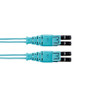
Panduit FZ2ELQ1SNSNM017 OM4 Duplex Fiber Patch Cable LC to SC, 17m
The Panduit FZ2ELQ1SNSNM017 is a factory-terminated OM4 multimode duplex fiber patch cable engineered for high-speed data center and telecommunications applications. Spanning 17 meters (55.8 feet), this LC-to-SC jumper delivers the bandwidth headroom required for 40GBASE-SR4 and 100GBASE-SR10 links up to 150 meters, while maintaining backward compatibility with 10G installations. The 50/125µm laser-optimized fiber and precision PC (physical contact) polish ensure low insertion loss and high return loss, critical for error-free transmission in spine-leaf architectures and cross-connect environments. LSZH jacketing meets fire-safety mandates for enclosed spaces, and the push-pull connector boots simplify moves, adds, and changes in densely populated patch fields.
Key Features
- OM4 Multimode Fiber (50/125µm): Laser-optimized for 40G/100G applications up to 150m; supports 10G links to 550m.
- Factory Pre-Terminated LC & SC Duplex Connectors: Eliminates field-termination labor and ensures consistent factory-tested insertion loss.
- 17-Meter (55.8 ft) Length: Ideal for row-to-row links in data centers, telecommunications room cross-connects, and equipment distribution area (EDA) patch panels.
- LSZH Jacket (Low Smoke Zero Halogen): Meets IEC 60332-1 and 60754 flammability and toxicity standards for plenum-equivalent safety in enclosed pathways.
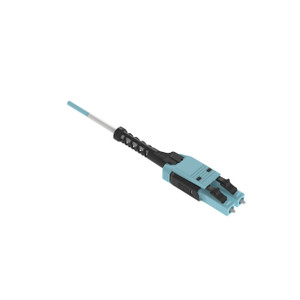
- Push-Pull Connector Boots: Tool-free insertion and extraction in high-density patch panels; reduces accidental disconnects.
- TIA-568.3-D & ISO/IEC 11801 Compliant: Verified performance parameters for structured cabling systems; supports ANSI/TIA-942-B data center infrastructure tier requirements.
- Panduit QuickNet™ Platform: Part of a modular pre-terminated fiber system; pairs with QuickNet cassettes, panels, and enclosures for rapid deployment.
OM4 multimode fiber represents the current industry standard for short-reach datacenter optical links. Its 50-micron core and laser-optimized refractive index profile enable effective modal bandwidth of 4700 MHz·km at 850 nm, approximately three times that of OM3 and twelve times that of legacy OM2 fiber. This bandwidth headroom translates directly into reach: 40GBASE-SR4 operates reliably over 150 meters of OM4, compared to just 100 meters on OM3, giving designers margin to accommodate unforeseen floor-plan changes or equipment repositioning. The FZ2ELQ1SNSNM017's 17-meter length falls into the sweet spot for intra-row and inter-row links in raised-floor data halls—long enough to span typical aisle widths and reach overhead cable trays, yet short enough to avoid the attenuation and handling risks of longer trunk assemblies. Both ends terminate in industry-standard duplex connectors: LC on one side for high-density switch transceivers (SFP+, QSFP28, QSFP56), SC on the other for legacy equipment or patch-panel interfaces still common in telecommunications carrier hotels. The physical-contact (PC) polish on each ferrule achieves endface geometry within 50 nm peak-to-valley, minimizing air gaps and back-reflection that can saturate receiver optics or trigger bit errors in sensitive coherent systems.
Pre-terminated fiber assemblies like this QuickNet™ jumper eliminate the single largest variable in fiber installation quality: field termination. Epoxy-and-polish and mechanical splice techniques depend heavily on technician skill, environmental conditions, and consumable quality; even experienced installers see batch-to-batch variation in insertion loss and return loss. Factory termination under controlled conditions with automated endface inspection delivers consistency that field work cannot match—the difference between a 0.15 dB typical IL and a 0.4 dB outlier can be the margin between a link that passes 100G BER testing and one that requires expensive truck rolls to rework. The LSZH jacket compound is formulated to limit smoke opacity below 60% and halogen acid gas emission below 0.5% when burned, meeting IEC 60332-3C bundle flame propagation requirements. This makes the cable suitable for installation in air-handling spaces, vertical risers, and under-floor plenums without expensive conduit, a crucial cost saver in retrofit projects where existing pathways are already congested. The 1.6 mm round jacket profile is small enough to preserve airflow in perforated floor tiles and structured pathway systems, yet robust enough to withstand the abrasion and pull tension of cable-tray installation and routine maintenance access.
Compliance with TIA-568.3-D and ISO/IEC 11801 ensures that link budgets calculated per these standards will hold in practice—permanent link loss, channel loss, and connector mating performance all fall within the parameters required for IEEE 802.3 Ethernet variants from 1000BASE-SX through 100GBASE-SR4. ANSI/TIA-942-B data center infrastructure standard references these same performance tiers for its structured cabling recommendations, making this jumper a drop-in component for Tier II, III, and IV data halls pursuing TIA-942 certification. The push-pull boot design uses a rigid polymer shroud that surrounds the connector body; installers squeeze the boot rather than pulling on the cable jacket, distributing force evenly and preventing the ferrule-to-housing separation that causes intermittent optical faults. In a 48-port 1U LC patch panel with 1.2 mm port pitch, this seemingly minor detail is the difference between a clean, single-hand disconnect and a fumbling multi-attempt extraction that risks disturbing adjacent links.