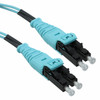
Panduit FX2ERLNSNSNF017 QuickNet OM3 LC Duplex to SC Duplex Fiber Assembly
The Panduit FX2ERLNSNSNF017 is a factory-terminated 17-meter OM3 multimode fiber assembly engineered for integrators who need reliable 10GBASE-SR and 40GBASE-SR4 connectivity between dissimilar equipment platforms. This LC duplex to SC duplex hybrid cable eliminates field termination labor while delivering the connector-face geometry and insertion-loss consistency that only factory polishing can guarantee. The 1.6mm zipcord construction and riser-rated jacket make it suitable for vertical pathways in telecommunications rooms, equipment distribution areas, and intra-building backbone runs where you're connecting newer LC-based switches to legacy SC-equipped storage arrays, routers, or older-generation SAN fabrics.
Key Features
- OM3 50/125µm multimode fiber supports 10 Gbps to 300m and 40 Gbps to 100m per IEEE 802.3ae/ba standards
- LC duplex (one end) to SC duplex (opposite end) hybrid configuration connects equipment with different connector standards
- Factory-terminated with physical contact (PC) polish on all connector end-faces for <0.3 dB typical insertion loss
- OFNR (Optical Fiber Non-conductive Riser) flame rating meets NEC Article 770 for vertical cable runs between floors
- 1.6mm zipcord jacket design allows tight-radius bends in crowded patch panels and cable management trays
- 17-meter length provides flexibility for cross-connect, interconnect, and horizontal distribution scenarios in mid-sized equipment rooms
- Panduit QuickNet factory testing includes end-face geometry inspection and insertion-loss verification per TIA-568.3-D
- Aqua jacket color-coding per TIA-598-D clearly identifies OM3 grade in mixed-fiber-type installations
- Pull-proof strain relief boots protect connector-to-cable transition points during installation and moves/adds/changes
- 100% compatible with existing LC and SC multimode infrastructure—no adapters or mode-conditioning patches required
Hybrid LC-to-SC assemblies solve a common integration challenge: you're deploying new 10G switches with LC interfaces but need to connect them to in-place storage, SAN directors, or older core switches that still use SC connectors. Running two separate cables—LC-LC from switch to panel, then SC-SC from panel to storage—doubles patch-cord count, eats panel density, and introduces an extra mated pair (and extra insertion loss). This Panduit assembly gives you a direct point-to-point link with one cable and two connector transitions instead of four. The OM3 fiber grade supports 10GBASE-SR to 300 meters and 40GBASE-SR4 to 100 meters, so you're future-proofed for 40G upgrades without re-cabling—critical when your backbone conduits are already at 40% fill and pulling new fiber means a building permit and a weekend outage window. The 1.6mm zipcord construction allows 10× cable-diameter bend radius (16mm / 0.63 inches), so you can dress these assemblies through crowded horizontal managers and vertical wire troughs without kinking or stressing the fiber. That bend performance matters when you're retrofitting a telecom room where the existing ladder rack has 2U of vertical clearance between switch and overhead runway.
Factory termination eliminates the field variables that cause high loss and return loss: end-face scratches from contaminated polishing film, off-axis fiber cores from improper cleaving, and epoxy voids from inconsistent cure time. Panduit's QuickNet process uses automated cleaving, precision ferrule insertion, and machine-controlled polish cycles with real-time interferometric inspection of each connector end-face. Every assembly ships with insertion-loss data showing <0.3 dB typical loss per mated pair (well below the 0.75 dB TIA-568.3-D channel budget allocation for one connection), and the PC polish profile ensures physical contact between fiber cores for <–40 dB return loss. That performance consistency means your 10G links train up immediately without bit-error-rate issues, and your 40G QSFP+ transceivers achieve the <–10 dBm receive sensitivity they need for error-free operation. In contrast, field-terminated connectors—even with skilled techs and proper tooling—average 0.5–0.7 dB loss and require on-site OTDR or light-source testing to verify. When you're installing 200 links in a data-center migration cutover window, the labor savings alone (15 minutes per field termination × 400 connector ends = 100 hours) justify the factory-assembly cost premium.
The OFNR riser rating qualifies this cable for vertical runs in non-plenum spaces—telecommunications closets to equipment rooms, floor-to-floor risers in cable shafts, and entrance-facility-to-telecom-room backbone links. OFNR jackets self-extinguish and limit flame spread per UL 1666 riser flame test, meeting NEC 770.154(A) requirements for cables run vertically between floors without being enclosed in metal conduit. This is the appropriate rating for most intra-building backbone applications unless your local AHJ requires plenum (OFNP) rating throughout. The 1.6mm zipcord jacket is non-conductive (all-dielectric construction with no metallic strength members), so you can run this cable in the same pathways as copper LAN and PoE infrastructure without creating ground-loop or lightning-coupling hazards. The zipcord format—two 900µm buffered fibers inside a single flat jacket—splits easily with a fingernail or cable knife when you need to separate the two fibers for strain-relief routing or individual cable management, but stays together during pulls for simpler installation than dual simplex cables.
OM3 multimode fiber (50/125µm core/cladding diameter, 2000 MHz·km effective modal bandwidth at 850nm) is the standard grade for 10G and 40G short-reach applications in enterprise data centers and telecom facilities. It supports 10GBASE-SR (850nm) to 300 meters and 40GBASE-SR4 (850nm, 4-fiber parallel) to 100 meters per IEEE 802.3ae and 802.3ba, covering 95% of intra-building horizontal and backbone distances. The 50µm core diameter matches the mode-field diameter of VCSEL (vertical-cavity surface-emitting laser) transceivers used in 10G/40G SFP+ and QSFP+ optics, ensuring efficient coupling and low insertion loss. The laser-optimized refractive-index profile minimizes differential mode delay (DMD), preventing modal dispersion from closing the eye diagram on high-speed links. This assembly uses aqua-colored jacket per TIA-598-D fiber identification standards, so field techs can instantly distinguish OM3 (aqua) from OM4 (aqua/erika violet), OM2 (orange), and OS2 singlemode (yellow) during troubleshooting or adds/moves/changes. That color-coding prevents the common error of patching 10G optics into OM1/OM2 legacy fiber (which only supports 10G to 33m) and then spending hours troubleshooting intermittent link flaps that are actually caused by insufficient modal bandwidth.
The LC duplex connector format uses two 1.25mm-ferrule connectors in a side-by-side housing with a single push-pull latch, delivering twice the port density of SC connectors in the same panel space. LC is the dominant connector type for 10G/25G/40G/100G data-center switching—most SFP+, SFP28, QSFP+, and QSFP28 transceivers use LC duplex or LC-quad (eight fibers) interfaces. The SC duplex connector on the opposite end of this assembly uses two 2.5mm-ferrule connectors in a side-by-side clip, the legacy standard for 1G and 10G storage, SAN, and telecom equipment installed in the 2000–2015 era. SC connectors use a push-pull latching mechanism (no key or twist-lock), so they're suitable for high-density panels where you need tool-free insertion and removal in tight spaces. Both LC and SC connectors on this assembly use ceramic (zirconia) ferrules with physical-contact (PC) polish—the end-face is slightly domed (10–25mm radius of curvature) so that the fiber cores make physical contact when mated, eliminating the air gap that causes Fresnel reflection and high return loss. PC polish is the standard for multimode links; you don't need angle-polished connectors (APC) unless you're running singlemode analog video or DWDM systems where <–60 dB return loss is required.
This 17-meter length handles typical intra-room cross-connects (rack-to-rack in a telecom closet), short backbone runs (equipment room to adjacent IDF), and horizontal links in mid-sized equipment distribution areas. It's short enough to avoid excess coiling (which wastes pathway space and creates kink risk) but long enough to route around cable trays, over overhead runways, and through vertical managers without pulling tight. When planning your cable lengths, leave 0.5–1.0 meter of service loop at each end for future re-termination or panel relocation, and account for vertical drop (floor-to-rack elevation change) plus horizontal pathway routing—a straight-line 12-meter distance often becomes 17 meters after following the prescribed cable pathways. Panduit manufactures this assembly in 1-meter length increments (identified by the final three digits of the MPN: 017 = 17 meters), so you can order exact lengths for each link and minimize excess cable in your cable management infrastructure.
Compliance with TIA-568.3-D (commercial building fiber cabling), ISO/IEC 11801 (generic cabling for customer premises), and ANSI/TIA-942-B (data center telecommunications infrastructure) ensures this assembly meets the insertion-loss, return-loss, and end-face geometry requirements for structured cabling warranties and equipment-manufacturer support agreements. TIA-568.3-D specifies ≤0.75 dB maximum insertion loss per mated connector pair for multimode patch cords; this Panduit assembly typically measures <0.3 dB, providing 0.45 dB of margin for connector contamination or wear over the cable's service life. The end-face geometry (fiber height, apex offset, radius of curvature) is held to IEC 61300-3-35 limits, ensuring consistent performance across mixed-vendor infrastructure—these Panduit connectors will mate reliably with Corning, CommScope, or Belden panels and patch cords without introducing excess loss from mismatched ferrule profiles. ANSI/TIA-942-B recognition matters for data-center projects where you're pursuing Tier III or Tier IV certification: the standard requires factory-terminated fiber assemblies (not field-term) for main distribution area and horizontal distribution area permanent links, and auditors will verify that your patch cords carry TIA-568.3-D compliant test data.
Panduit's QuickNet factory-terminated assemblies are built in an ISO 9001-certified facility with automated processes that eliminate the human variables in field termination: inconsistent epoxy application, off-center fiber positioning in the ferrule, and non-uniform polishing pressure. Each connector undergoes interferometric end-face inspection (IFI) to verify fiber height relative to the ferrule end-face (<0–50nm undercutting for PC polish), apex offset (<50µm), and radius of curvature (10–25mm dome). The cable-to-connector transition is strain-relieved with a pull-proof boot that protects the 900µm buffer tube from tensile stress during installation and prevents the fiber from being pulled out of the ferrule under lateral load. Every assembly ships with a serialized test report showing insertion loss at 850nm and 1300nm wavelengths, so you have documentary evidence of performance for structured cabling warranty claims or customer acceptance testing. That factory test data also establishes a baseline for future troubleshooting—if a link starts throwing errors three years after installation, you can compare current insertion-loss readings against the as-shipped values to determine whether the problem is connector contamination (loss increased by >0.5 dB), fiber damage (loss increased by >1.0 dB), or transceiver failure (loss unchanged but link still down).
For IP-based physical security systems integrating fiber backhaul, this assembly provides a reliable method to connect LC-based managed PoE switches (feeding IP cameras via fiber uplinks) to SC-equipped core switches or fiber aggregation points in enterprise networks. The OM3 grade supports the 10G uplink speeds needed when you're backhauling 32–48 PoE ports of 4K/8MP camera traffic (average 8–12 Mbps per camera × 40 cameras = 480 Mbps sustained, with 2–3 Gbps peak during simultaneous motion events). The riser rating allows you to run these assemblies vertically between security-equipment rooms and network operation centers without plenum-rated enclosures, reducing installation cost in retrofit projects. The factory termination and test data satisfy the integration-company quality standards required for enterprise and government projects where the contract specifies "factory-terminated fiber infrastructure with insertion-loss test certification."