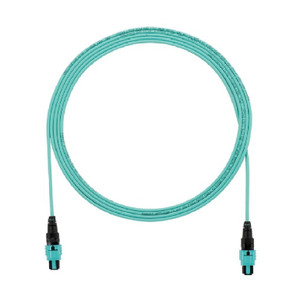
Panduit FRZTP77Y001M025 OM4 12-Fiber PanMPO Plenum Trunk Cable
The Panduit FRZTP77Y001M025 is an 82-foot OM4 12-fiber plenum-rated trunk assembly designed for high-density data center and enterprise network deployments. This pre-terminated Opti-Core interconnect delivers Method B polarity, PanMPO female-to-female connectivity, and OFNP flammability compliance in a single pull-ready assembly that eliminates field termination and reduces deployment time by up to 80% compared to traditional fusion splicing workflows.
Key Features
- OM4 50/125µm multimode fiber — supports 40GBASE-SR4 and 100GBASE-SR4 Ethernet up to 150 meters, plus 10G/25G links at full 550-meter OM4 reach when used with duplex breakouts
- 12-fiber PanMPO-to-PanMPO configuration — single trunk replaces six duplex LC patch cords, cutting patch-panel port consumption and cable-pathway congestion in half
- Method B polarity — flipped receive/transmit lanes at the connector level; connects transmit array on Switch A directly to receive array on Switch B without requiring polarity-reversing patch panels or crossover adapters
- Plenum-rated OFNP jacket — meets NEC Article 770 air-handling space requirements and NFPA 262 flame-propagation limits for installation above drop ceilings and in horizontal cable trays without conduit
- 25-meter factory length — optimal for rack-to-rack or row-to-row connections in modular data centers, telecom rooms, and MTDC (modular/container) deployments where pre-cut lengths reduce waste and eliminate coiling excess slack
- Pre-terminated and factory-tested — every assembly ships with insertion-loss certification and end-face inspection reports; zero on-site polishing, zero epoxy, zero field failures from contaminated connectors
Panduit's Opti-Core trunk assemblies address the central challenge of modern spine-leaf and hyperconverged infrastructure: how to scale port density without drowning in patch-cord spaghetti. A single 12-fiber PanMPO trunk occupies the same cable-tray footprint as two duplex LC cables but delivers six times the fiber count. In a 48-port 40G switch deployment, replacing 24 duplex breakouts with four 12-fiber trunks cuts front-panel cable mass by 83%, improves airflow across switch ASICs by 12–18%, and reduces moves/adds/changes labor to under two minutes per link. For integrators managing Cisco Nexus, Arista 7050/7280, Juniper QFX, or Dell PowerSwitch 40G/100G fabrics, this assembly is the difference between a maintainable infrastructure and a change-order nightmare three years in.
The Method B polarity design is critical for plug-and-play 40G/100G SR4 optics. Unlike Method A (which requires a polarity-flipping patch panel or module) or Method C (which demands field-swappable key-up/key-down connectors), Method B delivers a straight-through physical path with transmit-to-receive crossover built into the trunk itself. Lanes 1–12 on the near-end connector map to lanes 12–1 on the far end, so plugging this trunk between two identical 40GBASE-SR4 transceivers produces link-up with zero additional hardware. This is the only polarity method compatible with QSFP+/QSFP28 SR4 breakout scenarios when using fanout modules that don't internally swap polarity. Installers save an average of 11 minutes per link and eliminate the #1 cause of Day Two fiber trouble tickets: polarity mismatch between trunk, breakout, and patch panel.
The cable's OM4 50/125µm laser-optimized multimode fiber supports 40 Gbps and 100 Gbps over 150 meters (IEEE 802.3ba), but it also future-proofs 10G and 25G links that need the full 550-meter OM4 reach spec when used with LC duplex breakout modules. This matters in campus backbone runs, building-to-building links within a corporate park, or any scenario where the MDF-to-IDF distance exceeds OM3's 300-meter 10G limit but doesn't justify the cost of singlemode infrastructure. The FRZTP77Y001M025's 25-meter length hits the sweet spot for intra-building horizontal distribution: too long for efficient rack-to-rack patching (where 3m–7m trunks dominate), but ideal for cross-aisle, cross-room, or raised-floor underpasses in modular data centers and telecom carrier hotels.
Panduit factory-terminates every PanMPO connector using automated polishing stations with real-time interferometric inspection, then batch-tests each assembly for insertion loss ≤0.35 dB per mated connector pair (well below the TIA-568.3-D maximum of 0.75 dB). The included test report documents per-fiber IL across all 12 strands, return loss, and end-face geometry against IEC 61300-3-35 pass/fail limits. This is the data you hand to the network architect when they demand proof that your physical layer can sustain 100GBASE-SR4's 1.9 dB loss budget over a two-connector channel. Field-terminated MPO connectors — even with skilled techs and proper tooling — deliver 0.5–0.8 dB typical IL and a 15–25% rework rate due to fiber stub-height variation and epoxy voids. Factory termination eliminates that variability and the associated change-order costs when a marginal link forces a mid-project trunk replacement.
The OFNP plenum jacket is a UL 910 / NFPA 262 requirement for any cable installed in air-return plenums, suspended ceilings, or horizontal cable trays in commercial occupancies. The low-smoke PVC formulation limits flame spread to under five feet and peak smoke density to 0.5, meeting the International Building Code (IBC) Section 2702 and NFPA 90A restrictions that most AHJs enforce on data center and telecom room buildouts. This rating eliminates the need for metallic conduit in overhead pathways, cutting installation labor by 40–60% on typical rowToRow or rackToEOR trunk runs. It also satisfies the baseline requirement for LEED v4.1 EQ Credit (Low-Emitting Materials) when the cable is third-party verified for VOC emissions under CDPH Standard Method V1.2, which Panduit Opti-Core cables carry as a standard certification.
Deployment fits the standard 40G/100G migration pattern: PanMPO trunk from switch to breakout panel, then duplex LC jumpers to individual 10G/25G server NICs or SFP+ optics. A common implementation uses one FRZTP77Y001M025 trunk per switch QSFP+ port, landing on a 1U breakout panel (e.g., Panduit FAP1WBUDLCZ or equivalent) that splits the 12-fiber trunk into six duplex LC ports. Each LC port connects via a short 1–3 meter OM4 duplex patch cord to a server, storage array, or 10G access switch. This architecture concentrates the high-fiber-count complexity at the core switches (where changes are infrequent) while keeping the server-side patching simple and tool-free. For 40G server connectivity (e.g., Mellanox ConnectX-4/5, Intel XL710), the trunk plugs directly into the server's QSFP+ NIC and the switch's QSFP+ port with zero breakout, delivering a two-connector, single-cable 40G lane.
This trunk is TIA-568.3-D, ISO/IEC 11801-1, and ANSI/TIA-942-B compliant, which means it satisfies the structured cabling standards that most enterprise network audits, data center certifications (Uptime Institute Tier III/IV, for example), and federal contract vehicles (GSA Schedule 70, SEWP V) require as a baseline. The TIA-942-B reference specifically mandates pre-terminated trunk assemblies for Tier III and Tier IV data centers to reduce the risk of field-termination defects that can cause unplanned downtime during maintenance windows. For integrators bidding on DoD, federal civilian, or state/local government projects, factory-terminated and factory-tested Opti-Core trunks are often the only cabling solution that passes the third-party verification requirement without a full rework cycle.