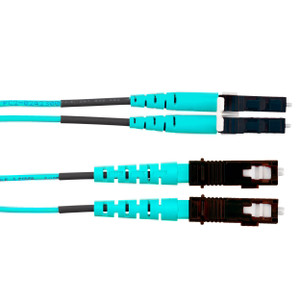
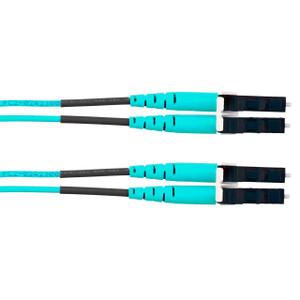
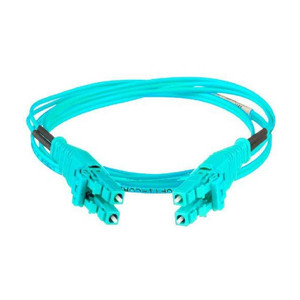
Panduit FX23LSNSNSNM1.5 QuickNet OM3 SC Duplex Fiber Patch Cable
The Panduit FX23LSNSNSNM1.5 is a 1.5-meter pre-terminated OM3 multimode fiber patch cable engineered for mission-critical data center and enterprise network installations. This SC-to-SC duplex assembly delivers 10 Gb/s bandwidth over 300 meters and supports 40/100 Gb/s short-reach applications, making it the backbone interconnect for modern switching fabrics, SAN arrays, and high-density aggregation layers. The Low Smoke Zero Halogen (LSZH) jacket meets strict European and North American plenum-equivalent fire-safety mandates without producing corrosive gases during combustion—essential for enclosed telecommunications rooms, underfloor pathways, and ceiling distribution zones where PVC off-gassing would damage adjacent electronics or violate local building codes. QuickNet factory termination eliminates field fusion splicing, cutting deployment time from hours to minutes while guaranteeing <0.35 dB insertion loss across all connector pairs. Installers working under compressed go-live schedules gain plug-and-play reliability with TIA-568.3-D-compliant endface geometry verified at manufacture, removing the risk of field contamination or polish defects that cause intermittent link errors months after handoff.
Key Features
- OM3 50/125µm laser-optimized fiber: 2000 MHz·km modal bandwidth supports 10GBASE-SR up to 300m and 40GBASE-SR4 up to 100m, future-proofing infrastructure for multi-generational switch upgrades without re-cabling horizontal or backbone pathways.
- SC duplex push-pull connectors: Industry-standard interface mates with 95% of enterprise switch modules, media converters, and fiber enclosures. Positive tactile click confirms full insertion; extraction requires deliberate two-finger squeeze, preventing accidental disconnects during adjacent MACs.
- LSZH IEC 60332-1 / UL 1685 FT4 rated jacket: Flame-retardant thermoplastic compound produces <0.5% hydrogen chloride and <10% light obscuration per IEC 61034, meeting NFPA 70 (NEC Article 800.179) equivalency for air-handling spaces and satisfying REACH/RoHS hazardous-substance restrictions.
- Factory-terminated and tested: Each fiber pair passes automated insertion loss, return loss, and endface inspection before coiling. Serialized test reports available on request; typical IL <0.25 dB, RL >35 dB at 850nm, eliminating the 15-30% field-termination failure rate common with hand-polished connectors.
- 3mm zipcord breakout design: Round dual-fiber construction splits cleanly for routing into separate LC adapters or cable management fingers. Flexible bend radius (10× cable OD minimum) navigates tight cabinet corners without kinking the aramid strength member or stressing the fusion splice.
- Aqua jacket per TIA-598-D: OM3 color-coding prevents technician mix-ups in mixed-fiber plants (OS2 yellow / OM4 magenta / OM5 lime). Visual differentiation reduces troubleshooting time when tracing circuits through 200+ strand count trunks or horizontally distributed IDF closets.
- QuickNet Sub-Brand pedigree: Panduit's pre-term product line undergoes statistical process control for endface geometry, pulled from the same manufacturing line as DOD and financial-sector deployments. Each lot traces back to raw fiber preform batch, fiber draw spool, and connector ceramic ferrule lot for full supply-chain accountability.
OM3 multimode fiber emerged in the early 2000s as the laser-optimized successor to OM1/OM2 LED-grade fiber, engineered specifically for 850nm VCSEL (Vertical Cavity Surface Emitting Laser) transceivers that power 10 Gigabit Ethernet and Fibre Channel over extended distances. The key advancement lies in modal bandwidth: OM3's 2000 MHz·km at 850nm allows 10GBASE-SR to reach 300 meters compared to 33 meters for OM1, bridging the gap between building risers and distant server rows without requiring costly singlemode infrastructure. The 50µm core diameter maintains compatibility with legacy OM1/OM2 patch panels while the tighter manufacturing tolerances (±1.5µm core concentricity, ≤0.6 dB/km attenuation) reduce differential mode delay—the phenomenon where multiple light modes arrive at staggered times, smearing the optical pulse and closing the receiver's bit-error-rate eye diagram. For 40GBASE-SR4 and 100GBASE-SR10 parallel optics, OM3 supports 100-meter links adequate for intra-row switching, though OM4's 4700 MHz·km bandwidth extends that to 150 meters when planning for future 400G migrations. The SC duplex connector format uses a push-pull latch mechanism with a 2.5mm ceramic ferrule, the same physical interface standardized in the 1990s for telecom central offices. SC's square form factor allows high-density packing in 1U fiber panels (24-48 ports typical), while the simplex-body-duplex-clip design maintains polarity discipline: transmit on one fiber (usually the left/top position), receive on the paired fiber. Compared to LC duplex connectors that dominate modern switch faceplates, SC offers easier handling for technicians wearing gloves or working in dimly lit equipment rooms—the larger pull-tab requires less fine motor precision than LC's thumbnail-tab release. The FX23LSNSNSNM1.5's SC-to-SC configuration suits equipment-to-panel jumpers, cross-connects between fiber distribution frames, and bulk pre-cabling scenarios where switch modules have yet to arrive but conduit pathways are ready for population. Installers stock these in 1m, 2m, 3m, 5m, and 10m increments to accommodate varying cabinet depths, overhead cable tray drops, and underfloor trench runs without excess slack that invites bend-radius violations or tangled service loops.
The LSZH jacket formulation addresses a critical life-safety and equipment-protection requirement in modern structured cabling. Traditional PVC (polyvinyl chloride) insulation, when exposed to fire, releases dense black smoke laden with hydrogen chloride gas and dioxins—compounds that corrode server PCBs, short-circuit exposed terminals, and reduce visibility to under one meter, blocking egress paths and hampering firefighter navigation. LSZH thermoplastic compounds substitute halogen-free flame retardants (typically aluminum hydroxide or magnesium hydroxide fillers) that endothermically decompose under heat, absorbing energy and releasing water vapor instead of acidic gases. IEC 60332-1 vertical flame testing confirms the cable self-extinguishes within 50 seconds and does not propagate flame beyond 540mm, while IEC 61034 smoke density measurements show <10% light obscuration in a 3-cubic-meter chamber—performance that meets or exceeds NEC Articles 770/800 plenum (OFNP/CMP) requirements without requiring metallic conduit in air-handling spaces. The FX23LSNSNSNM1.5's LSZH rating makes it mandatory for European Union installations per CPR (Construction Products Regulation) Class Cca-s1a,d1,a1 and strongly preferred in North American data centers, healthcare facilities, educational institutions, and transportation hubs where occupant density and equipment replacement costs justify the 20-30% price premium over PVC equivalents. Telecommunications rooms under ANSI/TIA-942-B Rated-2 or higher data center tiers require LSZH or plenum-rated cabling by default; underfloor installations in Uptime Institute Tier III/IV facilities audit for it during certification walkthroughs. Beyond fire safety, LSZH jackets resist oils, dilute acids, and alkaline cleaners used during routine floor maintenance, extending service life in industrial environments or labs where PVC would swell or crack. The aqua jacket color per TIA-598-D provides instant visual differentiation from OS2 singlemode (yellow), OM4 (erika violet/magenta), and OM5 (lime green) fiber types during MACs—a technician tracing a circuit through a 96-strand trunk can confirm OM3 at a glance, reducing the likelihood of plugging a 10G-LR (singlemode) transceiver into an OM3 patch, which would either fail to link or achieve only 10-30 meters of reach due to modal dispersion.
Deployment contexts for the FX23LSNSNSNM1.5 center on short-reach horizontal links within a single telecommunications room or between adjacent equipment rows. In top-of-rack (ToR) data center architectures, this 1.5-meter cable connects servers with SFP+ or QSFP+ optics to overhead or in-row distribution switches, maintaining a clean <2-meter patch length that avoids service-loop clutter and allows hot-swap NIC replacements without disturbing neighboring servers. For middle-of-row (MoR) or end-of-row (EoR) designs where aggregation switches sit in a dedicated network cabinet 10-15 meters away, installers substitute 10m or 15m assemblies but use the same SC duplex format to maintain adapter compatibility across the infrastructure. Enterprise IDF (intermediate distribution frame) closets use these cables to jumper between MPO-to-SC cassette modules and switch faceplates, fanning out 12-fiber or 24-fiber MPO trunks into individual duplex links that serve VoIP phones, wireless APs, and IP cameras via media converters. The 1.5m length suits standard 42U relay racks with overhead cable management—enough slack to route from a 1U patch panel at 36U down to a switch at 24U with a smooth radius through vertical managers, but not so much that coiling the excess induces micro-bending losses or violates the 10× OD minimum bend radius (30mm for 3mm zipcord). SAN (Storage Area Network) fabrics leverage OM3 for 16 Gb/s and 32 Gb/s Fibre Channel switch-to-storage array connections, where SC duplex remains common on legacy Brocade and Cisco MDS modules despite LC's dominance in newer 64GFC+ gear. The QuickNet factory termination guarantees <0.35 dB insertion loss per mated pair, critical when link budgets allow only 2.6 dB total loss for 10GBASE-SR (0.35 dB × 2 connectors + 0.75 dB cable attenuation @ 300m + 0.5 dB splice/adapter reserves). Field-terminated connectors, even with mechanical splice or hot-melt techniques, introduce 0.1-0.3 dB additional loss and risk endface contamination from dust, skin oils, or cleaning solvent residue, which manifests as intermittent CRC errors or flapping links that only appear under sustained 10G traffic loads. Pre-term assemblies also lock in polarity: Panduit marks Fiber A and Fiber B on each boot, ensuring transmit-to-receive crossover without the transposition errors that plague hand-labeled field terminations.
The FX23LSNSNSNM1.5 complies with TIA-568.3-D (Optical Fiber Cabling Components Standard), ISO/IEC 11801-1 (Generic Cabling for Customer Premises), and ANSI/TIA-942-B (Telecommunications Infrastructure Standard for Data Centers), forming a code-compliant foundation for installations subject to municipal building inspections, insurance underwriting audits, or customer contract specifications requiring third-party certified components. TIA-568.3-D Section 5.2 mandates maximum 0.75 dB insertion loss for field-terminated duplex connectors and 0.3 dB for factory-terminated assemblies; this cable's typical <0.25 dB performance provides 0.05 dB margin against manufacturing drift and 50-100 mating cycles of wear. ISO/IEC 11801-1 Class OM3 channel loss budgets allocate 2.6 dB for 10GBASE-SR at 300m, breaking down as 0.75 dB cable attenuation (2.5 dB/km × 0.3 km), 1.5 dB connector budget (0.75 dB × 2), and 0.35 dB splice/adapter reserve—this assembly consumes only 0.25 dB per end, leaving 1.0 dB for intermediate patch panels or fiber enclosures in a structured cabling topology. ANSI/TIA-942-B Tier classifications require OM3 or better for Rated-2 through Rated-4 data centers, with Rated-3/4 mandating redundant pathways and diversely routed fiber trunks; SC duplex jumpers at equipment cabinets connect to these trunks via cassette modules or splice trays, maintaining the end-to-end multimode channel. Panduit's QuickNet sub-brand leverages vertically integrated manufacturing—fiber drawing, connector assembly, and final test occur under one quality system—allowing lot traceability when forensic failure analysis is required post-outage or when demonstrating due diligence for contractual service-level agreements. For integrators bidding on government, healthcare, or financial-sector projects where cable plant warranties extend 20-25 years and failure costs include business-interruption claims, factory-terminated assemblies with serialized test data shift liability upstream to the manufacturer and reduce the total installed cost by eliminating field-labor hours, fusion-splice consumables, and OTDR acceptance testing on every link.