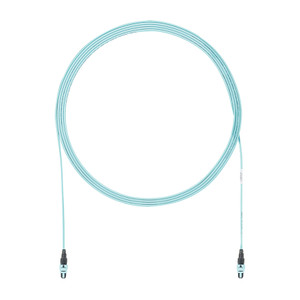
Panduit FRXTP77Y001F072 Opti-Core OM3 12-Fiber Plenum Trunk Cable
Pre-terminated fiber trunk cable engineered for datacenter and telecommunications infrastructure where deployment speed, polarity accuracy, and long-term 10/40/100G performance are non-negotiable. This Panduit Opti-Core assembly delivers twelve OM3 50/125µm multimode fibers in a plenum-rated jacket, factory-terminated with duplex LC connectors on both ends in Type B polarity configuration. At 72 feet (21.9 meters), it bridges equipment racks, cross-connects, and zone distribution boxes without field termination—eliminating on-site fusion splicing, connector installation labor, and the variability that comes with field work. Factory testing certifies every fiber path for insertion loss and return loss before it ships, so you're installing a known-good link rather than building one under schedule pressure in a live facility.
Key Features
- OM3 50/125µm multimode fiber — 10GBASE-SR to 300m, 40GBASE-SR4 to 100m, 100GBASE-SR4 to 100m per IEEE 802.3
- 12-fiber count (six duplex LC pairs) — supports six independent 10G links or three 40G/100G parallel optics channels
- Type B polarity — key-up/key-down reversal maintains proper Tx-to-Rx pairing in structured duplex systems without crossover adapters
- Plenum-rated OFNP jacket — UL 910 / NFPA 262 compliant for air-handling spaces, no conduit required in rated plenums
- Factory-terminated and tested — each fiber path verified for <0.35 dB insertion loss typical, eliminating field termination risk and cutting installation time by 70% versus pull-and-terminate
- 72-foot length — pre-measured for common row-to-row, rack-to-MDA, or floor-to-floor applications in enterprise datacenters and telecom central offices
Panduit's Opti-Core construction uses precision-polished LC connectors in a ruggedized boot assembly that survives the install cycle—cable pulls through overhead pathways, repeated connection cycles during testing, and the physical abuse of densely packed patch panels. The duplex LC form factor is the de-facto standard in SFP+ and QSFP+ transceiver modules across Cisco, Arista, Juniper, Dell, and HPE switching platforms, so this trunk integrates into your existing 10G/40G/100G infrastructure without adapter plates or break-out cassettes. OM3 laser-optimized 50/125µm fiber provides the modal bandwidth necessary for 10GBASE-SR at full 300-meter reach and 40/100GBASE-SR4 at 100 meters—adequate for intra-building horizontal runs and most riser applications in multi-tenant datacenter facilities. The aqua jacket color-coding matches TIA-598 and ISO/IEC 11801 conventions for OM3, simplifying visual audits and preventing cross-patching errors when you're managing mixed OM2/OM3/OM4/OS2 infrastructure in the same cable trays.
Type B polarity is the critical detail for duplex fiber systems. In a structured cabling deployment, you need Tx on one end to hit Rx on the far end without manual fiber flipping. Panduit's Type B configuration uses a key-up to key-down orientation flip—connector A is keyed up on end 1 and keyed down on end 2, while connector B is keyed down on end 1 and keyed up on end 2. This maintains the A-to-B fiber pairing required by IEEE 802.3 duplex auto-negotiation and works with standard Type A patch cords (straight-through key orientation) at both the equipment and cross-connect ends. You don't need polarity-reversing cassettes or MPO-to-LC modules unless you're converting from 12-fiber or 24-fiber MPO backbone trunks—this assembly is ready for direct equipment connection in a TIA-568.3-D compliant link. For installations using Type A end-to-end topology or Type C universal polarity systems, verify your cross-connect architecture before deployment; mixing polarity schemes creates Tx-Tx / Rx-Rx mismatches that fail link negotiation and waste troubleshooting time in production cutovers.
The plenum jacket meets NFPA 262 flame and smoke requirements, allowing installation in return-air plenums, drop-ceiling voids, and raised-floor environments without metallic conduit. This is the rated pathway in 90+ percent of commercial office builds and colocation datacenters—if your AHJ interprets NEC Article 770 to require plenum cable in those spaces, you need OFNP. The Panduit jacket is also low-smoke zero-halogen (LSZH) compatible for international deployments under IEC 60332-1 and IEC 61034, though this specific SKU is optimized for North American NEC installations. The cable's 3.0mm zipcord breakout diameter keeps bend radius manageable in high-density ladder rack and vertical cable managers—you can route this trunk through 1.5-inch radius corners without kinking the fiber or stressing the connector boots, which is tight enough for most Panduit and Chatsworth vertical managers in 42U and 48U racks.
Factory termination eliminates the three failure modes you get with field work: epoxy voids in adhesive-polish connectors, cleave angle errors in mechanical splice connectors, and fusion splice attenuation from contamination or arc misalignment. Every Panduit Opti-Core assembly leaves the factory with insertion loss ≤0.35 dB typical (≤0.50 dB max) and return loss ≥-40 dB, tested per IEC 61300-3-4 and IEC 61300-3-34. That's a channel-grade link before you add any mating adapters or bulkhead couplers—your total end-to-end loss budget for a 10GBASE-SR link is 2.6 dB per IEEE 802.3, and this trunk consumes less than 20% of that budget across 72 feet. Compare that to field-terminated LC connectors, which average 0.5–0.75 dB each when installed by qualified techs and can hit 1.2+ dB if the cleave is off or the polish pressure is inconsistent. In a 12-fiber trunk, that variability multiplies—factory termination gives you twelve known-good fiber paths with single-digit picofarad variability, not a statistical distribution where two of the twelve are marginal and one might fail certification.
This cable is sized for the 60–80 foot distance range common in datacenter row-to-EOR (end-of-row) topologies and equipment-to-MDA (main distribution area) links in structured telecom rooms. In a raised-floor environment, 72 feet covers a straight-line pull from a row of compute racks to a centralized core switch array two rows over, plus vertical rise to overhead pathways and service loops at both ends. For installations requiring longer reaches—say, floor-to-floor riser links in a multi-story building or campus backbone runs between buildings—Panduit manufactures this same Opti-Core trunk in lengths up to 300 feet (OM3's maximum 10G reach) and offers OS2 singlemode variants for 10G/40G/100G links beyond 300 meters. If you're designing a spine-leaf fabric or a storage-area-network cluster, coordinate your trunk lengths with your physical layout during the design phase; over-length trunks create service-loop bulk that wastes U-space and airflow, while under-length trunks force you into unplanned patch-cord daisy chains that burn your loss budget and add failure points.
Deployment is plug-and-certify. Pull the trunk through your pathway—overhead J-hooks, vertical managers, or under-floor grommets—secure it with Velcro straps every 4–6 feet per BICSI TDMM guidelines (never zip-ties on fiber; the pinch stress microcracks the glass), dress the service loops at both ends, and mate the connectors into your bulkhead adapters or equipment SFP+ cages. If you're connecting directly to switch modules, clean the ferrule endfaces with lint-free wipes and isopropyl alcohol, then inspect under a fiber microscope for contamination—Panduit ships these with dust caps, but they sometimes pop off in transit. Once connected, verify link light, then run an OTDR or light-source/power-meter certification test to confirm <0.5 dB end-to-end loss and document the as-built insertion loss for your O&M records. For mission-critical links—SAN fabrics, inter-switch links in a redundant core, or fiber-to-the-desk drops supporting 10G workstations—label both ends with the Panduit embossed tag system or Brady-style vinyl labels showing circuit ID, far-end termination point, and fiber count, so the next tech doesn't yank the wrong cable during a MAC event two years from now.
This trunk complies with TIA-568.3-D for commercial building telecommunications cabling, ISO/IEC 11801 for international structured cabling, and ANSI/TIA-942-B for telecommunications infrastructure in datacenters. It's tested to IEC 61300-2-4 for mating durability (500 insertions minimum), IEC 60794-1-2 for temperature cycling (-20°C to +60°C operating range), and Telcordia GR-326-CORE for mechanical shock and vibration—standards that matter when your cable is running through a plenum that hits 40°C in summer or when it's supporting a live 40G iSCSI link that can't go down during business hours. Panduit's Opti-Core line is backed by a 20-year manufacturer warranty when installed per TIA-568 guidelines and registered within 90 days of installation, covering materials, workmanship, and transmission performance—rare for a factory-terminated assembly and a hedge against the total cost of a failed link in a production environment.