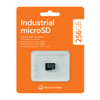
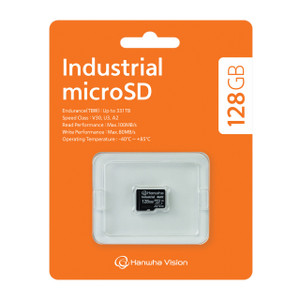
Hanwha SPP-E256G 256GB Industrial MicroSD Card
The Hanwha SPP-E256G is a 256GB microSDxC card engineered for continuous surveillance recording in edge storage deployments where temperature extremes or moisture exposure would degrade consumer-grade memory. This is not a general-purpose card — it solves a specific problem: onboard recording redundancy in Hanwha IP cameras operating in arctic outdoor sites, sealed enclosures with condensation risk, or high-heat industrial environments where standard microSD cards fail within weeks.
Key Features
- 256GB capacity — supports 10+ days of continuous 1080p recording per camera without network dependency. Meaningful for sites with intermittent connectivity or as a failsafe when your NVR goes down. A 4MP camera at 4 Mbps (H.265) fills roughly 1.8 GB per day, so 256GB holds approximately 140 days of single-camera continuous recording.
- Operating range: -40°C to +85°C — the critical differentiator. Consumer cards typically spec -25°C to +85°C and fail in cold environments. The SPP-E256G handles arctic deployments and interior sealed dome housings in summer heat without thermal throttling or bit corruption. Industrial facilities with extreme ambient temperature swings stay stable.
- V30/U3/A2 speed class with 80 MB/s sustained write — guarantees minimum 30 MB/s write throughput. At 25 Mbps per 4MP stream, you can reliably record 3+ simultaneous 4MP cameras per card without frame loss or stutter. Write speed is the constraint in continuous 24/7 recording; 80 MB/s handles multi-stream workloads without bottlenecks.
- 100 MB/s read, 80 MB/s write performance — read speed enables fast bulk export or forensic review without waiting for data offload. Write speed is the limiting factor in surveillance duty; 80 MB/s is sufficient for concurrent multi-camera streams.
- IPx7 immersion protection — rated for submersion up to 1 meter for 30 minutes. Protects the card itself in sealed housings, coastal spray-wash environments, or high-humidity facilities where condensation pools on electronics. Card-level water resistance eliminates moisture as a failure vector.
- 663 TB total bytes written (TBW) endurance rating — surveillance-grade wear leveling. At 100 MB/s sustained writes, that's roughly 1,800+ hours of continuous recording per card before wear-out — or 75+ days of nonstop writing. Real insurance against premature failure in write-intensive duty cycles. Consumer cards often cap at 200–300 TBW.
- IEC 61000 electromagnetic immunity compliance — ESD, RF interference, and power frequency immunity mean the card won't corrupt data when deployed near high-voltage industrial equipment, VFD drives, or noisy electrical panels.
Why This Card Over Consumer Alternatives
A standard Kingston or SanDisk microSD costs half as much and looks identical. But in -30°C or +65°C sealed environments, that savings evaporates after a single field failure and emergency on-site replacement. The SPP-E256G eliminates temperature as a reliability risk — it's tested and rated for thermal stress that would degrade a consumer card's NAND flash in weeks. The 663 TBW endurance spec reflects industrial wear-leveling algorithms; consumer cards rarely exceed 200–300 TBW.
Deploy this card if you're retrofitting edge storage into Hanwha cameras in temperature-extreme sites, you need 24/7 onboard recording with zero network dependency, or you're supporting high-humidity sealed enclosures where condensation has historically caused data loss. For planning, consult a surveillance storage retention guide to calculate multi-camera retention periods and card stack sizes.
Integration & Compatibility
Compatible with all Hanwha IP cameras and NVRs with microSD card slots. Form factor is standard microSDxC (11 × 15 × 1.0 mm); no proprietary adapters required. Pre-format the card in your camera using the camera's native format utility to ensure proper wear leveling and initialization — do not format on a laptop or desktop PC, as that may bypass industrial wear-leveling routines.
In multi-camera edge deployments, stack capacity across multiple cards or rotate cards on a scheduled basis to maximize lifespan. The SPP-E256G (often searched as SPP E256G) integrates seamlessly into existing Hanwha camera and NVR workflows without additional drivers or configuration.
Frequently Asked Questions
Q: How does the 256GB capacity translate to days of recording?
A: A 4MP camera recording at 4 Mbps (H.265 compression) generates approximately 1.8 GB per day. The SPP-E256G holds roughly 140 days of single-camera continuous recording. Multi-camera deployments require proportional capacity or card rotation schedules.
Q: Why does the -40°C to +85°C operating range matter?
A: Consumer microSD cards typically spec -25°C minimum and fail or corrupt data in arctic or sealed-enclosure heat environments. The SPP-E256G maintains reliability across extreme temperatures, eliminating thermal failure as a deployment risk in outdoor or industrial sites.
Q: What does IPx7 immersion protection protect against?
A: IPx7 means the card itself withstands submersion up to 1 meter for 30 minutes. This protects the card in high-humidity sealed housings, coastal spray environments, or wash-down facilities where condensation historically caused data loss. It does not rate the camera housing — only the card itself.
Q: Can I use this card in non-Hanwha cameras or laptops?
A: Yes. The SPP-E256G is a standard microSDxC card and works in any device with a microSD slot. However, it is optimized for continuous surveillance recording in Hanwha cameras. Other devices may not leverage the industrial wear-leveling firmware or derive the full endurance benefit.
Q: What is the difference between 80 MB/s write and 100 MB/s read speed?
A: Write speed (80 MB/s) determines how fast data is recorded to the card during continuous surveillance — this is the limiting factor in 24/7 recording. Read speed (100 MB/s) determines how fast you can offload or review recorded footage. Both are sufficient for concurrent multi-camera streams and forensic export.
Q: How does 663 TB TBW (total bytes written) affect lifespan?
A: At 100 MB/s continuous writes, 663 TB TBW equates to roughly 1,800+ hours (75+ days) of nonstop recording before wear-out. Consumer cards typically spec 200–300 TBW. In rotated or part-time deployments, the SPP-E256G will outlast consumer alternatives by years.
Ted PerryPerspective based on aggregated IP Security Depot and affiliated engineering team experience.
The Hanwha SPP-E256G solves a deployment problem that catches many integrators off-guard: consumer microSD cards fail catastrophically in temperature-extreme or high-humidity environments. I've seen standard Kingston or SanDisk cards drop from 256GB to unreadable in sealed outdoor housings within 3–6 months of summer heat cycling. The SPP-E256G's -40°C to +85°C operating rating and IPx7 immersion protection address exactly that failure mode — it's not marketing differentiation, it's thermal and moisture reliability engineered into the silicon.
Technical Highlights:
- 663 TB TBW endurance: At 80 MB/s sustained write, that's 1,800+ hours of continuous recording before wear-out. Consumer cards max out at 200–300 TBW; this industrial rating reflects proper wear leveling and longer lifespan in 24/7 duty cycles.
- V30/U3/A2 with 80 MB/s write minimum: Guarantees no frame loss or stutter across 3+ simultaneous 4MP camera streams per card. Write speed (not read) is the limiting factor in continuous surveillance; 80 MB/s is the real floor for multi-camera reliability.
- IEC 61000 EMI immunity: Protects data integrity near VFD drives, high-voltage contactors, or noisy industrial panels. Consumer cards lack this specification and can silently corrupt sectors in electrically hostile environments.
Deployment Considerations:
- Pre-format the card in the camera itself, not on your laptop. Hanwha cameras apply industrial wear-leveling routines during initialization; desktop formatting bypasses these protections and voids the endurance benefit.
- At 1.8 GB per day per 4MP camera (H.265), a single 256GB card holds ~140 days. In multi-camera edge deployments, either stack multiple cards per camera or implement a weekly rotation schedule to maximize lifespan and simplify chain-of-custody for forensic exports.
Deploy the SPP-E256G in outdoor surveillance sites with temperature swings, sealed IP67 dome enclosures prone to condensation, or warehouse/industrial facilities with EMI noise. Skip it for indoor room-temperature deployments where a $20 consumer card will serve just fine — the cost premium is justified only where thermal or moisture failure has been observed.