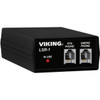
Viking Electronics LSR-1 Line Seizure Relay
The Viking Electronics LSR-1 is a line seizure relay designed to let emergency phones and priority alarm devices commandeer a shared phone line when it matters most. If your facility uses a single POTS line for both general use and an emergency intercom or life-safety dialout device, the LSR-1 (often searched as LSR 1) solves the fundamental conflict: it gives the priority device first claim on the line, cutting off routine traffic the moment an alarm condition is triggered. That means fewer dedicated lines, lower monthly recurring telecom costs, and no compromise on emergency response reliability.
Overview
Sharing a phone line between a standard extension and an emergency phone is straightforward in concept but problematic in practice — without active seizure logic, both devices compete for the same resource. The LSR-1 resolves this by monitoring line state and asserting control for the designated priority device when needed. This is a common requirement in elevator lobbies, parking structures, stairwells, and any location where code or policy mandates an emergency phone but running a dedicated line is cost-prohibitive or structurally impractical.
The relay connects inline between your phone line and the devices sharing it. Wiring is handled through two RJ11 jacks and one RJ11 plug — no punchdown blocks or custom terminations required for most installations. That matters in retrofit scenarios where the technician has limited access and needs to work quickly.
Key Features
- Line Seizure Logic: Grants the priority device (emergency phone or alarm dialer) exclusive access to the shared POTS line on demand. The line is effectively taken away from secondary devices until the priority call clears — no dropped emergency calls because a routine extension was off-hook.
- 32V DC Talk Battery: Provides the correct talk battery voltage for connected telephony equipment. This ensures compatibility with standard POTS-based emergency phones that depend on loop current to operate — no external battery supply needed for the talk circuit.
- Dual Power Input — 120V AC or 12V DC: The LSR-1 accepts either 120V AC or 12V DC at 500mA, giving installers flexibility. In locations where only a DC power bus is available (security panels, UPS-backed distribution), no AC outlet is required. In standard commercial spaces, a wall adapter works equally well.
- RJ11 Connectivity — No Punchdown Required: Two RJ11 jacks and one RJ11 plug handle all connections. For most installs this means patching in with standard modular cables — faster commissioning, simpler troubleshooting, and no need for a 110-block tool.
- Compact Form Factor: At 4.7" x 1.4" x 2.8" (119mm x 36mm x 71mm) and 1.0 lb (0.45 kg), the LSR-1 tucks into a backbox, equipment closet, or surface-mount enclosure without consuming significant real estate. Size matters in elevator machine rooms and small telecom closets.
- Indoor Temperature Range 32°F to 90°F (0°C to 32°C): Rated for conditioned indoor environments. This is an intentionally conservative range — it keeps the unit reliable in climate-controlled lobbies, corridors, and equipment rooms, but rules it out for unconditioned outdoor or unheated spaces without additional environmental housing.
- 5% to 95% Non-Condensing Humidity: Covers the full range of typical indoor commercial environments, including spaces with seasonal humidity variation. Non-condensing is the key qualifier — keep it away from direct moisture sources.
- Two-Year Limited Warranty: Viking's two-year limited warranty provides a reasonable coverage window for a device that will typically be installed and forgotten for years. For life-safety-adjacent applications, that assurance matters when justifying the installation to a facilities manager or AHJ.
Integration & Compatibility
The LSR-1 is designed for analog POTS-based telephony environments. It is compatible with standard emergency phones, elevator phones, and alarm dialers that operate over a conventional phone line. The RJ11 interface is universal for analog equipment, making it straightforward to drop in alongside Viking Electronics emergency phones or third-party analog devices already on the project.
For projects specifying emergency phones in parking structures, elevator cabs, or stairwells, the LSR-1 fits naturally into the line architecture between the building demarc and the field devices. Pair it with an appropriate telephone line interface if your PBX or VoIP gateway requires analog loop-start signaling adaptation on the same run.
If your project involves multiple emergency phone locations sharing a single line group, review the line capacity requirements per location — one LSR-1 per shared line segment is the standard approach. Viking's broader line-powered emergency phone product line integrates directly with this relay architecture.
Frequently Asked Questions
Q: What type of phone line does the LSR-1 require?
A: The LSR-1 is designed for standard analog POTS (plain old telephone service) lines. It is not intended for VoIP, digital PBX extensions, or IP-based telephony without an appropriate analog interface adapter upstream.
Q: Can the LSR-1 be powered from a security panel's DC output?
A: Yes. The LSR-1 accepts 12V DC at 500mA in addition to 120V AC, so it can draw power from a UPS-backed DC distribution bus or a security panel's auxiliary power output where a DC supply is available.
Q: What is the warranty on the LSR-1?
A: Viking Electronics covers the LSR-1 with a two-year limited warranty.
Q: Is the LSR-1 suitable for outdoor installation?
A: Not without additional environmental protection. The operating range is 32°F to 90°F (0°C to 32°C) with 5% to 95% non-condensing humidity — appropriate for conditioned indoor spaces. Outdoor or unconditioned environments require a suitable NEMA-rated enclosure.
Q: How many devices can share a line using the LSR-1?
A: The LSR-1 is designed to manage line seizure between a priority device (emergency phone or alarm dialer) and a secondary device on the same line. For installations with multiple shared devices, consult Viking's application guidance to determine whether additional relays are needed per line segment.
Q: What connectors does the LSR-1 use?
A: The LSR-1 uses two RJ11 jacks and one RJ11 plug — standard modular telephone connectors. No punchdown block or special termination tooling is required for most installations.
The LSR-1 is one of those devices that solves a specific, unglamorous problem with no wasted engineering — the dual 120V AC / 12V DC power input is the detail I appreciate most in the field, because elevator machine rooms and stairwell telecom closets almost never have a convenient AC outlet near the backbox. Being able to pull 12V DC at 500mA from the access control panel's aux output saves a conduit run and keeps the install clean.
Technical Highlights:
- Dual Power Input (120V AC / 12V DC, 500mA): Eliminates the need for a dedicated AC circuit in locations where only a DC power bus is present — a practical advantage in retrofit elevator and stairwell installations.
- 32V DC Talk Battery: Matches the loop-current requirement of standard POTS emergency phones, ensuring connected devices operate correctly without an external battery supply for the talk circuit.
- RJ11 Modular Connections (2 jacks, 1 plug): All connections are standard modular — no punchdown tool, no 110 block. In a confined backbox at 4.7" x 1.4" x 2.8", that speed of termination matters when you're working in a 12" x 12" enclosure.
Deployment Considerations:
- The 90°F (32°C) upper temperature limit is the constraint to watch in elevator machine rooms — those spaces routinely exceed that threshold in summer. Verify HVAC coverage or specify a ventilated enclosure before mounting.
- The LSR-1 is analog POTS-only. If the building has already migrated to a hosted VoIP trunk, you will need an ATA (analog telephone adapter) upstream to present a loop-start analog interface — the LSR-1 itself has no SIP or VoIP capability.
This is the right component for a parking structure or multi-tenant building where budget or conduit routing makes dedicated emergency phone lines impractical — the LSR-1 lets you deliver code-compliant emergency call capability on existing infrastructure without pulling new copper to every call point.