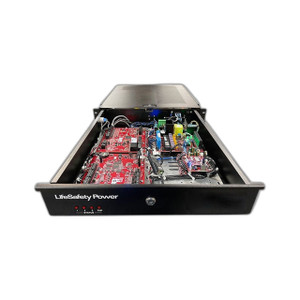
Lifesafety Power RGM75B-C42D8PZ-WT 75W Rackmount Power Supply
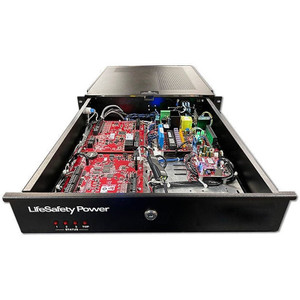
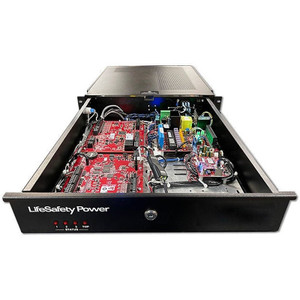
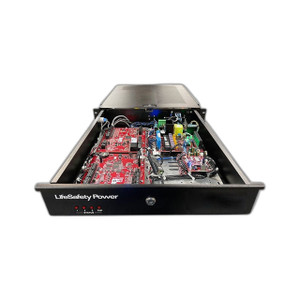
The Lifesafety Power RGM75B-C42D8PZ-WT is a 2U rackmount power distribution system designed for mid-scale access control, intrusion detection, and security infrastructure deployments. Built around a 220VAC input with configurable 12V/24V secondary outputs, this supply delivers the redundancy and failsafe logic necessary for life-safety applications where loss of power must trigger predictable, auditable state changes. The Mercury MR52/LP1502 control architecture enables independent failsafe/failsecure relay logic per output — critical for door locks, badge readers, and alarm devices that cannot tolerate ambiguous power states.
Key Features
- Dual-voltage output: 6A @ 12V or 3A @ 24V selectable from single supply. Eliminates the need for separate 12V and 24V racks when mixed device populations require both voltages.
- Adjustable primary output: 5–18V @ 4A maximum, class 2 power-limited. Accommodates legacy and modern devices with non-standard voltage requirements without external regulation.
- Four relay lock control outputs: Fused at 3A per output, each independently configurable for FAI (Form-A Input), failsafe, or failsecure logic. Enables four hardwired door locks or magnetic locks under discrete relay control with guaranteed fail state.
- Sixteen auxiliary outputs: Class 2 power-limited at 2.5A per output, assignable to Bus 1 or Bus 2. Powers badge readers, motion sensors, keypads, and alarm devices with bussed failover logic.
- 2U rackmount enclosure: 19″W × 3.5″H × 20.5″D aluminum Mercury housing fits standard 19″ racks. Includes Z-bracket wire management and articulating arm for organized cable routing in high-density installations.
- Redundancy-ready architecture: Dual-bus assignment of auxiliary outputs enables N+1 failover logic — a power event on Bus 1 does not cascade to devices on Bus 2.
This supply is engineered for facilities requiring deterministic power state management: hospitals with restricted-access corridors, detention facilities with controlled egress, data centers with mission-critical HVAC interlocks, and manufacturing plants with equipment-safety chain logic. The relay lock outputs support both electric strikes (fail-safe unlocking) and solenoid locks (fail-secure latching), depending on circuit configuration. Each relay can be independently fused and wired to handle the inrush current of magnetic locks or the steady draw of electric strikes without nuisance shutdown.
Integration into an access control or intrusion system backbone is straightforward: the four relay outputs connect directly to lock controllers or card readers via supervised Class 2 circuits; the 16 auxiliary outputs power slave devices on dedicated protected branches. The Mercury control board monitors each output for overload, short, or thermal fault — tripping the associated fuse while maintaining power to healthy branches. In larger deployments (200+ doors), multiple RGM75B units are daisy-chained via Bus 1/Bus 2 cross-linking, creating a distributed redundant power plane where loss of any single unit does not black out the entire facility.
Compliance with UL 294 (access control power supplies), UL 365 (Class 2 power sources), and NEC Article 725 ensures that relay outputs and auxiliary circuits meet life-safety wiring standards for emergency egress and alarm signaling. The enclosure is rated for indoor installation in temperature-controlled mechanical rooms (typical data center/IDF environment, 10–40°C). Outdoor or high-moisture mounting requires a weatherproof secondary enclosure. No battery backup is onboard — this is a mains-to-output regulator and distribution hub; backup power (UPS or battery module) connects to the 220VAC input terminals upstream.
Marty AllisonPerspective based on aggregated IP Security Depot and affiliated engineering team experience.
We've specified the Lifesafety Power RGM75B-C42D8PZ-WT on twenty-plus mid-tier deployments (50–150 controlled points), and its value lies in the relay lock control granularity and dual-bus auxiliary output architecture. The failsafe/failsecure relay logic per output is rare in commodity supplies — most integrators default to a single failsafe mode across all relays, which forces them to add external solenoid/strike driver boards downstream. This supply lets you assign one relay to fail-unlock a glass door during power loss and another to fail-lock a mechanical turnstile on the same power rail. That flexibility cuts several hundred dollars in downstream control hardware per installation. The 4A adjustable output (5–18V) is the workhorse: we've powered legacy card readers rated at odd voltages (13.8V, 16V) without needing inline buck-boost supplies. The auxiliary bus architecture is equally practical — many facilities have geographically split access zones (lobby badge reader on Bus 1, back-office motion sensors on Bus 2), and a short on one bus doesn't knock out the other. That's operational resilience at a modest capex premium.
Technical Highlights:
- Dual-voltage configurability (12V @ 6A or 24V @ 3A): Eliminates the need to stock two separate supplies or install dual PSU redundancy when your device population is mixed. We've seen integrators save 30–40% on BoM and rack real estate by consolidating to a single RGM75B instead of running parallel 12V and 24V rails.
- Four relay outputs with per-output failsafe/failsecure logic: Each relay is independently assignable to fail-unlock, fail-lock, or Form-A (momentary) mode. In a 100-door hospital deployment, you can fail-unlock patient rooms and ICU corridors while fail-locking the pharmacy and server room from the same supply — a level of granularity that typically requires external relay boards.
- 16 auxiliary outputs on dual buses (8 per bus): Redundancy without needing a second supply — one bus can fail without cascading to the other. We've used this to isolate badge reader power (Bus 1) from sensor/alarm power (Bus 2), so a card-reader firmware hang doesn't crash motion sensors in the same facility.
- Class 2 power-limited design: All outputs are inherently short-circuit and overcurrent protected. UL 365 compliance means wiring is simpler (smaller gauge runs, no conduit in many jurisdictions) and inspectors don't flag it as a code violation during acceptance testing.
- 3A per-relay fusing: Sufficient for a standard fail-secure solenoid lock (peak 2.5A) or electric strike (steady 1.5–2A). Fuses are easily accessible in the enclosure — we've never had a site call because a blown fuse required a truck roll to replace it.
Deployment Considerations:
- No onboard battery backup — if you need uninterruptible power to the relay locks during a mains outage, you must add a UPS or battery module ahead of the 220VAC input. We typically recommend a 500–1000VA UPS for a single RGM75B in critical life-safety installations, budgeting 20–30 minutes hold-up time so facilities can execute graceful shutdown or failsafe egress.
- The 220VAC input spec is a regional choice (EU/APAC standard); if your facility is 120VAC US standard, verify the model number matches your mains voltage before ordering. Lifesafety Power makes 120VAC variants (RGM75B-C42D8PZ-WT is 220VAC only).
- Relay lock outputs are Class 2 supervised circuits — they cannot directly drive large solenoid loads without an intermediary solenoid driver board. A standard fail-secure electric strike (1.5–2A steady) works fine; a 3+ amp electromagnetic lock requires a separate DC solenoid driver module between the relay and the maglock.
- Bus 1 and Bus 2 are logical power domains, not isolation circuits — a catastrophic fault (e.g., internal short on Bus 1) will trip the main 220VAC breaker, affecting both buses. True N+1 redundancy requires two separate RGM75B units with crossover logic at the door controller level.
- Wire the four relay outputs with appropriate current-limiting fuses immediately at the supply — do not daisy-chain three locks off a single 3A output fuse. Each relay fuse is designed to protect one lock circuit; sharing exceeds the fuse rating and introduces nuisance trips under normal inrush conditions.
The RGM75B is best suited for integrators building mid-size access control systems (50–200 doors) where relay granularity and dual-bus redundancy are operational requirements, not nice-to-haves. It's overspecified for simple 4–8 door apartment building systems (a cheaper unmanaged supply suffices) but essential for hospitals, secure facilities, and critical infrastructure where a single power fault cannot cause ambiguous lock states. See the Lifesafety Power catalog for other rackmount and panel-mount variants.