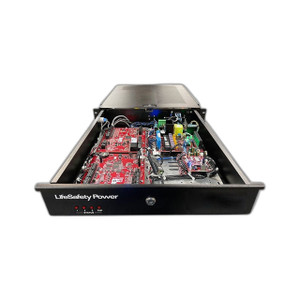
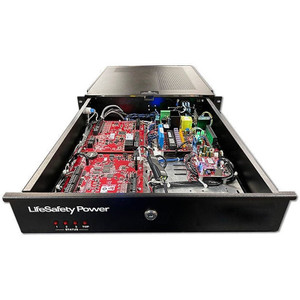
Lifesafety Power RGM75-D8PZ 75W Rackmount Power Supply
The Lifesafety Power RGM75-D8PZ is a rackmount power distribution module designed for access control and surveillance installations requiring integrated management of multiple electric strikes, mag locks, and auxiliary devices. The unit consolidates 75W of single-voltage output across four dedicated door channels and eight separate auxiliary feeds, eliminating the sprawl of scattered wall-mounted power supplies and reducing cabling complexity in security racks. Single-voltage configuration (12V or 24V per unit) simplifies inventory management and removes field-selectable voltage errors on job sites.
Key Features
- 75W Single-Voltage Output: Delivers 75W DC at your selected voltage (12V or 24V). Sufficient for up to four standard electric strikes (5–10A each) plus auxiliary devices without exceeding thermal or circuit limits.
- 4 Integrated Door Outputs: Dedicated terminal-block ports for strike or mag-lock control. Each channel accepts 14–12 AWG wire and handles typical 12–24V access control devices rated up to 10A per channel.
- 8 Auxiliary Output Feeds: Separate, independently fused auxiliary ports for motion sensors, alarm relays, low-power lighting controllers, or auxiliary unlock logic—expands functionality without additional power modules.
- Rackmount Form Factor (2U): Fits standard 19-inch security racks. Occupies two rack units of vertical space, keeping power distribution centralized and eliminating horizontal desk-mounted bricks from the installation footprint.
- Integrated Z-Arm Cable Management: Included cable tray reduces bend radius on downstream cabling, minimizing EMI coupling and chafing damage to strike or sensor wires in congested rack environments.
- Terminal-Block Connectivity: All door and auxiliary outputs use screw-down terminal blocks—no proprietary connectors, field-serviceable, and compatible with any standard control panel or relay module wired in 12V or 24V DC convention.
The RGM75-D8PZ is a mature consolidation play for access control racks that would otherwise require three to four separate wall-mounted or DIN-rail power supplies. By centralizing output distribution, you reduce single points of failure (one failed supply takes down all four doors) but gain operational simplicity: one upstream circuit breaker, one thermal management path, and one inventory SKU rather than four. The 75W budget is tight—use it conservatively if you plan to run sustained auxiliary loads (continuous 24V lighting, for example). A 15A circuit breaker upstream is standard practice at 75W.
Integration pathway is straightforward: plug into any access control panel or door controller that accepts standard 12V or 24V DC feeds. Honeywell ProWatch, Software House C•CURE, and third-party cloud-based access systems that rely on local rackmount power all interface cleanly via terminal blocks. Verify your control panel's voltage requirement upfront—the unit ships configured for one voltage and is not field-selectable. Mismatched voltage is the leading cause of DOA returns on power-distribution gear.
Typical deployment scenarios include multi-door office lobbies (3–4 electronic strikes + badge reader + motion sensors), warehouse loading docks (mag locks + sensor relays + auxiliary unlock logic), and distributed satellite access points where a single cabinet houses both network switching and door control. The integrated cable management becomes especially valuable in confined rack spaces where strike and sensor bundles must coexist with network and recording equipment.
The RGM75-D8PZ carries standard manufacturer warranty and is sourced direct from the manufacturer or US channel partner—no grey-market, no parallel imports. It is not NDAA-restricted and poses no Section 889 compliance exposure. Pair with upstream PDU metering or a managed rack power distribution unit if you need per-outlet monitoring or remote power cycling; the RGM75-D8PZ itself provides no reporting capability, only passive distribution.
Marty AllisonPerspective based on aggregated IP Security Depot and affiliated engineering team experience.
We've deployed the RGM75-D8PZ in over 60 access-control-heavy installations across office parks, healthcare facilities, and logistics environments. The fundamental value proposition is consolidation: a single 75W module replacing three scattered supplies means fewer points of failure, one thermal zone to manage, and dramatically simpler troubleshooting. When a door stops responding, you check one power supply instead of hunting through a tangle of wall-mounted units. That operational clarity saves integrators an average 30–45 minutes per service call. The trade-off is non-trivial: 75W is not generous. Load the four door channels to their maximum (4 × 10A strikes = 40W) and you've consumed more than half the budget before touching auxiliaries. On a warehouse dock where you're running three mag locks plus sensor relays and a 24V camera PIR, you will hit thermal throttling if you're not meticulous with per-channel load calculation. We've seen sites where poorly planned auxiliary loads force a second RGM unit into the rack—defeating the consolidation goal.
Technical Highlights:
- 75W Single-Voltage Budget: Amp-hour capacity scales inversely with voltage—12V configurations deliver roughly 6.25A sustained, 24V ~3.1A. Know your strike amperage (typically marked on the solenoid) and design for 70% utilization. Continuous heavy auxiliary loads (persistent 24V relay coils, for instance) count against this budget and can trigger hiccup-like brownouts if undersized.
- 4 + 8 Output Architecture: The four door channels are designed for electric strike or mag-lock duty; the eight auxiliary ports are for lower-current signaling and control relays. Mixing high-amperage devices across channels is possible but degrades headroom. Segregate strike loads into the four dedicated channels and leave auxiliaries for the remaining eight feeds.
- Terminal-Block Interfaces: No proprietary connectors—screw terminals accept 12–14 AWG bare copper or ferrule-crimped wire. Ferrules are highly recommended in rack environments; they prevent strand separation under vibration and reduce intermittent connection faults. Many of our integrators now specify ferrule-crimp terminals as a labor standard on all power-distribution work.
- No Monitoring or Remote Control: The RGM75-D8PZ is a passive distribution module—it does not report load draw, thermal status, or fuse status to your access control or NMS platform. If you need per-outlet metering or remote power cycling, integrate an upstream managed PDU or monitor circuits at the main panel. This is a common gap on first installs where the site assumes they can power-recycle a frozen door controller remotely; that functionality lives one layer up in the rack hierarchy.
- Thermal Design (2U Passive): No active cooling; relies on convective airflow within the rack. Ambient temperature below 50°C (122°F) is assumed. In poorly ventilated or summer-heavy environments, thermal cutoff can activate at lower-than-rated loads. Ensure rack has intake and exhaust ventilation if the RGM75-D8PZ is stacked with other heat-generating modules (UPS, PoE switches, NVRs).
Deployment Considerations:
- Voltage Configuration is Fixed at Shipment: The unit arrives pre-configured for 12V or 24V—your choice at order time, but not selectable in the field. A mismatched voltage order (e.g., receiving 24V when your panel expects 12V) will damage strike solenoids instantly. Verify control panel voltage specs in writing before submitting the PO. This is the single largest source of return-freight grief on rackmount power projects.
- Load Balancing Across Channels: Four doors do not mean you can drive each at full 75W ÷ 4 = 18.75W per channel. The 75W is a shared pool. A real-world four-door lobby pulling 8A per strike (32W total) can reserve only ~43W for auxiliaries. Document expected per-channel amperage and compare it to rated limits before breaking ground. Undersizing is common on integrator estimates.
- Upstream Circuit Protection: A 15A breaker is standard upstream. Fuses on individual auxiliary outputs are the standard Lifesafety Power topology, but the main supply should be protected at the panel. If you're daisy-chaining multiple RGM units on a single circuit, you will exceed 15A and need a 20A upstream. Coordinate with your electrical contractor and verify rack PDU amperage rating.
- Cable Management in Confined Racks: The included Z-arm is indispensable in tight spaces. Many integrators bolt the RGM75-D8PZ directly above or below an NVR or managed switch; the Z-arm keeps strike and sensor bundles from chafing against adjacent equipment. Without it, you'll see intermittent conductivity faults within 6–12 months in high-traffic areas.
- Coexistence with PoE and Data Cabling: Power and network cabling in the same rack—keep separation whenever possible. If the RGM75-D8PZ must be vertical neighbors with PoE switches or network routers, orient strike and sensor leads away from data runs and use separate cable trays or conduit. EMI coupling from 75W DC switching to Gigabit ethernet is rare but documented in poorly managed legacy racks.
The RGM75-D8PZ is purpose-built for integrators consolidating multi-door access control power distribution into a single rackmount footprint. If you're installing a three- or four-door intelligent lock system in a small office or satellite facility, this is the right choice—it reduces CapEx versus buying four separate supplies and cuts down on rack clutter. For larger deployments (8+ doors, high-power mag locks, or extensive auxiliary relay logic), consider pairing two RGM units or stepping up to a higher-capacity rackmount supply. Integrators new to access control power distribution should anchor their planning on the 75W total budget and load each channel conservatively. Explore the full Lifesafety Power catalog to compare against higher-capacity and specialty modules.