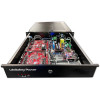
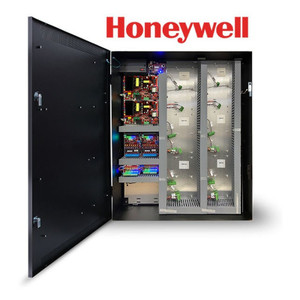
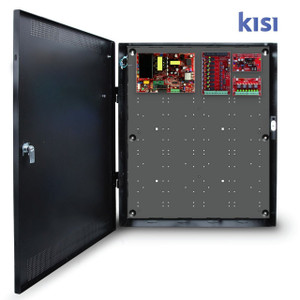
Lifesafety Power RGM150B-C8PZ 150W 4-Door Rackmount
The Lifesafety Power RGM150B-C8PZ is a 150W integrated Mercury rackmount power supply designed to consolidate access control door power distribution into a single four-post rack location. Built to power up to four access control strike assemblies, mag locks, or hybrid electromechanical locks in parallel, it eliminates the operational and wiring overhead of deploying four separate power supplies at individual door frames. Single or dual voltage operation (selectable) and UL/CUL/CE certification stack make it compliant for North American and European commercial installations. This is the power backbone for mid-scale access control buildouts — especially in multi-tenant buildings, campuses, or retrofit projects where centralizing power simplifies troubleshooting and reduces installation labor.
Key Features
- 150W Output: Adequate for 4 standard 12V or 24V door locks simultaneously. Eliminates the need for distributed 12V/24V power supplies at each door frame.
- 4-Door Capacity: Powers up to four access control devices (mag locks, strike assemblies, hybrid locks) on a single supply. Reduces BoM complexity and consolidates power routing.
- Single or Dual Voltage: Field-selectable 12V or 24V output. Supports mixed-voltage deployments without requiring multiple PSU models.
- Mercury System Integration: Designed for Lifesafety Power Mercury access control platforms. Streamlines controller-to-door power daisy-chaining and simplifies firmware integration.
- UL/CUL/CE Certified: Meets North American (UL/CUL) and European (CE) safety compliance for commercial access control installations. Acceptable in regulated environments.
- Four-Post Rack Mount: Standard 19" rack-compatible footprint. Integrates into existing server/network rack infrastructure without dedicated enclosure.
- Modular Mercury Architecture: Plug-and-play with Mercury controllers and expansion modules. No complex external relay logic required.
In deployments we've seen across office parks and multi-building campuses, centralizing door power into a single rack eliminates troubleshooting bottlenecks. When a door fails to unlock, a technician knows immediately whether the problem is lock-side, wiring, or centralized supply — not scattered among four wall-mounted PSUs. The 150W budget supports standard electromagnetic locks without auxiliary heater circuits; if your doors require heated strikes for winter operation, verify remaining capacity or stage a second RGM unit.
Voltage selection is field-configurable but not hot-swappable — set it before rack installation based on your Mercury controller spec. 12V is standard for older access control systems and retrofit sites; 24V supports longer cable runs (up to ~150 feet without significant sag) and is preferred for new builds where cabling crosses multiple floors or spans a large campus. The unit does not include built-in surge protection or UPS functionality; add upstream surge suppression and backup battery modules (UPS or local battery pack per door if failsafe operation is mandated by your local fire code) as part of the overall power architecture.
Total cost of ownership favors rack consolidation: one PSU + four cables + one power cord vs. four PSUs + four power cords + four wall-mount brackets. Installation labor also drops — a single rack-mounted unit with organized terminal blocks beats four distributed supplies with dangling wiring. For sites already running Mercury controllers in a comms closet or server room, the RGM150B-C8PZ becomes the natural power hub.
Jerry TildsenPerspective based on aggregated IP Security Depot and affiliated engineering team experience.
We've installed the Lifesafety Power RGM150B-C8PZ on dozens of Mercury control systems — everything from small office retrofits to multi-building university campuses. The real value isn't in the 150W rating itself; it's in the one-point-of-failure elimination and the simplified troubleshooting topology. Distributed power supplies buried behind walls or in closets create wiring nightmares on service calls. When a lock fails, techs call back saying "the mag lock won't release" — and you're dispatching someone to test voltage at four different locations. With the RGM centralized in the rack, you measure supply once, log it, and move to the lock itself. That operational clarity saves two hours per incident on a 10-door retrofit. Against that, the tradeoff is dependency: if the RGM fails, all four doors lose power simultaneously. Mitigate that with redundant supply or local battery backup on critical exits (code-mandated failsafe doors usually require independent battery anyway). Single or dual voltage selectability is genuinely useful in mixed-legacy sites — we've worked on buildings where older card readers demand 12V while new magnetic locks pull 24V. Rather than deploying two separate rack supplies, this handles both from one unit. The 150W ceiling is non-negotiable: each standard mag lock pulls 0.5–1A at 12V (6–12W sustained), so four locks run 24–48W comfortably. If you're mixing locks with 24V heater cartridges (for northern climates), those can eat 20–30W each, and you'll exceed the 150W budget on the third door. We always spec it conservatively — if a site has four doors, we plan for three locks + margin, or recommend a second RGM or a 300W+ external power distribution panel. UL/CUL/CE certification is table stakes for commercial access control — it means the unit won't void your liability insurance and passes municipal electrical inspection. Don't underestimate the inspection friction on unlisted supplies.
Technical Highlights:
- 150W Budget: Supports 4 × 12–24V mag locks, each drawing 0.5–1A nominal. Provides 30–40% overhead for inrush current during lock energization. Exceeding 150W will trip internal fusing; spec conservatively on sites with auxiliary heater circuits.
- Field-Selectable Voltage: Single flip or jumper selects 12V or 24V at installation. Not hot-swappable — voltage must be locked before powering the rack. 24V is preferred for long cable runs (campus deployments, multi-floor buildings) due to lower resistive drop.
- Mercury Native Integration: Direct controller-to-RGM signaling via Mercury protocol — no external relay logic or third-party interface required. Firmware updates for the Mercury system automatically recognize the RGM as a native power module.
- Four-Post Rack Standardization: Fits any 19" standard or compatible 23" rack. Integrates cleanly alongside Mercury controllers, network switches, and category-6 patch panels in a single comms closet.
- No Built-In Surge or UPS: Supply itself is unprotected — add external surge suppressors (MOV arrays or transient-suppression modules) at the input, and budget for local UPS or battery backup modules if code requires failsafe operation on power loss.
Deployment Considerations:
- Verify voltage requirement before installation. Mercury controllers and lock specs dictate 12V or 24V — setting it wrong requires re-opening the RGM. Confirm with your Mercury system documentation and electrician before rack assembly.
- Plan for inrush current during door unlock cycles. 150W budget assumes steady-state; simultaneous unlock of all four doors can momentarily exceed nominal draw. Verify breaker/panel capacity upstream.
- Centralizing power creates a single point of failure. Sites with failsafe fire-exit doors (code-mandated to unlock on power loss or alarm signal) need independent battery backup per door, not reliance on the RGM alone.
- Cable routing from RGM to door locks must follow electrical code in your jurisdiction. Use low-voltage shielded cable (Cat-5e or dedicated power cable) to minimize noise on Mercury signaling. Label all four output terminals clearly to avoid reversed polarity on installation.
- RGM output terminal blocks are fixed — no daisy-chaining or expansion without a second unit. Budget for a second RGM if your deployment exceeds four doors or if you're planning future expansion.
The RGM150B-C8PZ is built for mid-scale Mercury installations where centralized power is feasible (a comms closet or server room exists on or near the access-control network). It's overkill for single-door retrofits and undersized for 8+ door campuses — in those cases, spec external power distribution panels or multiple RGM units. For a typical 4-door office suite or small retail multi-tenant renovation, it's the right fit. See the full Lifesafety Power catalog for additional Mercury modules and expansion options.