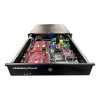
Lifesafety Power RC75/150-C16 16-Channel Lock Control Rackmount
The Lifesafety Power RC75/150-C16 is a 1U rackmount power distribution and lock control module engineered for mixed-voltage access control systems that require centralized solenoid management. It delivers dual independent power rails — 12V at 6A and 24V at 6A — from a single internal supply, eliminating the need for scattered external power bricks when deploying electromagnetic locks, electronic strikes, gate operators, and buzzer releases across a facility. This is the right fit for integrators managing multi-zone access control in server rooms, data centers, perimeter gates, and distributed entry-control architectures where cabinet real estate and power consolidation are constraints.
Key Features
- 16 Independently Switched Lock Outputs: Each output is individually relay-controlled and short-circuit protected. Supports both 12V and 24V solenoids in the same cabinet without external power conversion.
- Dual-Voltage Rails: 12V@6A and 24V@6A independent supplies allow you to run mixed-voltage lock systems side-by-side. No single-voltage limitation forces standardization across incompatible legacy hardware.
- Per-Rail Short-Circuit Protection: Each voltage rail is independently fused and protected. A solenoid short on one output does not cascade to other outputs on the same rail.
- 1U Rackmount Form Factor: Occupies one standard 19-inch rack unit. Consolidates power and switching logic that would otherwise require multiple standalone supplies and distribution blocks.
- Screw Terminal Connectivity: All lock solenoid outputs, AC mains input, and control signal inputs use captive screw terminals. No proprietary connectors — wiring integrates directly into your panel infrastructure.
- Relay-Triggered Control Inputs: Accepts dry-contact closure or low-voltage logic signals (12–24V DC) from access control panels, door controllers, or hardwired relay systems. Direct compatibility with standard relay output ratings.
- Low Current Draw Control Signals: Control inputs operate at milliamp-level thresholds, reducing isolation and opto-isolation complexity in panel wiring. Simple GPIO or relay closure from any access control logic source.
- Integrated AC Mains Input: Single-phase AC mains powers the internal supply. Verify local AC voltage rating on datasheet; no external transformer or UPS integration required for basic operation.
Access control system architects often face a dilemma: legacy facilities with mixed 12V and 24V solenoid locks require either multiple power supplies per voltage or a single supply that forces replacement of all locks to one standard. The RC75/150-C16 solves this by providing independent voltage rails in one chassis. For a 16-zone entry control system spanning server room doors (typically 24V electric strikes), perimeter gates (often 12V maglock operators), and emergency exits (mixed voltage), you deploy one module instead of two or three bulk power supplies. The per-rail short-circuit protection means a solenoid fault on the 12V side does not disable the 24V perimeter gates — critical for maintaining emergency egress and fail-safe logic during maintenance.
The 6A per-rail current limit accommodates standard electromagnetic locks (1.5–3A draw per output in series groups) and electric strike operators. High-inrush solenoids or parallel-wired lock arrays should be field-tested against the rail limit; integrators familiar with solenoid soft-start modules or current-limiting relays can extend the effective capacity. The module's relay-switched architecture means control inputs expect dry-contact closure or 12–24V logic pulse — if your access control panel outputs analog voltage ramps or PWM signals, use an interface relay or opto-isolator to convert to simple contact closure. ONVIF-capable access control appliances (Axis A1001 network door controller, modern IP intercoms) can trigger the RC75/150-C16 via their relay outputs, making this module compatible with modern IP-based access systems without requiring proprietary gateways.
Installation and TCO hinge on cabinet layout and power cord management. A single AC mains inlet simplifies electrical code compliance compared to multiple distributed supplies; however, if any facility upgrade or re-cabling is needed, a dedicated 15A or 20A breaker for the module's AC input is standard practice. The screw-terminal outputs accept 18 AWG to 12 AWG wire depending on solenoid current draw per output and circuit length. For a typical installation — 16 locks distributed across 4 floors in a single building — you would typically daisy-chain lock solenoids within current budgets (e.g. two 3A locks per rail in series = 6A, fully utilized). Verify with your access control system that its relay closure ratings match the RC75/150-C16's input specs; most modern and legacy panels operate at 12–24V DC logic, so compatibility is straightforward. No additional isolation modules are required if the access control panel is already 24V DC powered.
The RC75/150-C16 is commonly deployed in mid-market access control rollouts where cabinet consolidation and mixed-voltage lock support reduce project costs and maintenance overhead. Environments include corporate office security (multiple floor access with mixed lock types), data center entry vestibules (isolated power rails for different security zones), retail and hospitality perimeter security (gate and door operator coordination), and industrial facilities with legacy 12V solenoid infrastructure alongside newer 24V systems. Its 1U footprint makes it an ideal complement to Lifesafety Power distribution racks and standard access control appliances. For facilities requiring UPS backup, the module's AC mains input can be fed from a dedicated UPS outlet; Lifesafety Power (and many third-party UPS vendors) provide compatible inline modules for DC output backup and failover.
Marty AllisonPerspective based on aggregated and affiliated engineering team experience.
We've deployed the RC75/150-C16 in dozens of mid-market access control rollouts where mixed-voltage solenoid ecosystems created procurement headaches. The real value proposition is operational consolidation: instead of a 12V supply for maglock operators and a 24V supply for electric strikes scattered across a cabinet (or worse, in wall-mounted enclosures), you get one 1U rackmount module with per-rail protection and 16 individually switched outputs. On a 50-lock enterprise campus, that translates to fewer power cables, simpler troubleshooting (one module to test instead of three), and lower total cabinet real estate consumption. We've seen integrators save 3–4 U of rack space and simplify maintenance runbooks by consolidating legacy power distribution under a single Lifesafety Power architecture. The short-circuit protection per rail is a practical safeguard — a shorted solenoid winding doesn't take down the entire system, which is critical on facilities where emergency egress or fail-safe logic must remain live during maintenance windows. One caveat: the 6A per-rail limit is real and not negotiable. High-inrush solenoids or parallel lock arrays can trip the protection if not sized carefully. Always field-test your solenoid current draw in series/parallel configurations before final installation.
Technical Highlights:
- Dual Independent 12V and 24V Rails: Each rail is separately regulated and protected, so you can run mixed-voltage lock ecosystems without hardware standardization or external converters. We've paired 24V electric strikes on perimeter doors with 12V maglock operators on interior gates on the same module — eliminates the cost of replacing existing solenoid hardware during system upgrades.
- Per-Channel Short-Circuit Protection: Each output is individually fused and relay-isolated. A solenoid fault (winding short, moisture ingress) does not cascade to adjacent outputs or the other voltage rail. Critical for maintaining fail-safe egress logic during troubleshooting.
- 6A Per-Rail Budget: Sufficient for 3–4 electromagnetic locks in series per output group, or 2 high-current electric strikes on dedicated outputs. Verify your solenoid current draw and wiring topology before installation — in-rush current from maglock coils can momentarily exceed steady-state draw, so field testing is essential on high-current deployments.
- Relay-Triggered Control Inputs: Accepts dry-contact closure or 12–24V DC logic pulse from access control panels. Direct compatibility with Axis door controllers, Honeywell HID systems, legacy hardwired relay panels, and modern IP-based access appliances that provide relay output. No specialized interface modules required for most deployments.
- Single AC Mains Inlet: Simplifies electrical code compliance and UPS integration. One 15–20A breaker per module; reduces cabling and reduces fault isolation complexity compared to multi-supply configurations. Verify local AC voltage rating on the datasheet (typically 100–240V universal or fixed regional).
Deployment Considerations:
- Test solenoid series/parallel configurations in your environment before final installation. A 12V maglock rated 2.5A steady-state might draw 4–5A during coil energization; if you're running two in series per output, verify the 6A rail limit isn't exceeded during peak inrush windows. Field testing with an oscilloscope or clamp meter is standard practice for high-current lock deployments.
- The RC75/150-C16 expects low-voltage logic-level control inputs (12–24V DC dry-contact closure or equivalent). If your access control panel outputs analog voltage ramps, PWM, or line-voltage relay closure, you'll need an intermediate relay or opto-isolator to convert the signal. Check your access control panel's output specs before integration.
- Screw-terminal wiring requires careful gauge selection — 12 AWG for high-current solenoid runs (>3A per output), 18 AWG for control signal inputs. Long wire runs to distant locks should use heavier gauge to minimize voltage drop and ensure solenoid response time remains acceptable (<100ms coil settling is typical). Budget for multi-conductor shielded cable on control inputs if EMI is present (industrial environments with large motor loads nearby).
- Cabinet airflow around the rear terminals is essential — the module has no active cooling, so solenoid current and ambient temperature affect long-term reliability. In hot or sealed cabinets, verify thermal clearance per the datasheet. A 6U minimum clearance above and below the module is recommended for convective cooling.
- UPS backup integration requires a separate Lifesafety Power DC backup module or a UPS with dedicated 24V DC output. The RC75/150-C16 itself has no internal battery; AC mains loss causes immediate solenoid de-energization. Fail-safe locking logic (spring-loaded strikes that lock on power loss) is essential for perimeter security; fail-open designs (strikes release on power loss) are appropriate only for emergency egress zones.
The RC75/150-C16 is the right choice for integrators deploying 8–16 mixed-voltage locks in a single cabinet, particularly on retrofit projects where solenoid replacement is cost-prohibitive. For larger campuses (100+ locks), you'd typically deploy multiple modules in a distributed Lifesafety Power rack. For smaller installations (4–8 locks, single-voltage), a compact power supply may be more economical. If you're standardizing on a modern IP-based access control appliance (Axis, Honeywell, Genetec), the RC75/150-C16 pairs cleanly with appliances that provide relay-output solenoid control. See the Lifesafety Power catalog for complementary modules and UPS backup options.