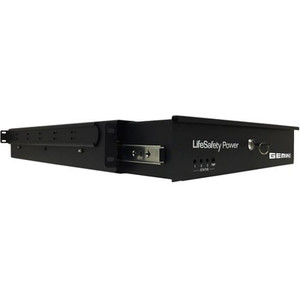
Lifesafety Power RC150B-C8D8 Rackmount Dual Voltage Lock Controller
The Lifesafety Power RC150B-C8D8 is a 19-inch rackmount power distribution unit designed for access control installations requiring simultaneous dual-voltage DC output. It supplies 12V@4A and 24V@4A on independent rails, with 8 dedicated lock control channels and 8 auxiliary relay outputs — eliminating the need for multiple power supplies when a single installation spans mixed-voltage solenoid locks, magnetic strikes, and auxiliary relay loads. This is the backbone that consolidates power distribution and switching logic in mid-to-large access control deployments.
Key Features
- Dual Independent Voltage Rails: 12V@4A and 24V@4A outputs operate simultaneously from a single chassis. Select voltage per door or per zone without powering multiple supplies.
- 8 Lock Control Outputs: Dedicated solenoid strike and magnetic lock channels with inrush current handling — scales across 8-door corridors or multi-entrance suites without external relay banks.
- 8 Auxiliary Relay Outputs: Isolated auxiliary channels for egress request inputs, door status sensors, alarm notifications, or future automation logic without consuming lock output capacity.
- 19-Inch Rackmount Chassis: Standard form factor stacks with access control panels, UPS modules, and network infrastructure in a single rack — reduces footprint and cabling complexity versus distributed PSU cabinets.
- Isolated Channel Design: Each lock and auxiliary output is electrically isolated from others and from the mains ground — prevents cross-voltage faults and simplifies troubleshooting in mixed legacy/modern panel environments.
- Thermal Protection & Monitoring: Built-in current limiting and thermal cutoff protect against solenoid stall and sustained overload — no external circuit breakers needed per channel.
- Compatible with Dual-Voltage Access Control Panels: Works with Lifesafety Power panels and third-party controllers that output isolated 12V or 24V logic signals — verify isolation before wiring to avoid ground loops.
In a typical deployment, the RC150B-C8D8 mounts directly below or above your access control panel in the server rack, receiving AC mains input through a backplate connection and distributing 12V/24V rails to door strikes, mag-locks, and auxiliary devices via screw-terminal or connector blocks. The dual-rail architecture means you can provision 12V locks on doors 1–4 and 24V strikes on doors 5–8 from the same unit — a significant operational simplification when you're retrofitting older 12V solenoid hardware alongside newer 24V mag-lock systems.
Power budgeting is straightforward: each voltage rail is independently rated at 4A, so the total load per rail (sum of all connected devices) must stay under 4A to avoid nuisance thermal shutdown. In practice, a solenoid strike draws 1–2A during energization and 0.5–1A held, and an auxiliary relay input typically draws <0.1A. This allows you to support 4–8 locks per rail depending on duty cycle and dwell time. For installations with higher per-channel loads or continuous duty requirements, Lifesafety Power offers larger models (RC300, RC600) — confirm your door hardware specs before selecting the unit.
The RC150B-C8D8 integrates directly into any 19-inch access control rack ecosystem. It expects AC mains input (typically 120VAC or 240VAC — check your unit's nameplate) and converts that internally to the dual DC rails. All lock and auxiliary outputs are common-negative with respect to ground; ensure your access control panel's signal outputs are isolated (not tied to panel ground) to prevent ground loop faults. When wiring to field devices, use appropriately gauged copper conductors: runs under 50 feet typically use 18–16 AWG; longer runs (50–150 feet) should step up to 14–12 AWG to minimize voltage drop, which directly reduces the holding force of solenoid coils and mag-lock electromagnets.
The Lifesafety Power RC150B-C8D8 carries full Lifesafety Power Manufacturer Warranty coverage and is UL 294 certified for access control power distribution. It is NDAA-compliant (US-manufactured control electronics) and poses no Section 889 supply-chain risk. The unit is designed to work seamlessly with Lifesafety Power's native access control panels (L7, L9, 3000 series) as well as compatible third-party systems (Salto, Keri Systems, HID VertX, Milestone XProtect with serial relay modules) that can output isolated switching logic. For integrators managing mixed-voltage or legacy installations, this controller represents the lowest-cost, highest-reliability consolidation point in a rackmount architecture.
Marty AllisonPerspective based on aggregated IP Security Depot and affiliated engineering team experience.
We've deployed the RC150B-C8D8 across a range of access control retrofits and greenfield campuses, and it consistently solves the "mixed voltage" problem that catches integrators off-guard. The scenario is almost always the same: you inherit a building with older 12V solenoid strikes on existing doors, and the new expansion wing specifies 24V mag-locks because they're cheaper to install and have lower stall current. Without a dual-voltage controller, you end up with two separate PSU racks, double the AC mains wiring, and a coordination nightmare when either system has a fault. The RC150B-C8D8 eliminates that by delivering both rails from a single compact chassis. The 8-channel lock + 8-channel auxiliary configuration is also deceptively flexible — most mid-tier access control ecosystems max out at 4 or 8 doors per panel, so pairing this unit with a single access panel covers a full building section without needing a secondary panel or messy external relay boards.
Technical Highlights:
- Independent Voltage Rails (12V@4A / 24V@4A): Each rail is separately fused and current-limited. You can draw the full 4A from 12V while simultaneously drawing 4A from 24V — total system power is approximately 96W, well within standard UPS/backup power budgets. This independence prevents a fault on one voltage class from crashing the other, which matters when a solenoid coil shorts and your 24V mag-locks need to stay energized for egress compliance.
- 8 Dedicated Lock Outputs + 8 Auxiliary Outputs: Lock channels are optimized for solenoid inrush (they'll tolerate brief high-current spikes during coil energization); auxiliary outputs are lower-current relay inputs and sensor returns. This separation means you don't accidentally apply 4A of solenoid inrush current to a sensitive door-sensor circuit. The auxiliary bank is typically used for request-to-exit buttons, sensor status monitoring, and tamper loops — adding auxiliary capacity without sacrificing lock channels.
- Isolated Channel Architecture: Every output floats with respect to mains ground. This is critical for legacy access control panels that were designed before modern isolation standards. When you wire the RC150B-C8D8 into an old Lifesafety Power L7 or a third-party system with non-isolated output logic, ground isolation prevents loop faults that would otherwise cause intermittent false events or nuisance solenoid energization.
- Thermal Cutoff & Current Limiting: The unit includes internal circuit protection per output — if a solenoid coil shorts or a door strike jams and draws sustained current above rating, the output de-energizes automatically and the unit logs a fault indicator. This prevents catastrophic failure of the entire system and beats relying on external breakers or installer-added fuses, which are often miscalibrated or absent.
- Compact Rackmount Form Factor: Takes up 2–3U of rack space depending on depth. Mounts directly adjacent to access control panels, NVR/video servers, and UPS modules — keeps cabling runs short and reduces the odds of ground loops or EMI coupling from long parallel wire runs.
Deployment Considerations:
- Verify Panel Output Isolation: The RC150B-C8D8 expects the access control panel's solenoid/relay outputs to be isolated from panel ground and mains ground. If your panel ties outputs directly to panel ground, you risk a ground loop. Before wiring, confirm isolation in the panel manual — test with a multimeter between the panel's output high-side and ground. Modern panels (HID VertX, Salto) are isolated by design; older panels may not be.
- Voltage Drop Over Long Runs: If a door strike or mag-lock is more than 50 feet from the rack, use 14–12 AWG copper to maintain full voltage at the device. We've seen jobs where integrators ran 18 AWG to a distant entrance and the mag-lock couldn't hold because of 2–3V drop — lock cycles followed, failures escalated. Measure the distance and right-size the wire upfront.
- AC Mains Input Voltage & Fusing: The RC150B-C8D8 has an internal transformer and expects either 120VAC or 240VAC input (check your unit label). The AC input should be fused at the mains panel per local code (typically 5–10A for this unit). Confirm the input voltage with the vendor before installation — a 120VAC unit fed 240VAC will destroy the transformer instantly.
- Load per Rail — Do the Math: Each rail is 4A. A typical solenoid strike draws 1–2A on pull-in and 0.5A held. Auxiliary relay inputs are <0.1A. If you plan to energize all 4 locks on a rail simultaneously, you'll consume 4–8A, which exceeds the 4A limit and triggers thermal cutoff. In practice, lock duty cycles are staggered, so simultaneous energization is rare — but confirm your application profile and consider duty cycle or a larger Lifesafety Power model (RC300) if sustained multi-door unlock is required.
- Grounding & EMI in Mixed Environments: When the RC150B-C8D8 shares a rack with video servers or network switches, EMI coupling can introduce false door-sensor events. Use shielded twisted-pair for long sensor returns, maintain separate cable trays for power and signal, and bond rack rails to the facility ground bus. This is standard practice but often overlooked in fast deployments.
The RC150B-C8D8 is the right choice for system architects managing mid-to-large access control deployments in existing buildings or campuses where voltage standardization isn't feasible, and for integrators who want to consolidate power distribution into a single reliable rackmount module. It's not a substitute for a full UPS or backup power strategy — you'll still need battery backup for life-safety egress compliance — but it is the most cost-effective way to deliver stable, isolated dual-voltage DC power to 8 access-controlled doors from a single chassis. For deeper integration guidance and alternative Lifesafety Power controllers, see the Lifesafety Power catalog.