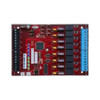
Lifesafety Power R8-BOXED 8-Output Lock Module
The Lifesafety Power R8-BOXED is a dedicated auxiliary lock output module designed to expand electromagnetic lock and door strike control in multi-door access control systems. With eight independently fused outputs rated 3A per circuit at 12VDC, the module isolates each lock on its own protection circuit—a single shorted lock or wiring fault will not cascade failure to adjacent doors. This distributed fusing architecture is essential in facilities where a doorway outage triggers evacuation delays, facility lockdown complications, or loss of revenue.
Key Features
- Eight Independent Outputs: 12VDC, 3A per output. Each circuit individually fused—a fault on one output does not affect the remaining seven.
- Failsafe / Fail-Secure Selection: Field-selectable per output via jumper. Failsafe unlocks on power loss (life-safety egress); fail-secure locks on power loss (access denial).
- Supervised Output Monitoring: FAI (Fault Alert Interface) supervision detects open circuits, short circuits, and power-supply anomalies—alerts propagate to the host panel for instant response.
- 12VDC Power Supply: Compatible with standard access control power infrastructure; accepts 12VDC from panel or external supply.
- Compact Module Form Factor: DIN-rail or wall-mount installation in electrical enclosures, control rooms, or distributed equipment closets.
- Wired Integration: Direct hardwired connection to access control panel lock outputs; no IP or network dependency—pure relay logic ensures reliability in critical-path security.
The R8-BOXED is typically deployed in mid-to-large access control systems where a single panel output count is insufficient to handle all door locks. Typical scenarios include multi-floor buildings (one module per floor), campus deployments (lobby + perimeter doors on separate outputs), and high-security facilities requiring granular per-door failsafe policy. The per-output mode selection ensures that life-safety exits can remain failsafe while server-room or vault doors are fail-secure—no need for secondary relays or external circuitry to match diverse lock behaviors.
Supervision via FAI is a critical operational feature. Unlike passive hardwired circuits, FAI detects a shorted solenoid before it draws excessive current, or an open wire before an authorized unlock attempt silently fails. In a 50-door facility with eight modules, real-time fault visibility prevents the scenario where a single bad lock cable goes undetected for weeks, only discovered when an authorized user cannot gain entry. Integration with your access control panel's alert stream (typically via supervised relay input or network messaging, depending on panel type) ensures maintenance staff respond within minutes, not days.
Compatibility is controller-specific. The R8-BOXED is designed as a plug-in auxiliary module for access control panels that provide dedicated lock-output expansion ports. Confirm your panel supports external lock modules—legacy panels with fixed onboard outputs may not offer an expansion interface. Cross-reference the R8-BOXED against your controller's documentation, and verify that your panel's firmware supports supervised output monitoring on auxiliary modules. IPSD pre-sales engineering can assist with compatibility assessment; contact support with your panel make, model, and firmware revision.
Installation best practices: wire each output with appropriate gauge conductors for its load. A 12VDC electromagnetic lock typically draws 0.5–2A; 3A per output supports dual locks or high-inrush solenoids. Use stranded, rated cable (18 AWG for <25 feet, 16 AWG for longer runs) to minimize voltage drop. Failsafe/fail-secure jumper positions should be documented in a system diagram and photographed during commissioning—future technicians will thank you when reconfiguring a door's lock mode during a retrofit. All eight outputs are live once 12VDC is applied; ensure the module is de-energized before any maintenance or reconfiguration work.
Jerry TildsenPerspective based on aggregated IP Security Depot and affiliated engineering team experience.
In our experience, the R8-BOXED fills a critical gap in mid-scale access control deployments where a single panel's onboard lock outputs are exhausted. We've commissioned this module in office parks, medical facilities, and light-manufacturing plants—typically where the main controller sits in a basement comm room and branch door controllers are distributed across multiple floors. The per-output fusing is not a luxury; it's a lessons-learned feature. We once troubleshot a 40-door system where a single shorted solenoid had disabled half the facility's exits because the entire lock circuit was on a single 8A fuse. Upgrading to the R8-BOXED and splitting those doors across individual 3A circuits eliminated the cascading failure mode and cut incident response time from hours to minutes. The real operational win is the supervised output monitoring—FAI alerts catch wiring faults and solenoid failures before they become security incidents. Pair this module with a panel that logs supervision events, and you get a maintenance dashboard showing which outputs are drifting into fault conditions, enabling proactive replacement before user-facing downtime.
Technical Highlights:
- Individual 3A Output Fusing: Protects each lock circuit independently. A shorted solenoid or cut wire on one output blows only that output's fuse, leaving seven outputs live. On a 50-door facility, this is the difference between one locked door and a full-facility lockdown.
- Per-Output Failsafe / Fail-Secure Jumper: Rare in auxiliary modules. Most expansion boxes force all outputs to one mode. This design allows life-safety exits (lobby, stairwell) to remain failsafe while secure areas (server room, vault) are fail-secure, all from a single module—no external relay logic required.
- FAI Supervision: Detects open circuits (broken wire), short circuits (solenoid coil short), and power-supply anomalies. In a hardwired system with no network, this is your only real-time health visibility. Panel integration varies by controller; confirm your panel accepts FAI input on auxiliary module ports.
- 12VDC Standard Supply: Plays well with existing access control infrastructure. Most panels have redundant 12VDC supplies; no need for additional external power conditioning.
- Compact Form Factor: DIN-rail mount in the panel's electrical enclosure or in a separate cabinet near door controllers. Reduces cable runs and voltage drop on long solenoid circuits.
Deployment Considerations:
- Verify your panel has an auxiliary lock-output expansion port and supports supervised monitoring on external modules. Legacy panels (10+ years old) may not have this interface—contact the panel manufacturer or IPSD support with your model number before procurement.
- Wire gauge matters. A 12VDC lock 50 feet away from the module on 22 AWG wire will cause excessive voltage drop and sluggish solenoid response. Run 16 AWG or better; use crimp terminals and solder connections at the module terminals to minimize contact resistance.
- Failsafe/fail-secure jumper positions are field-selectable but not hot-swappable. Module must be de-energized to reposition jumpers. Create a configuration diagram and photograph jumper positions during commissioning—future maintenance depends on knowing which doors are failsafe vs. fail-secure.
- FAI supervision requires the panel to accept supervised relay input (typically via a dedicated supervised zone on the main controller). If your panel does not support supervised outputs, the R8-BOXED still works—it just becomes a passive expansion box with no fault visibility. Confirm this feature before design to ensure you get the operational benefit.
- In high-ambient-temperature environments (mechanical rooms, rooftop cabinets), thermal derating may apply. Each 3A output is rated at 12VDC; ensure the module is mounted in a ventilated enclosure or cabinet to prevent fuse nuisance trips caused by internal heat rise.
The R8-BOXED is the right choice for integrators and facility teams that need reliable, granular lock output expansion without network complexity or firmware compatibility headaches. If your system includes multiple door types (life-safety vs. secure access) in a single deployment, the per-output failsafe selection is a genuine differentiator. For facilities prioritizing fault visibility and proactive maintenance, FAI supervision turns a passive expansion module into a condition-monitoring asset. Explore the full Lifesafety Power catalog to compare with single-output modules or network-based lock controllers for larger, more complex deployments.