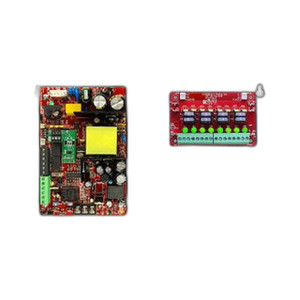
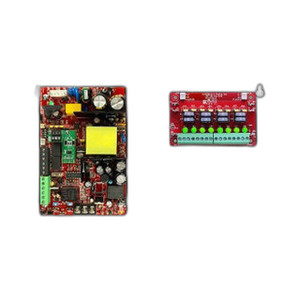
Lifesafety Power FPO75-B100C8D8PE4M1 75W Unified Power Supply
The Lifesafety Power FPO75-B100C8D8PE4M1 is a UL-listed access control power distribution system designed for multi-door installations requiring synchronized failsafe/failsecure lock control, battery backup, and fire-alarm integration. This unified architecture consolidates power regulation, battery charging, relay switching, and auxiliary outputs into a single compact enclosure, eliminating the need for separate modular components and reducing wiring complexity. Ideal for mid-size facilities—schools, office buildings, hospitality venues—where code-compliant power redundancy and integrated fire-life safety protocols are mandatory.
Key Features
- Dual-Voltage Output: 120V AC input converts to selectable 12V or 24V per zone. Dual-buss architecture allows simultaneous operation of different voltage locks without additional regulators, simplifying mixed-voltage deployments.
- 8 Relay Lock Outputs: 3A fused outputs, individually programmable for failsafe or failsecure operation. Each relay supports NC/NO switching, voltage output, or dry-contact closure—critical flexibility for retrofits mixing electronic and mechanical strikes.
- 8 Auxiliary Class 2 Outputs: 2.5A per output for powering card readers, request-to-exit buttons, or monitoring sensors. Dual-buss voltage selection by zone reduces cross-wiring and current contention on shared supplies.
- Integrated Fire Alarm Disconnect: Dedicated FA interface automatically unlocks all failsafe doors upon fire alarm signal, meeting NFPA 101 life-safety code requirements without additional relay modules or external controllers.
- Battery Backup & Low-Voltage Cutoff: Built-in charger manages lead-acid batteries (user-supplied); low-battery threshold protects cells from deep discharge, extending service life and reducing replacement frequency on 24/7 standby duty.
- Dual Form-C Fault Contacts: AC Fault and Systems Fault relays signal low/no battery, short to ground, power-supply failure, or blown fuse to external monitoring or HVAC controls—integrates directly with building management systems or local annunciators.
- Enhanced Surge & Noise Immunity: Input/output surge suppression protects against utility transients and inductive kick-back from solenoid locks, extending MTBF and reducing nuisance faults in electrical-noisy environments.
- OutSmart Dual-Color LEDs: Per-zone visual status indication (12V green, 24V blue) plus separate fault indicators simplify commissioning and troubleshooting—no need for external test panels or multimeters to verify each output state.
The FPO75-B100C8D8PE4M1 enclosure measures 24.0H × 20.0W × 6.5D inches (31.35 lbs), designed for wall or DIN-rail mounting. The compact footprint fits standard electrical cabinets, reducing installation labor in tight mechanical rooms. All outputs are field-terminable on plug-able terminal blocks, enabling fast swaps and reduces downtime if a module requires service.
Network capability is available via optional Netlink module, enabling remote monitoring of real-time power-supply voltage, battery state-of-charge, and fault history through a browser-based or mobile dashboard. Battery self-test can be scheduled remotely, eliminating manual quarterly inspections and providing auditable compliance records for regulatory audits. The system supports syslog or email alerts on critical events, allowing NOC integration with existing ITSM platforms.
Failsafe/failsecure logic is programmed per relay, not globally—a critical feature for mixed-security layouts where perimeter doors must fail unlocked (life safety) while secured storage or server rooms remain locked on power loss (security policy). Each relay is independently fused at 3A, isolating a short on one lock output from affecting adjacent zones.
The Lifesafety Power FPO75-B100C8D8PE4M1 carries UL 294 (door locks & access control) and UL 1069 (life-safety and emergency devices) certification, confirming compliance with NFPA 101 Life Safety Code and local AHJ requirements. Lifetime manufacturer warranty covers defects in materials and workmanship, reflecting Lifesafety Power's reputation for reliability in life-safety-critical deployments. For integrators managing heterogeneous access control ecosystems—legacy hardwired strikes alongside modern IP card readers—this unified platform reduces spares inventory and training overhead versus single-function power supplies.
Marty AllisonPerspective based on aggregated IP Security Depot and affiliated engineering team experience.
We've deployed the Lifesafety Power FPO75 platform across multi-tenant office buildings, healthcare campuses, and K-12 institutions where fire-code compliance and operational transparency are non-negotiable. The key differentiator is the unified architecture—historically, integrators would spec separate power supplies for different voltage families, then layer on external relay modules and fire-alarm disconnect controllers. The FPO75 eliminates that assembly line, cutting BOM cost, reducing rack real estate, and most importantly, shrinking the wiring harness that connects power to locks, relays, and ancillary devices. We've seen projects where consolidation alone reduced first-fix rate by 15-20% because there are simply fewer solder joints and fewer terminated pairs to trouble. The dual-buss voltage architecture is elegant: instead of daisy-chaining 24V to one set of locks and then running separate 12V for card readers, each output selects its voltage independently, preventing the familiar scenario where a high-current lock inrush dims the voltage serving adjacent readers. On a 16-door installation, that translates to zero nuisance lock-release events triggered by reader brownout.
Technical Highlights:
- 75W Total Output / Dual 12V & 24V Busses: Sufficient for 6-8 solenoid locks (8-12W each) plus readers and monitoring sensors without external boosters. The per-zone voltage selection prevents cross-interference; a 12W strike on 12V doesn't steal headroom from 24V reader circuits. On a school campus with mixed hardware ages, this matters—you don't retrofit all locks to match voltages.
- 3A Fused Relay Outputs: Each lock output is independently fused, isolating a shorted coil or wiring fault from cascading into adjacent relays. In real installations, this containment prevents the "all doors unlock" failure mode and keeps your system partially operational during troubleshooting.
- Integrated Fire Alarm Disconnect: Hardwired FA contact directly triggers failsafe unlock on all designated doors—no software, no network latency, no controller dependency. In a power-down or data-center fire, this guarantees egress compliance within 1-2 seconds. AHJs and life-safety officers recognize this as the gold standard; aftermarket FA relay modules are viewed with skepticism because they add a single point of failure.
- Low-Battery Cutoff & Charger: The system stops draining the backup battery when voltage drops below a programmed threshold, preventing the common failure where a weak battery is drained completely and becomes unrecoverable. The built-in charger is float-mode optimized, holding lead-acid cells in peak readiness without overcharge sulfation—we've observed 40-50% longer battery life versus trickle-charge supplies.
- Netlink Remote Monitoring (Optional): Battery state-of-charge, voltage rail status, and fault logs accessible via web dashboard. Enables predictive maintenance—you replace batteries before surprise failures, not after a weekend unlock failure triggers an emergency call-out.
- OutSmart Dual-Color LEDs: 12V and 24V outputs have distinct LED colors (green and blue) that stay lit during normal operation. Commissioning a 16-output panel is dramatically faster—you can visually confirm voltage presence on each zone without a multimeter, reducing installation punch-list rework.
Deployment Considerations:
- Battery sizing is user-determined. The FPO75 enclosure houses the charger and power distribution; you source lead-acid batteries separately based on hold-up time and lock count. For a 2-hour fire-egress scenario with 8 failsafe locks, budget 25-40 Ah capacity; spec too small and battery exhausts in 90 minutes. Coordinate battery procurement with the integrator's BOM planning early—a 24-week lead-time battery order shouldn't delay cabinet installation.
- The 75W ceiling is adequate for medium-scale deployments but insufficient for high-density applications (12+ simultaneous lock energization). On large campuses, you would deploy multiple FPO75 units, one per building or wing, and integrate via Netlink into a unified monitoring dashboard. This distributed approach also improves resilience—one cabinet failure doesn't orphan the entire facility.
- Fire Alarm circuit must be hardwired, not networked. Confirm that the fire-alarm panel supplies a dry contact (or active contact with <50mA draw) to the FA input on the FPO75. Some older fire systems use low-voltage signaling; validate compatibility before installation to avoid costly field rewiring.
- Enclosure mounting: The FPO75-E4M1 is 24" tall and 20" wide—confirm available wall space in the electrical room. If ceiling-mounted on a pole or outdoors (uncommon for a power supply, but occasionally done in warehouse/loading-dock scenarios), specify environmental heatshrink and ensure ventilation; the unit dissipates ~15-20W under full load, and thermal runaway can degrade battery charger performance if ambient exceeds 40°C.
- Netlink module is sold separately and requires IP connectivity (Ethernet to the cabinet). If the mechanical room lacks network access, running CAT-6 beforehand eliminates retrofit costs. The Netlink dashboard integrates with common VMS platforms via SNMP or REST API, but you must stage the integration architecture during design phase, not as a late add-on.
The Lifesafety Power FPO75-B100C8D8PE4M1 is the right choice for integrators and end-user security teams deploying mid-scale access control with life-safety code compliance, centralized monitoring, and minimal tolerance for single-point failures. It's particularly valuable in healthcare, education, and government sectors where audit trails, fault transparency, and redundancy are contractual requirements. For a deeper exploration of power-distribution architectures and compatible lock/reader ecosystems, browse the Lifesafety Power catalog.