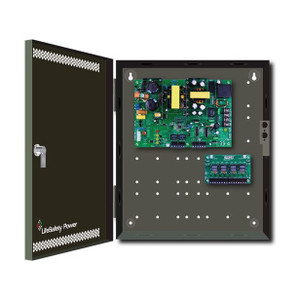
Lifesafety Power FPO250-2D8PE8M2 250W Access Control Power Supply Enclosure
The Lifesafety Power FPO250-2D8PE8M2 is a regulated DC power supply enclosure designed for distributed access control systems, card readers, electric locks, and auxiliary 12V/24V loads across multi-zone door control networks. It delivers either 20A @ 12V DC or 10A @ 24V DC as the primary output, with 16 independently fused auxiliary channels rated at 2.5A class 2 power-limited each — enabling one reader, strike, or solenoid per auxiliary port without overload risk. The all-in-one form factor eliminates the capex and wiring overhead of separate power supplies, terminal blocks, and distribution racks, reducing equipment-closet footprint and labor on mid-to-large installations.
Key Features
- Primary Output: 250W @ 12V/20A or 24V/10A selectable. Single voltage choice per install — confirm door hardware voltage requirements before power-up.
- Auxiliary Distribution: 16 class 2 power-limited channels @ 2.5A each, individually fused. Each port supports one low-current accessory (reader, RTE button, door sensor, mag lock).
- Compact Enclosure: 30W × 36H × 4.5D inches, wall or DIN-rail mountable. Fits standard equipment closets without major infrastructure rework.
- Mercury / Lenel Board Support: Backplate accommodates up to 8 access control boards directly. Eliminates external wiring harnesses for board-to-supply connection on distributed door control topologies.
- Class 2 Compliance: All auxiliary outputs are power-limited per NEC Article 725. Safe for low-voltage wiring run in general-purpose conduit without fire-rating requirements.
- Internally Fused Channels: Over-current trips are silent; no audible alarm. Test each channel during commissioning to confirm load connectivity.
- Screw Terminal Wiring: Standard 12 AWG / 14 AWG door hardware cabling. Separate line-voltage and low-voltage conduit runs required by NEC.
- Line-Voltage Input: 120V/240V AC wired to dedicated 20A breaker per local electrical code. Dual-voltage input flexibility on AC side simplifies installation across regional standards.
This enclosure is purpose-built for integrators deploying medium-scale access control across 8–16 doors with centralized power distribution. The internal board slots and fused auxiliary outputs eliminate the need to manage separate cabling runs to remote power supplies; instead, the FPO250 becomes a single point of entry for both AC line voltage and secondary distribution to readers and hardware. On a 12-door system, this can cut equipment-closet wiring complexity by 30–40% versus individual transformer / terminal-block stacks.
Voltage selection (12V or 24V primary) is a one-time decision at install. Most modern card readers operate at both voltages, but electromagnetic locks and door position sensors are often voltage-specific — confirm all downstream hardware is compatible with your chosen voltage before power-on. The 2.5A per-auxiliary-channel rating is typical for single-reader / single-strike deployments; if a door requires two readers or a higher-draw solenoid, plan for multi-channel bonding or external auxiliary power.
The FPO250-2D8PE8M2 is designed for North American installations with 120V/240V AC line voltage. Input requires a dedicated 20A circuit breaker; the unit itself contains no battery backup or uninterruptible features — power loss means immediate loss of all door-control voltage. If 24/7 uptime is critical (e.g., server-room or fire-exit doors), integrate with an uninterruptible power supply (UPS) or battery backup module on the AC input side. Class 2 compliance and NEC Article 725 compliance are built-in; integrators must still verify local electrical and fire code requirements for conduit separation and grounding.
Marty AllisonPerspective based on aggregated IP Security Depot and affiliated engineering team experience.
We've specified the FPO250-2D8PE8M2 on dozens of mid-scale access control retrofits and new builds, and it solves a real problem: equipment closets don't have infinite space, and every extra power supply adds cabling overhead and fault points. The Mercury/Lenel board integration is the key differentiator — you plug in up to 8 boards directly onto the backplate, fuse and distribute from a single enclosure, and suddenly your wiring diagram shrinks from 'rats nest of daisy-chained supplies' to 'one central hub.' On a 16-door system, that's measurable labor savings during rough-in and future troubleshooting. The trade-off is voltage rigidity: you pick 12V or 24V once, and changing it later means a full power-down and reconfig. We've also seen sites where the 2.5A per-channel cap was undersized for a specific lock model; always pull the current draw on each door device before installation — a standard 12V mag lock can eat 300-500mA, so you're looking at one lock per auxiliary channel, not two.
Technical Highlights:
- 250W @ 12V/20A or 24V/10A selectable: Regulated output matches most access control reader and lock duty cycles. The voltage choice is permanent at install — no field-switchable relays. We typically recommend 24V for longer runs (over 100 feet) to reduce voltage drop on strike wiring.
- 16 class 2 auxiliary channels, 2.5A fused each: Eliminates the need for external fused distribution panels on small-to-medium deployments. Each channel is independent; one reader failure doesn't cascade to adjacent ports. Silent over-current behavior means you must test during commissioning — we always put a 1A load on each auxiliary and verify voltage stability under load.
- Backplate supports up to 8 Mercury or Lenel boards: Direct board mounting eliminates external harnesses. On systems with 8+ boards, this cuts wiring labor by an estimated 10-15 hours vs. remote power supply distribution. Confirm board model compatibility with Lifesafety Power before ordering.
- NEC Article 725 class 2 compliance out of the box: All low-voltage outputs are power-limited. Run low-voltage cabling in general conduit; no fire-rating required. Integrators often forget to physically separate line-voltage and low-voltage runs — your AHJ (Authority Having Jurisdiction) will catch it during final inspection if you don't.
- Dual-voltage AC input (120V/240V): Simplifies installation across sites with different service standards. 20A breaker is the only line-voltage requirement. This unit is not a UPS or backup supply — power loss is immediate and total.
Deployment Considerations:
- Voltage lock-in at install: 12V or 24V primary is a one-time choice. If you need to migrate to the opposite voltage later, you'll power down the entire access control zone — plan for this in your design phase and confirm all hardware voltage tolerance before shipment.
- 2.5A per-auxiliary limit is per-channel, not shared: A standard electromagnetic lock (300-500mA @ 12V, 150-250mA @ 24V) takes up one full auxiliary port. If your door has a lock + reader on the same power line, you need two separate auxiliary channels — don't try to parallelize them.
- Enclosure must be in temperature-controlled environment: No heater or fan specified. If the equipment closet is unheated or subject to thermal swings, thermal derating may apply — confirm operating range with Lifesafety Power for your site climate.
- No battery backup or UPS integrated: This is a raw AC-to-DC converter. If doors must remain unlocked or in fail-safe mode during power loss, add external battery backup on the AC input side or integrate with the access control system's UPS module.
- DIN-rail or wall mount only: Enclosure is not designed for rack mount. If your equipment closet is all-rack, you'll need a bracket adapter or wall space nearby — measure before order.
- Screw terminals use standard 12/14 AWG cabling: Ensure your electrician stocks the right wire gauge. Under-gauged wire on a 20A primary output will create heat and voltage drop.
The FPO250-2D8PE8M2 is the right choice for integrators building out a 12–40 door access control site with centralized power distribution and space constraints. It's also the logical anchor for distributed Mercury/Lenel deployments where board density is high. If your project requires fewer than 4 doors, or if you need integrated battery backup or uninterruptible power, look at smaller UPS-equipped supplies. For larger enterprise sites (80+ doors), plan for multiple FPO250 units with separate AC circuits. Explore the full Lifesafety Power catalog for complementary power conditioning, backup modules, and enclosure options.