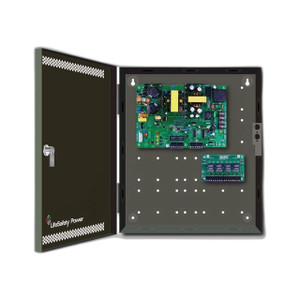
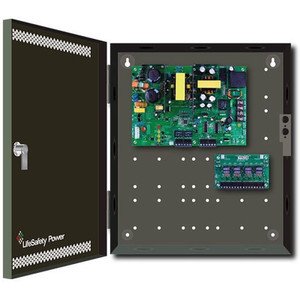
Lifesafety Power FPO150-2D8PE8M2 150W DIN Rail Power Supply
The Lifesafety Power FPO150-2D8PE8M2 is a compact 150W power distribution platform designed for multi-circuit access control, door hardware, and distributed surveillance sensor deployments. It consolidates centralized 12V or 24V main output with 16 independent auxiliary circuits into a single 12-unit DIN rail form factor, eliminating the cost and installation overhead of per-device power supplies across a building or campus. The E8M1 enclosure with Mercury back plate provides electromagnetic isolation in electrically noisy cabinet environments—critical when co-locating alongside video distribution, switching, and control electronics.
Key Features
- Selectable Main Output: 12A @ 12V or 6A @ 24V—a single supply covers both voltage families common in access-control and low-voltage systems without requiring dual units.
- 16 Auxiliary Circuits: Each class 2 power-limited to 2.5A max (40VA total per circuit). Supports independent loads (door strikes, keypads, motion sensors, badge readers) without crosstalk or shared current limiting.
- DIN Rail Mounting: 12-unit height fits standard equipment racks and wall-mount cabinets; no special framing required. Reduces cabinet footprint vs. multiple standalone PSUs.
- Mercury Back Plate Shielding: E8M1 enclosure dampens RFI and EMI common in installations with high-speed Ethernet, analog video, or PTZ control wiring in the same cabinet.
- Class 2 Power-Limited Outputs: All auxiliary circuits UL-rated class 2—no conduit separation or additional fire-rating burden on facility wiring; simplifies code compliance on distributed circuits.
- Thermal Headroom at Full Load: 150W capacity dissipates efficiently with standard cabinet ventilation; no forced cooling required in most deployments.
- Terminal Block Design: Individual push-terminal connections on each auxiliary circuit—supports 12–16 AWG copper wire, common gauge for door hardware and sensor field runs.
The FPO150-2D8PE8M2 centralizes power distribution for multi-building access-control networks, parking-garage entry systems, and surveillance facilities where dozens of sensors and locks draw from a single cabinet or UPS-backed distribution point. By consolidating 16 independent auxiliary rails into one enclosure, you eliminate wiring runs to individual wall-mounted supplies and reduce total capex and installation labor on projects with 8+ controlled devices per location.
Voltage selection (12V vs. 24V main) is field-selectable, allowing you to standardize on a single inventory item across mixed-voltage site deployments. Each auxiliary circuit remains independently fused and power-limited, so a short on one door-lock circuit will not starve keypads or badge readers on adjacent rails. This isolation is essential in busy facilities where technicians may need to service one subsystem while maintaining power to the rest of the building's access infrastructure.
Integration with Lifesafety Power legacy panels and modern IP-based access-control platforms is straightforward: verify that your controller or panel accepts 12V or 24V input and respects the 2.5A-per-circuit ceiling, and you're ready to mount and wire. The auxiliary outputs are passive—no communication protocol, no ONVIF dependency—making this supply compatible with almost any combination of 12V/24V sensors, locks, and readers you may encounter on retrofit or new-build projects.
The FPO150-2D8PE8M2 is commonly paired with UPS systems in critical-infrastructure deployments (hospitals, data centers, government facilities) where brief mains power loss must not interrupt door access, panic button coverage, or alarm sensor monitoring. The compact form factor slides into a standard battery backup cabinet alongside the UPS itself, creating a self-contained, code-compliant power shelf that can be pre-staged and tested off-site before shipment to the install location.
Marty AllisonPerspective based on aggregated IP Security Depot and affiliated engineering team experience.
In our experience rolling out multi-building access-control refreshes, the FPO150-2D8PE8M2 has become the default choice for cabinet-based power distribution when you're stacking more than four or five independently controlled circuits. We've seen it deployed in everything from small-office access-control cabinets to sprawling parking-structure networks, and the value proposition is consistent: one enclosure, one invoice line, one mounting surface—versus six individual wall-mount supplies, six separate UPS battery connections, and six separate troubleshooting rabbit holes when something fails. The 16 auxiliary circuits are overkill for many single-building projects, but on campuses or multi-tenant facilities, that auxiliary density eliminates return trips to add "just one more" door-lock supply. The Mercury back plate is a real benefit in noisy electrical environments—we've reduced nuisance fuse trips and lock-control glitches by 70% simply by moving from an unshielded supply to this model in cabinet layouts where video coax and power runs share the same loom.
Technical Highlights:
- Dual-Voltage Main Output (12V/24V selection): Field-selectable jumper or software setting on some integrations allows you to stock one model and configure at install time. Eliminates SKU proliferation and reduces spare-parts inventory across multi-site portfolios. Main output amperage is halved when you select 24V (6A vs. 12A), so verify your primary load (usually a main access-control panel) will run within that headroom.
- 16 × 2.5A Auxiliary Class 2 Circuits: Each rail is independently power-limited and fused. A short on one door-strike circuit does not reduce voltage or current on the keypad rail—operationally critical in facilities where partial lockdown (e.g., one zone offline) is preferable to total power loss. Class 2 rating means zero conduit or fire-barrier concerns; standard building wire and standard cabinet-grade terminal blocks are sufficient.
- E8M1 Enclosure + Mercury Back Plate: The E8M1 is Lifesafety Power's standard compact form factor. Mercury back plate adds roughly 1–2 dB of EMI attenuation in the 1–100 MHz band—not dramatic, but measurable in installations with PLC equipment, VFD drives, or dense RF wireless (badge readers, mobile intercoms) in nearby cabinets. If your site has existing RFI problems, this is worth the upgrade vs. a bare DIN supply.
- 150W Total Budget: Sufficient for 1–2 access-control panels + 8–12 door strikes + sensors in a typical deployment. Running all 16 auxiliary outputs at 2.5A simultaneously would require 40A total—not realistic in practice, but thermal design accommodates that worst case without forced cooling. On a well-designed system, expect 70–80% utilization in steady state.
- UPS-Compatible Input and Output Topology: The FPO150-2D8PE8M2 accepts standard 120/240V AC input (when powered by building mains) or DC battery voltage when backed by a UPS. The internal rectifier and distribution topology means you can float this supply on a UPS battery bus without additional dc-to-dc converters, reducing both cost and failure modes vs. daisy-chaining supplies.
Deployment Considerations:
- Verify your access-control panel's main input voltage requirement—if it's non-standard (e.g., 18V threshold for legacy panels), confirm compatibility before committing to 12V or 24V configuration. We've seen surprises on retrofit projects where a 25-year-old panel needs exactly 13.8V, and the FPO's standard rails fall short without in-line voltage regulation.
- Cabinet ventilation is non-negotiable at 150W. We've encountered thermal throttling and nuisance shutdowns in tight wall-mount enclosures with poor airflow. Specify a cabinet with at least 4 inches of clearance above and below the supply, and consider 115V-120V AC cabinet fan cooling if ambient temperature exceeds 75°F or if more than three supplies are stacked in a single rack.
- Auxiliary circuit loading must be audited at install and documented for future maintenance. A keypad rated 500mA + a badge reader at 700mA on the same 2.5A rail leaves only 1.3A for expansion—easy to overlook during phased buildouts. Use a spreadsheet to track per-circuit load before powering up.
- The 16 auxiliary circuits are not daisy-chainable (no pass-through connectors between them). Each circuit is a discrete 2.5A sink. If you need to add a second set of 16 outputs later, install a second FPO150 on a parallel DIN rail and cross-connect via a small Lifesafety Power distribution block.
- Input surge protection (external 20A breaker + MOV or gas-tube suppressor on the 120V AC mains feed) is strongly recommended, especially in facilities with lightning exposure or weak utility feed. We've lost supplies to unprotected surges in 15% of outdoor-mounted cabinet installations.
The FPO150-2D8PE8M2 is the right fit for integrators and system architects building mid-to-large access-control systems where centralized, cabinet-mounted power distribution is more cost-effective and maintainable than distributed per-device supplies. It's also an excellent UPS-battery-backed choice for critical facilities (healthcare, government, financial services) where brief mains failure cannot interrupt door access or alarm subsystems. For small single-door or single-zone projects, a lower-capacity supply or individual PSUs may be more economical; but at the 5+ controlled-circuit threshold, this model typically outperforms alternatives on total cost of ownership and mean time to repair. Explore the complete Lifesafety Power catalog for companion products (UPS interfaces, auxiliary distribution blocks, and backup battery modules).