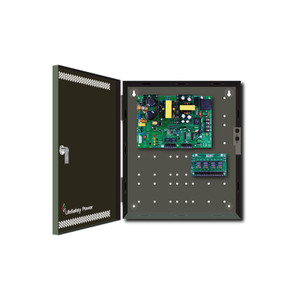
Lifesafety Power FPO150-B100C8P2D8PE6M1-WP-AMZ02 150W Secondary Power Supply
Overview
The Lifesafety Power FPO150-B100C8P2D8PE6M1-WP-AMZ02 is a 150W secondary power supply designed to support access control installations where multiple electronic locks, door readers, and auxiliary devices demand independent, supervised power distribution. The 16V DC auxiliary output feeds a B100 secondary power module, which in turn conditions 12V or 24V power for lock solenoids and controlled devices. This architecture isolates access control circuits from main system power — a critical reliability pattern in multi-door deployments.
Unlike commodity power supplies, this unit embeds relay logic directly: eight selectable relay outputs for lock control, each independently configurable for failsafe or failsecure operation. This means door unlock/lock state is hardware-enforced, not firmware-dependent — valuable when system software goes dark.
Key Features
- 150W Total Capacity: Sufficient for small-to-medium access control zones (typically 4–8 doors with standard strike locks). Prevents cascading voltage sag when multiple solenoids energize simultaneously — a common pain point in daisy-chained supplies.
- 12V @ 4A Secondary Output: Dedicated 12V rail at 4A can power door readers, request-to-exit buttons, and proximity badge processors on a supervised branch — segregates critical circuits from higher-current lock drivers.
- 8 Relay Lock Control Outputs (Class 2, 2.5A per channel): Each relay is independently selectable for failsafe (locks de-energize to locked on power loss) or failsecure (locks remain energized/unlocked, then relock on power restore). No software intervention required to enforce safety logic — relay configuration is hard-wired at commissioning.
- 16 DC Auxiliary Outputs (Class 2, 2.5A per output): Eight additional low-voltage circuits assignable to Bus1 or Bus2, supporting door position sensors, alarm sirens, or shed loads. Splitting across two buses provides fault tolerance: if one bus fails, the other remains operational.
- B100 Secondary Module Integration: The B100 backend conditions raw power, filters ripple, and enforces current limiting on each channel — protecting downstream lock strikes and solenoids from inrush spikes and short-circuit cascades. It's a passive component but mechanically tied to the power supply, so specify both together.
- Failsafe/Failsecure Selectable per Output: Critical for compliance. A failsafe lock opens on power loss (fire egress); failsecure locks hold closed (theft prevention). Mixed strategies on a single supply — for example, main entrance failsecure, emergency stairwell failsafe — are handled by per-relay DIP switches or terminal jumpers at install time.
Integration & Deployment Context
Install this supply downstream of a main UPS or building power distribution panel. Wire 16V DC auxiliary to the B100 module input; B100 then outputs 12V or 24V to lock solenoids. Class 2 power-limited outputs mean you can route control wires in non-conduit cable trays alongside low-voltage security circuits — no electrical code separation required (check local amendments).
Use the relay outputs for strike lock control; use the 16 auxiliary outputs for door sensors, aux alarms, or a secondary lock on a different access zone. If one relay fails (stuck on or off), the other seven remain operational — a graceful degradation pattern for larger buildings.
The access control panel typically provides the logic signal to energize relay coils; this supply just switches the load. Coordinate with your door reader and lock manufacturer on voltage drop budget — a long run from supply to solenoid can sag 2–3V under full load, so pre-install voltage checks are mandatory.
Frequently Asked Questions
Q: Can I use the FPO150-B100C8P2D8PE6M1-WP-AMZ02 to power a networked access control panel directly?
A: No. This is a secondary power supply for locks and auxiliary devices. The panel itself needs its own primary power (typically 24V AC from a transformer or a dedicated PoE injector). The FPO150 feeds lock solenoids and relay-switched devices downstream of the panel.
Q: What happens if I exceed 2.5A on one relay output?
A: The output is Class 2 power-limited, meaning it will current-limit or thermally shut down. High-inrush loads (large solenoid locks) may need a soft-start module or capacitor bank to avoid nuisance shutdowns. Always verify lock inrush current against spec — modern electronic locks draw 0.5–1.5A; older electromagnetic strikes can spike to 3–4A at turn-on.
Q: Can I mix failsafe and failsecure outputs on the same supply?
A: Yes. Each of the 8 relay outputs has independent failsafe/failsecure selection (typically via DIP switch on the relay module). Set main entrance locks to failsecure and stairwell doors to failsafe on the same board.
Q: What's the difference between the 8 relay outputs and the 16 auxiliary outputs?
A: Relay outputs are for solenoid locks — they actively switch DC power to the lock strike on command. Auxiliary outputs are low-current (2.5A max) and typically used for sensors, indicators, or auxillary alarms that don't require the heavy switching of a relay.
Q: Does the FPO150-B100C8P2D8PE6M1-WP-AMZ02 include battery backup?
A: No. Battery backup (UPS or charger module) must be added separately. For life-safety deployments, integrate this supply into a building UPS system or add a dedicated 24V battery charger to the B100 module (if compatible — consult the integration guide).
The FPO150-B100C8P2D8PE6M1-WP-AMZ02 (often searched as FPO150 B100C8P2D8PE6M1 WP AMZ02) is a solid secondary supply for small-to-medium access control installs where you need hardware-enforced failsafe/failsecure logic and independent power isolation from the main panel. The relay architecture is the key draw here — failsafe or failsecure isn't a software policy, it's a wired choice at commissioning. In a fire alarm trigger or UPS shutdown scenario, relay state holds without code execution.
Technical Highlights:
- 16V DC Auxiliary + B100 Backend: The supply delivers 16V to the B100 module, which then outputs 12V or 24V to locks. This two-stage approach filters inrush spikes and current-limits each channel independently — prevents one shorted solenoid from collapsing voltage across other outputs.
- 8 Independently Configurable Relays at 2.5A Each: Each relay can be set failsafe or failsecure at the terminal block or DIP switch. Total relay capacity is 20A (8 × 2.5A), but watch cumulative load on the 16V supply to the B100 — if all 8 relays energize simultaneously, you're drawing 8A at 16V, which is 128W. Well within the 150W budget, but any auxiliary loads eat into headroom.
- 16 Auxiliary Outputs (Class 2 Power-Limited): Secondary outputs for door sensors, buzzers, or shed logic. Split across Bus1 and Bus2 — if one bus shorts or opens, the other seven outputs on the alternate bus remain live. Adds a layer of fault tolerance without extra hardware.
Deployment Considerations:
- Class 2 power-limited outputs mean no conduit separation required from low-voltage data cables — simplifies routing but verify local electrical code anyway (some jurisdictions impose additional rules on access control circuits).
- The 2.5A per-channel limit is tight for large electromagnetic strike locks; modern electric locks (push-to-exit, mag locks) often stay under 1.5A, but always measure inrush on site. If you see >2.5A, add a soft-start or relay buffer circuit upstream of the strike.
- No battery backup integrated — UPS integration is your responsibility. For life-safety (emergency egress), that supply must be on a separate, continuously monitored UPS, not shared with ordinary office systems.
Best fit: 4–8 door access control zones where failsafe/failsecure policy is hard-wired and power isolation from the main panel matters. Skip this if you need >8 door circuits or integrated battery backup on the same board.