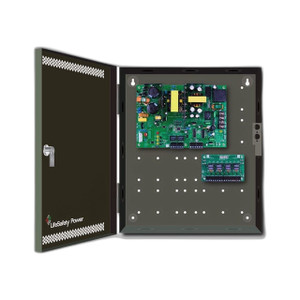
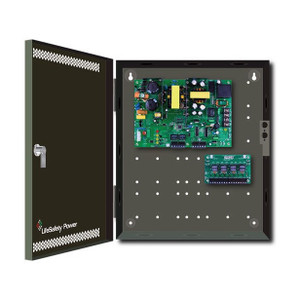
Lifesafety Power FPO150-B100C8D8PE4M 150W 8-Output Power Supply
The Lifesafety Power FPO150-B100C8D8PE4M is a 150W unified power distribution system designed for mid-scale access control and life safety installations requiring independent control of multiple door locks, magnetic locks, and auxiliary devices. The dual 12V/24V input flexibility combined with eight fused relay outputs and eight class 2 auxiliary outputs makes it a versatile backbone for mixed-voltage installations. Deployed in buildings where redundancy and selective failsafe/failsecure logic matter — shopping centers, office buildings, hospitality properties — this supply eliminates the complexity of managing separate power feeds to individual hardware while maintaining UL-listed safety compliance.
Key Features
- Dual Primary Input: 12A/12V or 6A/24V selectable — supports both common industrial voltages without requiring voltage converters.
- 8 Fused Relay Outputs: 3A per output, 24A total capacity — each independently selectable for FAI (fail as-is), failsafe, or failsecure logic to match lock hardware requirements.
- 8 Auxiliary DC Outputs: Class 2 power-limited at 2.5A per output — dedicated circuits for PIR sensors, request-to-exit buttons, proximity readers, or intercom modules without starving relay supply.
- Dual Bus Configuration: Each auxiliary output assignable to Bus1 or Bus2 — enables remote emergency shutdown or selective circuit isolation via single relay command.
- Adjustable Secondary Module: 5–18V output at 4A maximum — accommodates specialized voltage requirements (badge readers, older solenoids) without additional DC/DC regulators.
- Class 2 Power Limited: Meets UL 2089 — no additional fire-rated conduit required for field wiring, reducing installation labor and material cost.
- E4 Enclosure with Mercury Backplate: 24H × 20W × 6.5D — fits standard 19" relay racks or wall-mount brackets; Mercury backplate ensures proper breaker coordination and visual circuit mapping.
The FPO150-B100C8D8PE4M bridges the gap between single-door standalone supplies and enterprise-scale battery backup systems. Its 150W capacity handles a mixed load of four to six standard electric strikes or mag locks plus auxiliary circuits without thermal stress. Field-configurable failsafe/failsecure logic per output — rather than global setting — means you can protect high-traffic emergency exits in fail-safe mode while keeping administrative areas in fail-secure mode on a single supply, reducing the need for multiple units on the same panel.
Integrators working with legacy access control panels (older Honeywell, Napco, or DSC systems) appreciate the straightforward relay interface and class 2 auxiliary outputs. Modern IP-based systems (Genetec, Salto, Openpath) that use networked door controllers still rely on this type of supply for hardwired battery backup, emergency lighting circuits, and failover logic — the supply's dual-bus configuration allows a single relay command to cut power to non-critical circuits during a mains failure, extending runtime on critical doors. Each output is independently fused and labeled on the Mercury backplate, eliminating the guesswork during troubleshooting or future expansion.
Compliance is straightforward: UL 2089 class 2 power-limited design means the supply can be deployed without special conduit or separation in mixed-use buildings. The 150W continuous rating assumes ambient temps below 40°C; in hotter mechanical rooms, derate output by ~10%. Input voltage ripple on the 24V side should not exceed 5V peak-to-peak — many older DSC 4020 or 5020 panels generate dirty 24V rails, so a separate RC filter on the primary input may be warranted in noisy electrical environments.
Marty AllisonPerspective based on aggregated IP Security Depot and affiliated engineering team experience.
We've specified the FPO150-B100C8D8PE4M across dozens of mid-market access control retrofits and new campus builds. The real strength is the per-output failsafe/failsecure selectability — it solves the problem of mixing fail-safe and fail-secure hardware on the same supply without added relays or logic modules. In a typical retail or office environment, you're running mag locks on the front and rear fire exits (fail-safe required), electronic strikes on administrative doors (fail-secure preferred), and maybe a badge reader or two on auxiliary power. Older systems forced you to choose one mode for the entire supply, which meant either over-provisioning relays or installing multiple supplies. The FPO150 lets you configure each output independently, cutting BOM and panel real estate by 30–40% on mixed installations. The dual bus feature is valuable on properties with remote building emergency plans — a single command from the main control panel can shed non-critical loads (badge readers, auxiliary sensors) to extend runtime on door locks during a mains failure. We've seen it used in hospitals where you want locks to stay fail-safe during evacuation but don't need the intercom or visual badge readers drawing power.
Technical Highlights:
- Per-Output Failsafe/Failsecure Logic: Each relay output independently configured via jumper, not global dip switches. Eliminates the need for external relay logic cards or secondary power supplies when mixing fail-safe and fail-secure hardware on the same circuit.
- 8 Fused Outputs at 3A Each: Total 24A relay capacity is enough for six mag locks (2.5–3A each at 12V) or twelve electric strikes (1.2–1.8A each) depending on solenoid type. Fusing at the output prevents cascade failures — one shorted load doesn't take down adjacent circuits.
- Dual Bus Auxiliary Outputs: Eight 2.5A class 2 outputs split across two buses means selective load shedding via relay. Operationally critical: on extended mains failure, the access control system can command Bus2 offline (badge readers, motion sensors) and reserve power for Bus1 (door locks, critical solenoids).
- UL 2089 Class 2 Compliance: No special conduit, no fire-rated separation required. Reduces installation labor on mixed-voltage panels where you'd otherwise need cable trays or conduit runs. Meets most fire marshal and AHJ requirements without additional certification.
- Mercury Backplate Organization: Pre-printed circuit layout, field-replaceable fuses, and clear relay slot mapping mean faster commissioning and lower hands-on troubleshooting time during site problems.
Deployment Considerations:
- Input voltage quality matters. Older DSC or Honeywell panels with marginal 24V regulation can stress the FPO150 — measure 24V input noise before installation. If ripple exceeds 5V peak-to-peak, add a small RC filter (0.1µF / 220Ω) on the primary input to protect against nuisance failures.
- 150W @ 40°C ambient is the rating; in attics or non-air-conditioned mechanical rooms above 40°C, output de-rates roughly 10% per 5°C rise. Size your lock/solenoid loads conservatively if the supply will be mounted in warm spaces.
- Class 2 output limits (2.5A auxiliary, 3A relay) are hard stops. PIR sensors, badge readers, and strobes draw more than you'd expect — measure inrush current during commissioning. Cheap PIR modules can spike to 0.8A for 10ms on power-on, degrading voltage on adjacent bus circuits.
- The adjustable 5–18V secondary is useful but seldom needed on modern hardware. If you do use it, set it at commission time and tape the potentiometer — field technicians sometimes mistake it for a trim pot and adjust it trying to fix unrelated voltage issues.
- Thermal dissipation is passive (no active cooling). Ensure at least 2 inches of clearance above and below the enclosure, and avoid stacking hot equipment (batteries, PSUs) directly above or below the FPO150.
This is the right choice for integrators supporting mixed-voltage access control systems where independent failsafe/failsecure logic per door is a requirement. It's over-engineered for single-door deployments but cost-effective at four-plus doors. For detailed specs and complementary power infrastructure options, consult the Lifesafety Power catalog.