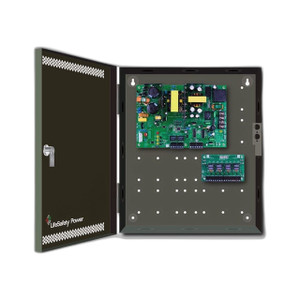
Lifesafety Power FPO150-B100C82D8PE4M/P8-B 150W Power Supply
Overview
The Lifesafety Power FPO150-B100C82D8PE4M/P8-B is a 150W distributed power supply designed for access control, door strike, and auxiliary device management in commercial security installations. It provides dual selectable output configurations—12A at 12VDC or 6A at 24VDC—allowing flexibility in wiring architecture and device pairing. The unit integrates 24 separately controlled DC outputs (8 relay lock control channels plus 16 auxiliary power channels), each with independent failsafe/failsecure logic selection. This multi-output topology is particularly valuable in larger access control deployments where individual door strikes, mag locks, and peripheral sensors require isolated supervision and fault isolation.
Key Features
- Dual Output Configuration (12A/12V or 6A/24V): Switch between voltage rails without hardware modification. 24V output delivers the same wattage across longer wire runs with lower current draw—meaningful when running strikes or locks more than 50 feet from the supply, as voltage drop becomes negligible. 12V is standard for legacy systems and lower-cost wiring.
- 8 Relay Lock Control Outputs: Each fused at 3A per channel, allowing independent control of door strikes, mag locks, or gate solenoids. Every output selects between FAI (Fail As Is), failsafe, or failsecure mode on a per-channel basis—critical when mixing normally-locked stairwell doors with normally-unlocked common area entries.
- 16 Auxiliary Power Outputs: Class 2 power-limited at 2.5A per channel, selectable for Bus1 or Bus2 supervision. Use these for motion sensors, door contacts, or badge readers. Bus selection enables dual-path redundancy for critical zones.
- Adjustable 5–18V Secondary Output @ 4A Max: Provides independent power for auxiliary controllers, keypads, or signage independent of the main 12/24V rail. Class 2 power-limited topology keeps the circuit safe for low-voltage signaling without isolation transformers.
- 12V Secondary Voltage Power Module: Integrated secondary transformer output ensures compatibility with legacy controllers and auxiliary modules expecting isolated 12VDC, reducing the need for external buck converters or isolation supplies.
- Modular Fusing Architecture: Each lock and auxiliary output carries its own fuse cartridge. A single failed solenoid or sensor short won't cascade—only that channel disconnects, and the rest of your access control remains live. Simplifies troubleshooting in multi-door environments.
Integration & Compatibility
The FPO150-B100C82D8PE4M/P8-B integrates with access control panels that require multi-output power distribution. The 24 independently supervised outputs work with any panel that can wire discrete lock and sensor circuits; the failsafe/failsecure jumpers on each channel adapt to your door logic without reprogramming. Bus1/Bus2 selection on auxiliary outputs is typical of systems using dual-path current supervision for alarm signaling (e.g., NC door loops, PIR circuits). The adjustable secondary output accommodates auxiliary readers or controllers operating at non-standard voltages—common in mixed deployments where you're retrofitting newer hardware alongside legacy infrastructure.
When to Choose This Model
Deploy the FPO150-B100C82D8PE4M/P8-B when your access control site has more than 4–6 doors or mixed strike types (mag locks, electronic strikes, solenoid gates), or when you need independent supervision of perimeter sensors on separate fused outputs. The dual voltage flexibility and per-channel failsafe/failsecure jumpers reduce panel wiring complexity. Avoid this model if your installation is a single-door retrofit; a smaller 2–4 output supply will suffice and cost less.
Frequently Asked Questions
Q: Can I use the FPO150-B100C82D8PE4M/P8-B for both 12V and 24V devices simultaneously?
A: No. The main output is selectable as either 12A/12V or 6A/24V—you choose one. However, the secondary 5–18V adjustable output can run independently, and the 12V module provides a third isolated rail, so you can power auxiliary devices at a different voltage while the main outputs deliver either 12V or 24V to strikes and locks.
Q: What happens if a solenoid or mag lock shorts on one of the relay outputs?
A: That channel's 3A fuse opens immediately, isolating the fault to that single output. The other 7 relay channels and all 16 auxiliary channels remain operational. You lose that one door control until the fuse is replaced; the rest of your access control is unaffected.
Q: Are the failsafe/failsecure settings per-channel or global?
A: Per-channel via jumper select on each of the 8 relay outputs. Each can be independently set to FAI, failsafe, or failsecure, allowing you to leave stairwell doors locked on power loss while common areas remain unlocked—no firmware changes needed.
Q: Does this supply have battery backup?
A: No battery or charger circuit is integrated. If your site requires UPS backup for access control, you'll need a separate battery backup supply or UPS on the input side of the FPO150-B100C82D8PE4M/P8-B.
Q: What's the difference between the 8 relay outputs and the 16 auxiliary outputs?
A: The 8 relay outputs deliver up to 3A per channel (for door strikes and locks) and support fail mode selection. The 16 auxiliary outputs are 2.5A max, current-limited for sensors and low-power devices, and selectable for Bus1 or Bus2 supervision to accommodate dual-path alarm wiring.
Q: Will the adjustable secondary output work with non-standard voltages between 5V and 18V?
A: Yes, it's adjustable across the full 5–18V range at up to 4A. You can dial in the exact voltage your auxiliary equipment requires (e.g., 9V for older controllers, 15V for legacy readers) without external regulators.
The Lifesafety Power FPO150-B100C82D8PE4M/P8-B (often searched as FPO150 B100C82D8PE4M/P8 B) is a workhorse for mid-to-large access control deployments where output isolation and per-channel fail-mode logic are non-negotiable. The 150W budget with 24 independently fused outputs is rare at this price point—most competitors either limit you to 4–6 outputs or force global failsafe/failsecure selection. The real value is in the modular fusing and dual-voltage flexibility.
Technical Highlights:
- 24 Isolated DC Outputs (8 @ 3A relay + 16 @ 2.5A auxiliary): Each output carries its own fuse cartridge. If a mag lock shorts on channel 3, only that channel disconnects—the other 23 outputs stay live. In a 12-door facility, this means one failed strike doesn't cascade the entire access control offline. Compare that to older single-fuse designs where one solenoid failure kills the whole panel.
- Per-Channel Failsafe/Failsecure Jumper Selection: Set stairwell doors to fail-secure (locked on power loss) and public areas to fail-safe (unlocked) without touching the access control panel. Jumpers live on the supply itself—no firmware patches, no panel reprogramming required when requirements shift.
- Dual Voltage Output (12A/12V or 6A/24V): 24V delivers the same 150W across longer cable runs with half the current. If you're wiring strikes 80+ feet from the power supply, 24V eliminates voltage drop headaches and lets you use thinner gauge wire (saving cost on pulls). 12V is standard for retrofit work in older buildings.
- Adjustable Secondary Rail (5–18V @ 4A): Eliminates the need for a separate isolated buck converter or auxiliary supply. One less chassis to rack, one fewer connection point to fail. Run your legacy reader at 9V, your newer controller at 15V, all from the same power supply.
Deployment Considerations:
- No Battery Backup Built In: The FPO150-B100C82D8PE4M/P8-B is a raw power distribution unit—there's no charger, no battery terminal. If your site requires UPS capability (e.g., HIPAA healthcare, federal buildings), you'll need an external battery backup on the input side. Plan for that in the power closet budget.
- Auxiliary Output Bus Selection Requires Dual-Path Supervision: The 16 auxiliary outputs are only valuable if your access control panel supports dual-path (Bus1/Bus2) current supervision for alarm loops. If you're using a simple single-loop system, those auxiliary outputs are just extra DC supply taps—less useful, though still present. Confirm your panel wiring before committing to the auxiliary outputs for critical sensors.
- 3A Per Relay Output is Adequate for Single Strikes, Tight on Dual Mag-Locks: A typical electronic strike is 0.6–1.2A. A single mag lock (Glass door) is 0.5–0.8A. Two mag locks in series on one output will eat 1.2–1.6A and leave only 1.4–1.8A of headroom before the fuse opens. If you have double-mag setups, plan for two outputs per door rather than one.
The FPO150-B100C82D8PE4M/P8-B is the right choice for a multi-door access control site (6+ doors) where you need granular control over power distribution, fail logic, and voltage rails without sacrificing reliability. It's overkill for a single-door retrofit; it's exactly right for a medical facility, office lobby, or warehouse with mixed strike types and legacy/modern controller integration.