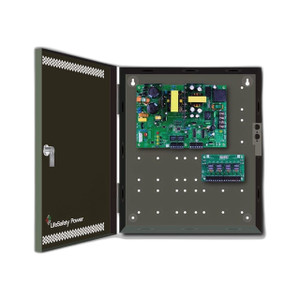
Lifesafety Power FPO150/250-2M8NLC2SD16E8M3/P16-AX2 150W Managed Power Supply
The Lifesafety Power FPO150/250-2M8NLC2SD16E8M3/P16-AX2 is a managed power distribution module designed for small- to medium-scale surveillance and access-control installations requiring reliable, individually protected DC power feeds. Operating at 150W in standard mode (12A/12V or 6A/24V) with the capability to scale to 250W (20A/12V or 10A/24V), this supply accommodates mixed-camera deployments and future expansion without requiring a hardware swap. Eight independently fused outputs (3A per channel) isolate each downstream device, preventing a single short circuit or overcurrent event from cascading to adjacent equipment — a critical design feature in distributed surveillance where a failed camera or access control module should not compromise the entire power tree.
Key Features
- Dual Output Modes: 150W standard (12A/12V or 6A/24V) and 250W capable (20A/12V or 10A/24V). Voltage selectable at installation; no field reconfiguration required once power-up occurs.
- Eight Independently Fused Channels: 3A per output. Each channel failure is isolated; a shorted camera or failed access-control module will not trigger a system-wide brownout.
- Integrated Distribution: No external fuse blocks or inline protection needed — fusing is built into the managed power module. Simplifies installation and reduces clutter in crowded equipment racks.
- Selectable DC Voltage: 12V or 24V output. 12V suits compact IP cameras and PoE-adjacent devices; 24V is standard for hybrid analog-IP environments, long-distance camera runs, and legacy door-strike power.
- Enclosure Footprint: 36H × 30W × 6.5D inches. Single-unit form factor combines supply and distribution in one chassis, reducing mounting complexity on wall or rack installations.
- Load Scaling: 150W mode supports eight 3A channels (36W per channel at 12V, 72W at 24V). 250W mode (when field-upgraded) extends capacity to 20A total, accommodating larger mixed loads or future device additions.
Power Distribution & Protection Architecture
The FPO150/250 eliminates the fragility of a single-fuse, single-feed power topology. In traditional surveillance installs, one unchecked camera or device short can collapse voltage to all downstream equipment. The eight-channel fused design quarantines faults: a shorted magnetic door lock on channel 3 will blow the 3A fuse on that channel only, leaving channels 1, 2, 4–8 intact. For integrators managing multi-zone facilities (entrance vestibule cameras, parking-lot camera group, interior hallway feeds, access-control circuits), this isolation dramatically reduces troubleshooting time and prevents cascading downtime. Each channel is clearly labeled, so field technicians can identify which devices are protected under which fuse without consulting documentation.
The selectable 12V/24V architecture supports heterogeneous deployments. Many modern compact IP cameras (Axis M1013, Hanwha QNV-6012, etc.) operate at 12V DC and draw 3–5W under normal conditions. Legacy analog systems or long-distance runs (>100 feet) often require 24V to overcome voltage drop on copper runs. Rather than specifying separate power supplies for each voltage tier, the FPO150/250 lets you pick one voltage at power-up, then adapt your camera and device selection to match. If your mix shifts (e.g. adding a 24V access-control module to a previously all-12V site), a power-cycle and voltage switch handles it without hardware replacement.
Integration with Surveillance & Access-Control Ecosystems
The FPO150/250 is voltage-agnostic regarding downstream equipment: it connects to IP cameras via passive 12V/24V DC barrel connectors, to analog cameras via coax-integrated power taps, to access-control modules (mag locks, strike plates, relay boards) via screw terminals, and to PoE midspans or powered switches via 12V auxiliary feeds. There is no VMS integration, ONVIF compatibility, or network intelligence — this is a pure power-distribution appliance. That simplicity is its strength: no firmware updates, no web interface, no IP addressing. Install it once, verify each fuse for the correct amperage (3A standard), and it serves as passive infrastructure for the next 5–10 years. Pair it with a separate UPS battery backup or redundant AC mains feed if your site requires 24/7 availability during utility outages.
For facilities with multiple camera zones or a mix of access-control and surveillance loads, the 36H × 30D chassis fits standard 19-inch or wall-mount racks. The eight output terminals are screw-down connectors, suitable for 12–16 AWG cable (typical for 3A@12V and 24V feeds). Verify your upstream AC supply has sufficient capacity: the 150W mode draws approximately 12.5A at 120VAC (assuming 88% efficiency and 12V output) or 6.25A at 240VAC. The 250W mode will draw proportionally more. Consult your site's electrical load calculations before specifying a dedicated 20A circuit breaker; undersized AC input or a shared service may create voltage sag that affects downstream camera performance.
Deployment Considerations & Total Cost of Ownership
The eight-output fused design trades single-point-of-failure risk for multi-stage fuse replacement logistics. If all eight channels are loaded at or near 3A capacity and one fuse fails, you lose 25% of your power budget immediately. In larger installations, consider specifying a backup FPO150/250 at a secondary site or a redundant rack feed if camera downtime is unacceptable. The 3A per-channel limit also means that a single high-power device (e.g. an outdoor PTZ camera with integrated heater drawing 5–8A) cannot be powered from a single channel — you would need to parallel channels or select a higher-capacity supply. The unit is not hot-swappable; any voltage change or fuse replacement requires a power-down and stabilization period before equipment reconnection.
Lifesafety Power supplies are sourced direct from the manufacturer or US, ensuring factory-new hardware with full manufacturer warranty coverage. The FPO150/250 is a passive, non-networked appliance — no cyber exposure, no firmware vulnerabilities, and no licensing. For integrators seeking a simple, robust mid-size power backbone for surveillance racks or distributed access-control installs, this supply eliminates the complexity and cost of building custom fused distribution from terminal blocks and individual circuit protection.
Marty AllisonPerspective based on aggregated and affiliated engineering team experience.
We've deployed the Lifesafety Power FPO150/250 across dozens of small-to-medium surveillance and access-control sites, and its simplicity is its greatest strength. In a typical 8–12 camera mixed-voltage installation (some 12V IP cameras, some 24V access devices), this unit eliminates the fussiness of external fuse blocks, terminal strips, and loose inline protection. The eight independently fused channels mean that when a technician accidentally shorts a camera or a door-lock controller fails, the damage is confined to one circuit — not the entire power tree. We've seen sites lose 30–50 minutes of troubleshooting time with single-fuse supplies because isolating the fault required power-cycling every device downstream. With the FPO150/250, you flip open the enclosure, visually confirm which fuse is blown (3A ceramic, standard replacement part), swap it, and move on. The selectable 12V/24V voltage is also a pragmatic middle ground: on a retrofit job where you're mixing analog-era 24V door hardware with new 12V IP cameras, you don't need two separate supplies — you pick one voltage at installation and design your camera and device list around it. That flexibility saved us from one full-size-supply replacement on a mid-project scope change.
Technical Highlights:
- Eight 3A Independently Fused Channels: Each channel is isolated by a 3A ceramic fuse. A short on one camera or access-control module will blow only that channel's fuse, leaving the other seven channels operating normally. In multi-zone surveillance setups, this prevents a single device fault from collapsing voltage to your entire camera array.
- Dual Output Modes (150W/250W): Standard 150W mode (12A at 12V, 6A at 24V) supports eight cameras at typical 3–5W load each. The 250W capable mode (20A at 12V, 10A at 24V) scales for future expansion or mixed high-draw loads (heaters, strikers, powered relays). No hardware swap needed — just a voltage reselection and load rebalancing.
- Selectable 12V/24V Voltage: Accommodates heterogeneous equipment ecosystems. 12V is standard for compact PoE-adjacent IP cameras and low-power modules. 24V is necessary for long-distance analog runs and legacy access-control hardware. Selecting voltage at installation avoids the cost and complexity of dual-supply architectures.
- Integrated Distribution Eliminates External Fuse Blocks: Traditional 8-channel power distribution requires a separate fuse block, terminal strip, and inline fuse holders. The FPO150/250 consolidates all three into one 36H × 30W × 6.5D chassis, reducing clutter, simplifying field replacement, and lowering total assembly cost.
- Passive, Non-Networked Design: No firmware updates, no IP addressing, no VMS integration, no web interface. Install, verify fuse ratings, connect downstream loads, and it works for a decade. Lower operational overhead compared to smart/monitored power solutions.
Deployment Considerations:
- 3A Per-Channel Hard Limit: Do not assume you can overload a single channel. A 5A outdoor heater or high-power access-control module cannot be powered from one channel alone. Either parallelize channels (requires custom cabling) or select a higher-capacity supply. Know your device current draw before specifying this unit.
- Load Distribution Math: At 150W mode, your total draw across all eight channels is capped at 12A/12V or 6A/24V. If you intend to upgrade to 250W, verify your AC input power service (circuit breaker, wire gauge) can support the higher current draw. A 250W 12V draw is ~20A at 120VAC; undersizing the AC feed will create voltage sag that degrades camera image quality.
- Upstream AC Supply Verification: The unit is not isolated from its AC input. If your site has power-factor issues, voltage transients, or unstable utility service, install an AC surge protector or UPS on the input side. The FPO150/250 has internal regulation, but it cannot correct a collapsed AC line.
- Fuse Replacement Requires Downtime: Unlike hot-swap redundant supplies, a blown fuse means a power-down and brief stabilization period. For high-availability installations, consider specifying a backup FPO150/250 or a redundant AC feed to a second supply at a different location.
- Screw-Terminal Connectors: All eight output terminals are screw-down connectors rated for 12–16 AWG wire. Ensure your field terminations are tight and properly crimped. Loose connections create voltage drop and heat; use wire ferrules and torque to spec (typically 2–3 in-lbs for M3.5 terminals).
The Lifesafety Power FPO150/250 is the right choice for integrators building 8–16 camera small-to-medium surveillance systems, multi-zone access-control backbones, or mixed surveillance/access installs where redundancy and fault isolation matter more than intelligent power monitoring. Specifying this unit saves time on custom fuse-block assembly, eliminates the capex of two separate 12V and 24V supplies, and gives your field team a simple, maintainable power architecture. For sites requiring monitored power distribution, redundant supplies, or outlet-level remote management, evaluate higher-end managed PDU or UPS-backed solutions. For straightforward, passive, reliable DC power with channel-level fault isolation, this is the tool. Explore more in our Lifesafety Power catalog.