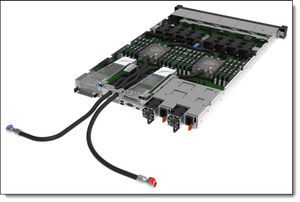
Lenovo 4XG7A91490 Intel Xeon Gold 6544Y 16-Core Processor Option for SR630 V3
Overview
The Lenovo 4XG7A91490 is an Intel Xeon Gold 6544Y processor option configured for the ThinkSystem SR630 V3 server platform. Running 16 cores and 32 threads at a 3.6 GHz base with a 4.1 GHz boost frequency, this 5th Generation Intel Xeon Scalable CPU is built for compute-dense rack workloads — think virtualization hosts, analytics back-ends, and AI inference nodes where per-core throughput matters as much as aggregate thread count. At 270W TDP, thermal and power planning are non-trivial, but the performance return per watt is competitive within the Xeon Gold 6000 series tier.
This is a factory-configured processor option for the SR630 V3 chassis. If you are specifying a new SR630 V3 build or adding a second socket, 4XG7A91490 is the Lenovo part number to reference for procurement and compatibility tracking within the ThinkSystem ecosystem.
Key Features
- 16 Cores / 32 Threads at 3.6 GHz Base: The Xeon Gold 6544Y delivers 32 concurrent execution threads — enough headroom to run dense VM farms or containerized microservices without forcing aggressive vCPU oversubscription ratios that degrade latency-sensitive workloads.
- 4.1 GHz Boost Frequency: Single-threaded peak at 4.1 GHz means legacy serial workloads, database queries, and per-core-licensed software (Oracle, SAP) benefit from higher effective clock rates without requiring P-core premium silicon.
- Performance Hybrid Core Architecture — 4 High-Priority + 12 Standard Cores: Four cores run at a dedicated 3.7 GHz high-priority frequency while the remaining 12 operate at 3.5 GHz base. This asymmetric design lets the scheduler route latency-sensitive threads to high-priority cores automatically, reducing jitter in mixed workloads without manual CPU affinity tuning.
- 45 MB L3 Cache: Large last-level cache reduces DRAM fetch latency on working sets that fit within it — particularly relevant for in-memory analytics, time-series databases, and caching tiers where repeated data access patterns are common.
- Intel UPI at 20 GT/s: The inter-socket interconnect runs at 20 GT/s, which in a dual-socket SR630 V3 configuration keeps NUMA penalty low for cross-socket memory access — critical if you are running workloads that cannot be cleanly partitioned to a single socket's memory domain.
- LGA 4677 (Socket E) — 5th Gen Xeon Scalable Platform: Compatibility is scoped to 5th Gen Xeon Scalable-compatible platforms. The SR630 V3 is the validated chassis for this option. Do not attempt to seat this in earlier SR630 or SR630 V2 variants — socket and platform firmware are incompatible.
- 64-bit Operating Mode: Full 64-bit instruction set support across all cores — a baseline requirement for any modern hypervisor (VMware vSphere, Microsoft Hyper-V, KVM) and container runtime.
- 270W TDP: A 270W thermal envelope requires adequate chassis airflow and validated power supply headroom in the SR630 V3. In a dual-socket configuration, budget over 540W for processor power draw alone before accounting for DIMMs, NVMe, and PCIe cards.
Integration & Compatibility
The 4XG7A91490 is validated for the Lenovo ThinkSystem SR630 V3 server platform. It slots into the LGA 4677 Socket E interface and requires platform firmware that supports 5th Generation Intel Xeon Scalable processors. Workload compatibility extends to all major hypervisors, container orchestration layers, and Linux/Windows Server operating systems that support the x86-64 instruction set. For Lenovo ThinkSystem servers and related datacenter server options, verify UEFI firmware revision requirements in the SR630 V3 compatibility matrix before deployment. Organizations building out AI inference or high-density video analytics infrastructure should also reference network switching capacity as part of overall rack planning when pairing compute with IP camera or NVR back-end workloads.
Frequently Asked Questions
Q: What server platform is the Lenovo 4XG7A91490 compatible with?
A: The 4XG7A91490 is a processor option for the Lenovo ThinkSystem SR630 V3. It uses the LGA 4677 (Socket E) interface and requires a platform supporting 5th Generation Intel Xeon Scalable processors. It is not compatible with SR630 or SR630 V2 chassis.
Q: How many cores and threads does the Xeon Gold 6544Y provide?
A: The Intel Xeon Gold 6544Y in this option delivers 16 physical cores and 32 threads via Hyper-Threading. Base frequency is 3.6 GHz with a boost up to 4.1 GHz.
Q: What is the TDP of this processor and what does that mean for power planning?
A: The TDP is 270W. In a dual-socket SR630 V3 configuration, processor power draw alone exceeds 540W — make sure your power supply units, PDU circuits, and UPS capacity account for this before provisioning the system.
Q: Does the Xeon Gold 6544Y support dual-socket configurations in the SR630 V3?
A: Yes. The SR630 V3 is a dual-socket platform and the 6544Y uses Intel UPI at 20 GT/s for inter-socket communication. In a dual-socket deployment, NUMA topology should be considered when pinning latency-sensitive VMs or containers.
Q: What is the high-priority core configuration on the 6544Y?
A: The 6544Y uses an asymmetric core design: 4 high-priority cores at 3.7 GHz and 12 standard cores at 3.5 GHz base. The OS scheduler can route latency-critical threads to the high-priority cores, which helps mixed workloads without requiring manual CPU affinity assignments.
The 4XG7A91490 is worth a close look if you are specifying an SR630 V3 for mixed virtualization and analytics workloads. The asymmetric core layout — 4 high-priority cores at 3.7 GHz alongside 12 standard cores at 3.5 GHz — is a detail that gets overlooked in spec comparisons but genuinely matters when you have latency-sensitive services sharing a host with bulk compute jobs. The 45 MB L3 cache is also a differentiator at this core count, reducing how often the processor has to go out to DRAM on hot working sets.
Technical Highlights:
- 20 GT/s Intel UPI: In a dual-socket SR630 V3 build, this interconnect speed keeps cross-NUMA memory latency in check. For workloads that cannot be cleanly partitioned — shared-memory analytics, certain databases — this is the spec that determines whether dual-socket actually helps or just adds NUMA overhead.
- 4.1 GHz Boost: Per-core-licensed software stacks (Oracle DB, some SAP modules) benefit disproportionately from high single-threaded frequency. At 4.1 GHz peak, the 6544Y holds its own against higher core-count parts that clock lower under boost.
- 270W TDP: This is not a processor you drop into an underpowered chassis. At 270W per socket, a dual-socket configuration draws over 540W from CPU alone. Verify PSU, PDU circuit amperage, and UPS runtime calculations before rack deployment.
Deployment Considerations:
- Platform firmware matters here — the SR630 V3 must be running UEFI firmware validated for 5th Gen Xeon Scalable before this processor will POST correctly. Check the Lenovo FixCentral compatibility matrix for the SR630 V3 before scheduling installation.
- The 270W TDP makes thermal management non-optional. Confirm that your rack has adequate front-to-rear airflow and that adjacent 1U devices are not blocking inlet paths — SR630 V3 chassis airflow is front-inlet dependent.
This option is well-suited for organizations building out SR630 V3 clusters as video analytics compute back-ends — the high-priority core architecture handles real-time inference threads while standard cores absorb the recording and indexing workload without contention tuning.