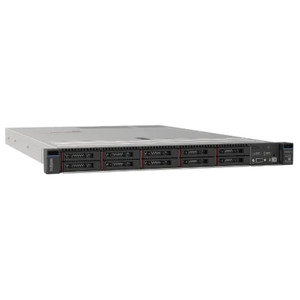
Lenovo 4XG7A91494 Intel Xeon Gold 6526Y 16-Core Processor for ThinkSystem SR630 V3
Overview
The Lenovo 4XG7A91494 is a factory-new Intel Xeon Gold 6526Y processor option kit designed specifically for the Lenovo ThinkSystem SR630 V3 rack server. Built on Intel's 5th Generation Xeon Scalable architecture using a 7nm process node, the 6526Y delivers 16 cores and 32 threads at a 2.8 GHz base clock with a 195W thermal design envelope — positioning it squarely in the performance tier for compute-dense workloads that demand consistent throughput without crossing into the power budget territory of the higher-wattage Xeon Gold variants. If you're speccing a 2-socket SR630 V3 for a workload that balances parallel thread count against rack power allocation, the 4XG7A91494 is a rational anchor point.
Key Features
- 16 Cores / 32 Threads at 2.8 GHz Base: The 6526Y's 16-core count gives workload schedulers enough parallelism for multi-threaded applications — virtualization hosts, containerized microservices, or parallel batch processing — without the licensing overhead that higher core-count Xeons can trigger on per-core software pricing models. The 32-thread count means the OS sees double the physical cores for thread-level parallelism.
- Hybrid Core Topology — 4 High-Priority at 3.0 GHz + 12 Efficiency Cores at 2.6 GHz: Intel's 5th Gen Xeon Scalable introduces a differentiated core design: 4 cores run at a higher priority at 3.0 GHz while 12 cores operate at 2.6 GHz. This matters for mixed workloads where a subset of threads is latency-critical — the scheduler can preferentially assign those threads to the faster cores, keeping tail latency in check without boosting the entire die.
- 37.5 MB Last-Level Cache: The large on-die cache reduces main-memory access latency for working sets that fit within it — relevant for in-memory databases, analytics caching layers, and real-time inference pipelines. More cache per core means fewer trips to DRAM, which is the dominant latency source in most server workloads at this performance tier.
- 195W TDP — Balanced Power Envelope: At 195W, this processor fits within the SR630 V3's thermal design without requiring supplemental cooling beyond the server's standard configuration. It draws meaningfully less power than higher-bin Xeon Gold and Platinum parts in the same family, which matters for operators managing per-rack PDU allocations in dense deployments. Lower TDP also translates directly to reduced heat load in the row, easing CRAC requirements.
- Intel UPI at 20 GT/s: The Ultra Path Interconnect runs at 20 GT/s, providing the inter-socket bandwidth needed in 2-socket SR630 V3 configurations where NUMA-aware workloads exchange data between sockets. This is the throughput ceiling for cache-coherent cross-socket communication — relevant if you're deploying workloads that span both sockets and need predictable memory access times across NUMA nodes.
- LGA 4677 (Socket E) on 7nm Process: The LGA 4677 socket is the standard platform for 4th and 5th Gen Xeon Scalable, meaning this processor is compatible with the same motherboard infrastructure across the SR630 V3 generation. The 7nm node delivers improved compute density and power efficiency compared to the prior 10nm generation — more transistors per watt, which contributes to the per-core performance improvement at equivalent power draw.
- 64-bit Operating Mode: Fully 64-bit native — no legacy 32-bit compatibility overhead. Every modern server OS and hypervisor expects this; it's worth confirming for any edge deployment running specialized industrial software that may have 32-bit dependencies.
Integration & Compatibility
The 4XG7A91494 is qualified for the Lenovo ThinkSystem SR630 V3 platform. The LGA 4677 socket design requires precise handling during installation — this is a processor option kit, meaning it is intended for installation by qualified personnel familiar with Lenovo's SR630 V3 field replacement procedures. The Lenovo ThinkSystem SR630 V3 supports dual-socket configurations; if you are populating a second socket in an existing SR630 V3, verify that your existing processor is from the same Xeon Scalable generation to ensure platform compatibility and that BIOS firmware is current for 5th Gen Xeon support. No cooler is included with this kit — the SR630 V3 ships with its own heatsink assembly; confirm the appropriate heatsink is installed for the TDP class of this processor. Country of origin is Mexico.
Frequently Asked Questions
Q: What server is the Lenovo 4XG7A91494 compatible with?
A: The 4XG7A91494 is a processor option kit qualified for the Lenovo ThinkSystem SR630 V3. It uses the LGA 4677 (Socket E) interface and is designed to be installed in the SR630 V3 platform specifically.
Q: Does the 4XG7A91494 include a heatsink or cooler?
A: No. The cooler is not included with this processor kit. The ThinkSystem SR630 V3 server ships with its own heatsink assembly. Confirm the correct heatsink for a 195W TDP processor is installed in the target system.
Q: What is the core and thread count of the Intel Xeon Gold 6526Y?
A: The Xeon Gold 6526Y provides 16 physical cores and 32 threads. It uses a hybrid core topology with 4 high-priority cores at 3.0 GHz and 12 efficiency cores at 2.6 GHz, with a 2.8 GHz overall base frequency.
Q: What is the TDP of the Xeon Gold 6526Y in this kit?
A: The processor has a Thermal Design Power (TDP) of 195W. Plan rack power budgets and confirm the SR630 V3 heatsink installed supports this TDP class.
Q: Can this processor be used in a dual-socket SR630 V3 configuration?
A: The SR630 V3 supports dual-socket configurations. If populating a second socket, ensure the existing processor is from the same 5th Generation Intel Xeon Scalable family and that the system BIOS is updated to support 5th Gen Xeon processors before installation.
The 4XG7A91494 is one of the more practical picks in the 5th Gen Xeon Gold lineup for SR630 V3 deployments where you're watching rack power allocation closely. The Xeon Gold 6526Y runs at 195W TDP — that's the number that drives your PDU headroom and heatsink selection, and it keeps this processor in a workable thermal class for standard 1U rack cooling without requiring exotic airflow configurations.
Technical Highlights:
- Hybrid Core Topology (4 @ 3.0 GHz / 12 @ 2.6 GHz): The differentiated core frequencies mean latency-sensitive threads get preferential scheduling to the faster cores. In a VMS or analytics server context, this directly benefits real-time inference or alarm-processing threads that can't tolerate scheduling jitter.
- 37.5 MB Last-Level Cache: For workloads with hot working sets — video indexing, in-memory event correlation, or database query caches — this cache depth reduces DRAM access frequency, which is where most latency accumulates at scale.
- 20 GT/s UPI: In a dual-socket SR630 V3, this interconnect speed sets the ceiling for cross-NUMA bandwidth. If your workload spans both sockets, this is the spec that determines whether you'll see NUMA-induced latency spikes under load.
Deployment Considerations:
- No cooler is included — verify the SR630 V3 heatsink assembly in the target chassis is rated for a 195W processor before installation. Using an undersized heatsink will trigger thermal throttling under sustained load.
- In dual-socket builds, confirm BIOS firmware supports 5th Gen Xeon Scalable before seating this processor. Mixed-generation socket population is not supported on this platform.
Best fit: SR630 V3 deployments running virtualized workloads or containerized surveillance analytics platforms where per-core software licensing makes higher core-count processors cost-prohibitive, but parallel thread throughput still needs to clear 32 threads under peak load.