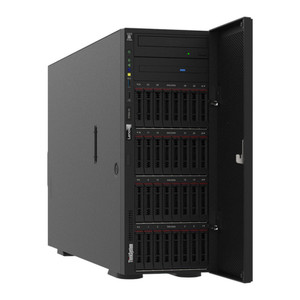
Lenovo 4XG7A63579 Intel Xeon Gold 6338 32-Core Processor for ThinkSystem SR650 V2
Overview
The Lenovo 4XG7A63579 is an Intel Xeon Gold 6338 processor option for the ThinkSystem SR650 V2 rack server — a 32-core, 64-thread compute unit built for demanding enterprise workloads where core density and memory bandwidth matter more than raw single-thread speed. Running at a 2.0 GHz base with a 3.2 GHz boost on its 12 high-priority cores, this 3rd Generation Intel Xeon Scalable processor delivers the kind of balanced throughput profile that suits virtualization hosts, database tiers, and high-channel-count video analytics servers alike. If you are speccing a ThinkSystem SR650 V2 for a workload that needs to handle dozens of concurrent threads without burning unnecessary power at idle, the 4XG7A63579 is worth a close look.
Key Features
- 32 Cores / 64 Threads at 205W TDP: At 205W, this is a high-end processor option that trades power efficiency for raw parallelism. Deploying this in a video analytics or VMS server context means you can handle significantly more concurrent AI inference tasks or camera streams per socket compared to lower-core-count options in the Gold 6000 family. Size your chassis power delivery accordingly — the SR650 V2 is designed to accommodate this TDP class.
- 2.0 GHz Base / 3.2 GHz Boost Frequency: The base-to-boost spread matters in mixed workloads. Lightly threaded tasks (database queries, VMS event processing) can boost to 3.2 GHz while sustained parallel loads (batch analytics, transcode pipelines) will settle near the 2.0 GHz base. Real-world throughput lives between these two figures depending on your workload shape.
- 12 High-Priority Cores at 2.2 GHz / 20 Low-Priority Cores at 1.8 GHz: Intel's Application Specific Attributes (ASA) architecture segments this processor into differentiated core clusters. Latency-sensitive processes can be pinned to the 12 higher-frequency cores while background or batch workloads consume the remaining 20. For VMS operators, this means time-critical alerting threads can be isolated from bulk recording I/O — a useful scheduler knob if your hypervisor or OS supports core affinity.
- 48 MB L3 Cache: The 48 MB last-level cache feeds 64 threads without forcing frequent main-memory round-trips on working-set-resident workloads. On database-backed VMS platforms or analytic engines with hot data sets under 48 MB, expect a measurable latency benefit versus processors with smaller cache allocations.
- LGA 4189 Socket / Ice Lake Microarchitecture (10 nm): The LGA 4189 platform supports up to eight-channel DDR4 memory per socket on compatible server boards — critical when you need to provision large memory pools for in-memory databases or high-resolution video frame buffers. The 10 nm Ice Lake node improves instructions-per-clock versus prior Cascade Lake generation, which translates to better throughput at equivalent clock speeds.
- 11.2 GT/s System Bus Rate: The UPI (Ultra Path Interconnect) bus rate of 11.2 GT/s governs inter-socket bandwidth in dual-socket SR650 V2 configurations. If you are populating both processor sockets, this bus rate determines how efficiently workloads that span NUMA nodes can share data — relevant for large in-memory analytics jobs or NUMA-unaware applications.
- 64-Bit Operating Mode: Full 64-bit support is expected at this tier, but worth confirming for environments still running legacy 32-bit guest operating systems — those guests cannot address more than 4 GB RAM regardless of installed physical memory.
Integration and Compatibility
The Lenovo 4XG7A63579 is a factory-configured processor option for the ThinkSystem SR650 V2 platform. It is not a standalone retail CPU — it is supplied as part of Lenovo's server configuration or as a qualified add-on component for that specific chassis. Confirm compatibility with your SR650 V2 system board revision before ordering; Lenovo's Compatibility Matrix (available on the Lenovo Support portal) lists qualified processor options per board revision and firmware level. The LGA 4189 socket and 3rd Generation Intel Xeon Scalable platform also support Intel Optane Persistent Memory 200 Series (PMem) modules where the memory subsystem is configured appropriately — a consideration for in-memory database deployments seeking to extend effective memory capacity beyond standard DDR4 limits.
Frequently Asked Questions
Q: What server platform is the Lenovo 4XG7A63579 compatible with?
A: The 4XG7A63579 is a processor option qualified for the Lenovo ThinkSystem SR650 V2 server. It uses the LGA 4189 socket associated with the 3rd Generation Intel Xeon Scalable (Ice Lake) platform. Verify compatibility with your specific SR650 V2 board revision via Lenovo's official compatibility documentation before ordering.
Q: What is the processor boost frequency for the Xeon Gold 6338?
A: The Intel Xeon Gold 6338 in this configuration has a base frequency of 2.0 GHz and a maximum boost frequency of 3.2 GHz. The 12 high-priority cores operate at 2.2 GHz under sustained load, while the 20 low-priority cores run at 1.8 GHz.
Q: How many cores and threads does the 4XG7A63579 provide?
A: The Xeon Gold 6338 delivers 32 physical cores and 64 threads via Intel Hyper-Threading, with a 205W TDP.
Q: What is the L3 cache size on this processor?
A: The Intel Xeon Gold 6338 includes 48 MB of L3 (last-level) cache shared across all 32 cores.
Q: What is the UPI bus speed and why does it matter?
A: The processor runs at 11.2 GT/s on the Ultra Path Interconnect bus. In dual-socket SR650 V2 configurations, this governs inter-socket data transfer bandwidth — higher GT/s means less latency and more throughput for workloads that access memory resident on the other socket's NUMA node.
Q: Is the Lenovo 4XG7A63579 sold as a standalone processor or only as part of a server configuration?
A: The 4XG7A63579 is a Lenovo part number designating a processor option for the ThinkSystem SR650 V2. It is offered as a configured processor component for that server family. Consult Lenovo's product documentation or a pre-sales specialist to confirm whether it ships as a standalone upgrade kit or factory-installed configuration for your specific order.
When I look at the 4XG7A63579 for enterprise security infrastructure, the detail that stands out is the asymmetric core architecture: 12 high-priority cores running at 2.2 GHz alongside 20 lower-frequency cores at 1.8 GHz. That segmentation is not just a marketing footnote — it is a real scheduling lever for VMS operators who need to separate time-critical alert processing from bulk recording I/O on a single socket.
Technical Highlights:
- 32-Core / 205W TDP: At 205W, you are drawing near the top of what standard data center power circuits per-socket support — but you get 64 threads in return. For high-channel-count NVR servers or AI inference workloads, that thread count means more concurrent streams handled per server, directly reducing the number of physical nodes you need to deploy.
- 48 MB L3 Cache: On a VMS platform with dozens of active camera streams, a large L3 cache reduces the frequency of memory round-trips for hot frame buffers and index tables. Compared to processors with 20–30 MB cache, this can translate to measurably lower per-frame decode latency under sustained load.
- 3.2 GHz Boost / 11.2 GT/s UPI: The boost frequency matters for bursty workloads like motion-event processing spikes, while the 11.2 GT/s UPI link keeps inter-socket latency manageable if you populate both processor slots in a dual-socket SR650 V2 configuration.
Deployment Considerations:
- The 205W TDP is high by enterprise rack standards — confirm your rack PDU circuit capacity and server chassis cooling configuration before speccing multiple SR650 V2 nodes with this processor. Thermal headroom in dense deployments can become a constraint.
- The LGA 4189 platform and Ice Lake microarchitecture support Intel Optane PMem 200 Series, but only in specific memory slot configurations. If your VMS or analytics platform is optimized for large in-memory data sets, confirm the PMem topology is supported by your SR650 V2 board revision before committing.
For a high-channel-count video analytics deployment — think 200+ camera streams with concurrent AI-based motion classification — the SR650 V2 with the 4XG7A63579 gives you the core density and cache depth to handle that workload in a two-socket configuration without immediately reaching for a second physical server.