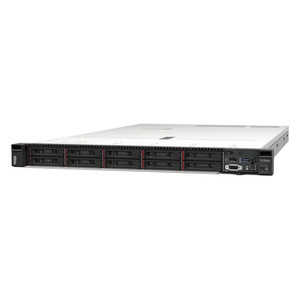
Lenovo 4XG7A63466 Xeon Platinum 8358P 32-Core Processor Option for SR650 V2
Overview
The Lenovo 4XG7A63466 is a factory-configured processor option kit that installs a 3rd Generation Intel Xeon Platinum 8358P into the Lenovo ThinkSystem SR650 V2 rack server. The 8358P is a 32-core, 64-thread Ice Lake processor running at 2.6 GHz base with a 3.4 GHz boost, sitting in the Intel Xeon Platinum 8000 series — the tier designed for memory-intensive, compute-dense, and always-on workloads. If you are building or expanding a rack server infrastructure around the SR650 V2 platform, this part number is how you spec in the 8358P at purchase or as a field-installed upgrade option.
The 8358P targets environments where thread count and memory capacity matter more than raw single-core clock speed: large-scale video analytics, AI inference, virtualization hosts running dozens of VMs, and high-density storage servers. With support for up to 6 TB of RAM per processor (via Intel's Ice Lake memory architecture), this CPU does not become the bottleneck in memory-saturated workloads — which is increasingly the constraint in modern surveillance analytics and enterprise data platforms.
Key Features
- 32 Cores / 64 Threads: The 8358P delivers 64 concurrent execution threads, making it a strong fit for hypervisor workloads where each VM or container competes for CPU time. Running 20–30 VMs on a single dual-socket SR650 V2 is realistic; more threads mean less contention and more consistent VM performance under load.
- 2.6 GHz Base / 3.4 GHz Boost (Ice Lake): The 10 nm Ice Lake architecture improves per-core IPC over the prior Cascade Lake generation, so per-thread workloads — database queries, video transcoding, analytics inference — run faster at the same clock than previous-gen Platinum parts. The 3.4 GHz boost engages when thermal headroom allows, useful for bursty workloads that spike without sustaining full load.
- 48 MB L3 Cache: 48 MB of shared L3 cache reduces memory latency for working sets that fit in cache — relevant for in-memory databases, analytics engines, and VMS platforms that cache frequently accessed video index data. Less cache miss pressure translates directly to lower average query latency.
- 240 W TDP: At 240 W TDP, this is a high-power processor — the SR650 V2 chassis and its configured power supplies must be provisioned accordingly. Plan your rack power budget carefully: a dual-socket SR650 V2 with two 8358P processors will draw close to 480 W from CPUs alone before factoring in DIMMs, drives, and NIC cards. Adequate power redundancy (redundant PSU configuration) is not optional for uptime-critical deployments.
- LGA 4189 Socket / 11.2 GT/s UPI: The LGA 4189 socket and 11.2 GT/s UPI interconnect are the foundation of the SR650 V2's dual-socket coherency fabric. In a dual-processor configuration, both sockets share memory and cache coherency over UPI, which matters for NUMA-aware workloads. Ensure your OS and application are NUMA-optimized for best dual-socket throughput — non-NUMA-aware software will leave performance on the table.
- Up to 6 TB Max Memory per Processor: Intel Ice Lake's memory architecture supports up to 6 TB of RAM per socket — critical for in-memory analytics platforms, large Oracle or SAP HANA instances, and AI/ML training pipelines that cannot afford swapping. For surveillance analytics specifically, this headroom allows running multiple deep-learning inference models entirely in RAM alongside a full VMS workload.
- 64-Bit / 10 nm Lithography: The 10 nm process shrink relative to the prior-gen 14 nm Cascade Lake delivers better performance-per-watt. For a data center running dozens of these servers, the efficiency gain compounds across the rack — lower heat output per unit of compute, which translates to reduced cooling load and operating cost over a multi-year deployment horizon.
Integration and Compatibility
The 4XG7A63466 is a Lenovo-validated processor option for the ThinkSystem SR650 V2 platform. Installing a processor that is not on Lenovo's validated hardware compatibility list can trigger firmware warnings and is not supported by Lenovo's service stack. Always verify the SR650 V2's current firmware revision supports the 8358P stepping before installation — Lenovo's HCL and firmware release notes are the authoritative reference for this check.
For enterprise deployments integrating with network video recorder platforms or large-scale VMS infrastructure, the SR650 V2 with 8358P is compatible with all major hypervisors (VMware vSphere, Microsoft Hyper-V, Red Hat KVM) and supports Intel Virtualization Technology (VT-x and VT-d) for hardware-assisted virtualization and PCIe passthrough — enabling direct GPU or capture card assignment to VMs in analytics pipelines. The processor's AVX-512 instruction set support accelerates certain AI inference and cryptographic workloads that leverage AVX-512-optimized libraries.
For storage and network infrastructure planning: the SR650 V2 chassis supports high-bandwidth NIC and HBA options. With 64 threads available, this platform can sustain simultaneous high-throughput storage I/O and compute workloads without CPU saturation — important when the server acts as both a compute node and a data ingestion endpoint in a converged infrastructure design.
Frequently Asked Questions
Q: What server platform is the Lenovo 4XG7A63466 compatible with?
A: The 4XG7A63466 is a processor option validated for the Lenovo ThinkSystem SR650 V2 rack server, using the LGA 4189 socket. It is not a standalone CPU sold for general consumer or third-party server use — it is a Lenovo-sourced option kit for that specific platform.
Q: What processor does the 4XG7A63466 include?
A: It includes the Intel Xeon Platinum 8358P, a 3rd Generation Intel Xeon Scalable (Ice Lake) processor with 32 cores, 64 threads, 2.6 GHz base frequency, 3.4 GHz boost, 48 MB L3 cache, and 240 W TDP.
Q: How much memory does the Xeon Platinum 8358P support?
A: The 8358P supports up to 6 TB of maximum internal memory per processor. In a dual-socket SR650 V2 configuration, total platform memory capacity is determined by the server's DIMM slot count and supported DIMM types — verify the SR650 V2 memory configuration guide for your specific build.
Q: What is the TDP of the 4XG7A63466 processor, and does it affect power supply selection?
A: The Xeon Platinum 8358P has a 240 W TDP. In a dual-socket SR650 V2 configuration, CPU power draw alone approaches 480 W. You must provision the SR650 V2 with power supplies rated for the full system load — Lenovo's Power Configurator tool is the recommended method for calculating PSU requirements for a specific BOM.
Q: Does the 8358P support AVX-512 instructions?
A: Yes, the Intel Xeon Platinum 8358P (Ice Lake) supports AVX-512 instructions, which accelerates certain AI inference, scientific computing, and cryptographic workloads that use AVX-512-optimized software libraries.
Q: Is the 4XG7A63466 compatible with VMware vSphere or Microsoft Hyper-V?
A: The Xeon Platinum 8358P supports Intel VT-x and VT-d, which are required for hardware-assisted virtualization and PCIe device passthrough under VMware vSphere, Microsoft Hyper-V, and Red Hat KVM. Verify Lenovo's VMware or Microsoft HCL entries for the SR650 V2 to confirm the specific firmware and driver stack required for your hypervisor version.
The Lenovo 4XG7A63466 comes up regularly when teams are configuring the SR650 V2 for high-density virtualization or large-scale analytics workloads. The Xeon Platinum 8358P's 32 cores at 240 W TDP is a deliberate trade — you are buying core count and memory bandwidth, not maximum clock speed. For workloads that scale horizontally across threads, that is exactly the right trade to make.
Technical Highlights:
- 32 Cores / 64 Threads at 2.6–3.4 GHz: Thread density is the primary reason to select this SKU over lower-core-count Platinum options. At 64 threads per socket, a dual-socket SR650 V2 provides 128 threads total — enough to run a meaningful virtualization cluster node or a full VMS analytics stack without CPU saturation.
- 48 MB L3 Cache: Working sets that fit within 48 MB stay in cache and avoid DRAM latency penalties — directly relevant for database and analytics workloads where repeated access to index structures or model weights is common. This is a measurable throughput advantage over lower-cache predecessors.
- 240 W TDP / 6 TB Max Memory: The 240 W envelope means this processor is provisioned for sustained compute, not power efficiency. Pair that with 6 TB max memory support and you have a platform that can host memory-pinned AI inference models, in-memory databases, or large-scale video analytics pipelines without architectural compromise.
Deployment Considerations:
- Verify the SR650 V2 firmware revision against Lenovo's HCL before installing the 8358P. Not all early SR650 V2 firmware revisions support all Ice Lake processor steppings — a firmware mismatch can result in the server refusing to POST or degrading CPU performance silently.
- The 240 W TDP demands that you calculate full rack power draw before deployment. With two 8358P processors plus a full DIMM complement and active drives, a single SR650 V2 node can easily exceed 1,000 W sustained — factor this into your PDU, UPS, and cooling provisioning, or you will have thermal or power events under peak load.
This part is the right call for SR650 V2 deployments acting as high-thread compute nodes in a VMware or KVM cluster, or as the processing backbone of a converged VMS and analytics platform where core count, memory ceiling, and sustained throughput all matter simultaneously.