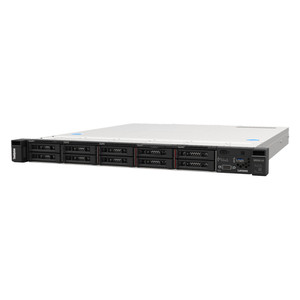
Lenovo 4X67A76715 NVIDIA A100 80GB PCIe Gen4 GPU Accelerator
Overview
The Lenovo 4X67A76715 is an NVIDIA A100 80GB PCIe Gen4 GPU accelerator designed for data-center-class AI inference, deep learning training, and high-performance compute (HPC) workloads. Where the 40GB A100 variant forces data scientists to tile large models across multiple cards, the 80GB HBM2e frame on this unit accommodates transformer models, large-scale recommendation engines, and multi-billion-parameter networks entirely in-card memory — eliminating NVLink peer transfers that add latency and complexity. If you're speccing GPU accelerators for AI inference servers or HPC clusters, the 80GB tier is the configuration to evaluate when model size is the binding constraint.
Key Features
- 80 GB HBM2e On-Card Memory: High Bandwidth Memory 2e delivers the capacity to host large language models, recommendation systems, and seismic or genomic HPC datasets without spilling to host RAM or NVMe. In practice, this means a single card can run inference on models that would require two 40GB cards in a multi-GPU fabric — fewer cards, simpler cabling, lower licensing overhead.
- 1,935 GB/s Memory Bandwidth: The A100's HBM2e stack moves data at up to 1,935 GB/s — roughly 5x the bandwidth of GDDR6-based server GPUs at this power class. Memory-bandwidth-bound workloads (matrix multiplications, convolutions, FFTs) run at near-theoretical throughput, which translates directly to higher frames-per-second on inference pipelines and shorter epoch times on training jobs.
- 8,192 CUDA Cores (NVIDIA Ampere Architecture): The Ampere SM (Streaming Multiprocessor) generation added third-generation Tensor Cores alongside standard CUDA cores, enabling mixed-precision (FP16/BF16/INT8/TF32) compute. For AI workloads where FP32 precision isn't required, Tensor Core throughput multiplies effective FLOPS substantially — relevant for any deployment running quantized inference at scale.
- PCIe Gen4 x16 Interface: PCIe 4.0 doubles the host-to-GPU bandwidth versus Gen3 (64 GB/s bidirectional versus 32 GB/s). In inference pipelines where the CPU preprocesses data batches before GPU dispatch, the wider pipe reduces host-transfer stalls — particularly relevant in video analytics servers handling multiple high-resolution streams simultaneously.
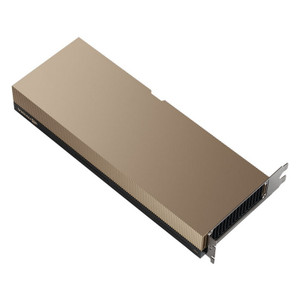
- Passive Cooling Design: The 4X67A76715 ships with a passive heatsink rather than active fans. This requires a server chassis with adequate forced-air airflow (standard in 1U/2U rack servers), but eliminates fan noise, reduces mechanical failure points, and allows the card to operate in acoustically sensitive or fan-redundancy-managed environments. Verify your chassis airflow spec before deploying — passive GPUs are unforgiving in under-ventilated enclosures.
- 300W TDP: The 300W thermal design point sits within the standard PCIe slot + supplemental power connector budget supported by most enterprise GPU-ready servers. At full load this card draws up to 300W, so power-supply headroom and rack PDU capacity planning are mandatory steps before deployment — a fully populated 4-GPU tray draws up to 1,200W from GPU alone.
- Ethernet + PCIe Dual Interface: The card exposes both PCIe (primary compute) and Ethernet connectivity, supporting configurations where the GPU participates in GPUDirect RDMA or network-attached storage access patterns without routing through the host CPU memory fabric — a meaningful architecture option for distributed training and high-throughput data-pipeline workloads.
Integration and Compatibility
The PCIe Gen4 interface makes the 4X67A76715 mechanically compatible with any server motherboard or riser supporting a PCIe 4.0 x16 slot, and backward-compatible (at reduced bandwidth) with PCIe 3.0 hosts. Lenovo ThinkSystem servers with PCIe 4.0 risers are the validated platform for this part number. For software, NVIDIA's CUDA toolkit, cuDNN, TensorRT, and RAPIDS ecosystems all support the A100 Ampere architecture — verify driver version compatibility with your OS and container runtime before provisioning. Deployments running video analytics at scale (GPU-accelerated VMS, multi-stream AI inference for object detection, license plate recognition, or crowd analytics) will find the 80GB tier necessary when running multiple large model instances concurrently. For AI compute infrastructure planning, review your GPU server planning guide to validate chassis, power, and cooling prerequisites before ordering. Organizations running NVIDIA NGC containers or Kubernetes-based GPU clusters should confirm that the A100 80GB PCIe variant is listed in their NGC compatibility matrix — it is distinct from the SXM4 form factor used in DGX systems. See the datacenter compute category for complementary server and storage options.
Frequently Asked Questions
Q: What is the difference between the A100 40GB and the A100 80GB (4X67A76715)?
A: The 4X67A76715 carries 80GB of HBM2e memory versus 40GB on the standard A100 variant. The larger frame lets you load bigger models — large language models, recommendation engines, or multi-task inference pipelines — onto a single card without splitting across two GPUs. Memory bandwidth is also higher on the 80GB die. If your models fit comfortably in 40GB, the 40GB variant costs less; if you're running 50B+ parameter models or need headroom for future model growth, the 80GB is the correct configuration.
Q: Does the 4X67A76715 require active cooling in the server?
A: Yes. The 4X67A76715 uses passive cooling — it has no on-card fans. The host server chassis must provide sufficient forced-air airflow across the card to maintain safe operating temperatures under sustained 300W load. Standard 1U and 2U rack servers designed for GPU accelerators meet this requirement; verify your chassis GPU airflow specification before deploying in non-standard or custom enclosures.
Q: Is the 4X67A76715 compatible with PCIe 3.0 servers?
A: The PCIe Gen4 interface is backward-compatible with PCIe 3.0 slots at reduced bandwidth (approximately half the host transfer rate). The GPU will function, but host-to-GPU data transfer throughput will be lower than in a native PCIe 4.0 system. For bandwidth-sensitive workloads or large batch inference pipelines, a PCIe 4.0 host is strongly recommended.
Q: What is the maximum power draw of the 4X67A76715?
A: The card has a maximum TDP of 300W. Server power supply and rack PDU capacity must account for this at full load. A chassis with four A100 80GB cards draws up to 1,200W from GPU alone, before accounting for CPU, memory, storage, and networking. Plan PDU and UPS capacity accordingly.
Q: Can the 4X67A76715 be used for video surveillance analytics workloads?
A: Yes. The A100's 8,192 CUDA cores and 80GB HBM2e are well-suited for GPU-accelerated video analytics — running simultaneous deep learning inference across multiple high-resolution camera streams for object detection, face recognition, license plate recognition, or anomaly detection. The 80GB memory capacity allows multiple large inference models to reside in GPU memory concurrently, avoiding model reload overhead between stream batches.
When evaluating the 4X67A76715 for a physical security or enterprise AI deployment, the spec that drives the decision is the 80GB HBM2e frame — not the CUDA core count. Most integrators I talk to underestimate how quickly GPU memory becomes the binding constraint once you move past single-model inference and start running concurrent models at production scale.
Technical Highlights:
- 80 GB HBM2e Memory: Hosts large transformer and recommendation models in-card without spilling to host RAM. In video analytics deployments running five or more concurrent deep learning models (detection, classification, re-ID, LPR, anomaly), this capacity eliminates the model-swap latency that tanks throughput on 24GB or 40GB cards.
- 1,935 GB/s Memory Bandwidth: Roughly 5x a comparable GDDR6 server GPU. For convolution-heavy inference pipelines processing 4K or multi-megapixel camera frames, this bandwidth translates to measurable throughput gains — more streams per card, lower per-stream latency.
- 300W Passive TDP: At 300W with no on-card fans, thermal management responsibility shifts entirely to the chassis. This is not a card you drop into a tower workstation — validate your server's GPU airflow rating before purchasing.
Deployment Considerations:
- Confirm PCIe Gen4 riser availability in your target Lenovo ThinkSystem chassis — not all riser configurations support x16 Gen4 at the slot position you need. Check the chassis compatibility matrix before ordering.
- At 300W TDP, sustained inference workloads will push the card to thermal limits in under-ventilated or high-ambient-temperature environments. Don't assume datacenter ambient alone is sufficient — verify chassis airflow CFM against NVIDIA's A100 thermal spec.
The 4X67A76715 is the right card for a centralized AI inference server handling city-scale video analytics, multi-branch surveillance aggregation, or HPC preprocessing pipelines where model memory — not raw FLOPS — is the bottleneck. If your models fit in 40GB and you're not running multiple concurrent model instances, the 40GB variant is the more cost-efficient path.