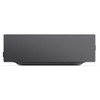
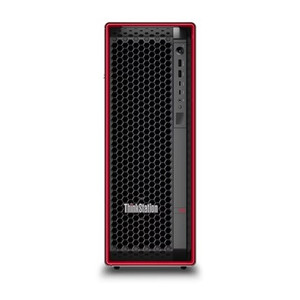
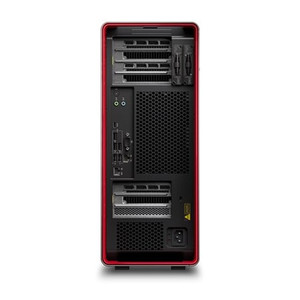
Lenovo 30KL0003US ThinkStation PGX NVIDIA Grace Blackwell AI Workstation
Overview
The Lenovo 30KL0003US ThinkStation PGX is a compact AI workstation built around the NVIDIA Grace Blackwell GB10 superchip — a purpose-built platform for on-premises AI inferencing, model development, and edge AI deployment. Where traditional GPU workstations bolt a discrete accelerator onto a general-purpose CPU, the GB10 integrates NVIDIA's Blackwell-generation GPU directly with a 20-core Arm-based Grace CPU on a unified memory architecture. The result is a machine designed from the silicon up for AI workloads, not adapted to them after the fact.
At 9 lb, the ThinkStation PGX occupies a fraction of the floor space of a rack-mounted AI server, making it a practical fit for deployments where space, power infrastructure, or proximity to the workload matters — edge inference nodes, AI-assisted security analytics stations, or engineering workbenches running local large language models and vision AI pipelines.
Key Features
- NVIDIA Grace Blackwell GB10 Superchip (20-core): The GB10 combines a Blackwell-generation GPU with a 20-core NVIDIA Grace (Arm Neoverse) CPU on a single package with a high-bandwidth chip-to-chip interconnect. This unified design eliminates PCIe bottlenecks between CPU and GPU — the kind of latency that throttles inferencing throughput when model weights and activations have to shuttle across a discrete PCIe lane. For real-time AI inference at the edge, that interconnect bandwidth is the difference between keeping up with live data streams and falling behind.
- 128GB LPDDR5x-SDRAM Unified Memory: With 128GB of LPDDR5x shared between the CPU and GPU, the ThinkStation PGX can hold large AI models entirely in memory without spilling to disk. Running a 70-billion-parameter model in quantized form or a multi-modal vision-language model for security analytics is feasible without the memory-management gymnastics required on systems with discrete GPU VRAM ceilings. Maximum supported memory is 128GB — this is a fixed-memory platform, not upgradeable after purchase.
- 4TB NVMe SSD (PCIe Gen4, M.2 2242, TLC Opal): The single 4TB NVMe drive provides fast local storage for model weights, training datasets, and inference logs. PCIe Gen4 sequential read speeds keep data pipeline stalls minimal when loading large checkpoints. The M.2 2242 form factor (22 x 42mm) is more compact than the standard 2280 — worth knowing if you are planning a drive swap, since 2242-compatible NVMe drives are a narrower market than standard length. Opal self-encrypting drive support means at-rest data protection is handled in hardware without CPU overhead.
- NVIDIA ConnectX-7 Smart NIC: ConnectX-7 delivers high-bandwidth, low-latency Ethernet connectivity with RDMA (Remote Direct Memory Access) and hardware offload for network processing. In AI pipelines that pull inference requests from network-attached data sources — camera feeds, sensor streams, or distributed data lakes — offloading network processing to the SmartNIC keeps the GB10's compute resources focused on the actual AI workload rather than packet handling.
- WiFi 7 (2x2 BE) + Bluetooth 5.3: WiFi 7 (802.11be) supports multi-link operation and significantly higher throughput than WiFi 6E — useful for edge deployments where running wired Ethernet to a workstation location is impractical. Bluetooth 5.3 covers peripheral connectivity. Neither replaces the ConnectX-7 for high-throughput AI data ingestion, but both expand deployment flexibility for the physical environment.
- NVIDIA DGX OS (Worldwide, Multiple Language): The system ships with NVIDIA's DGX operating system — a purpose-tuned Linux distribution pre-configured for AI workloads with CUDA drivers, container runtime, and NVIDIA AI Enterprise toolchain integration built in. This eliminates the driver and environment setup overhead that typically consumes the first day of standing up a new AI workstation. The worldwide, multi-language licensing means the unit can be deployed globally without regional OS restrictions.
- 240W Power Envelope: At 240W, the ThinkStation PGX draws a fraction of the power of a full AI server node. A standard 20A circuit handles multiple units simultaneously. For edge deployments where dedicated power infrastructure is unavailable — retail back offices, branch security operations centers, or manufacturing floor edge nodes — the 240W ceiling is a practical deployment enabler. Compare to rack-mounted AI servers that can exceed 10kW per node.
Integration and Compatibility
The 30KL0003US connects via Ethernet through its NVIDIA ConnectX-7 Smart NIC, making it compatible with standard enterprise network infrastructure. PCIe and Ethernet interfaces support integration with external storage, network-attached compute clusters, or data acquisition hardware. The NVIDIA DGX OS provides a CUDA-native environment compatible with the NVIDIA AI Enterprise software stack, including support for containerized AI workloads via Docker and Kubernetes. Inferencing frameworks such as TensorRT, Triton Inference Server, and common Python-based ML libraries run natively in this environment.
For physical security and surveillance applications, the ThinkStation PGX is well-suited to serve as an on-premises AI inference node feeding video analytics pipelines — processing streams from network IP cameras through vision AI models locally, without routing sensitive footage to cloud endpoints. Integrators running network video recorders alongside edge AI infrastructure can deploy the PGX as a dedicated analytics engine rather than loading analytics processing onto the NVR itself.
The LPDDR5x-SDRAM architecture and Arm-based Grace CPU are part of NVIDIA's broader Lenovo and DGX ecosystem, which also includes cloud-hosted DGX instances and rack-scale DGX systems. Organizations scaling from a single ThinkStation PGX to a multi-node cluster can maintain software environment consistency across that stack. For a broader look at building out AI-capable network infrastructure, the network switches category includes high-throughput options suited to low-latency AI data pipelines.
Frequently Asked Questions
Q: What operating system does the Lenovo 30KL0003US ship with?
A: The ThinkStation PGX 30KL0003US ships with NVIDIA DGX OS — a purpose-tuned Linux distribution pre-configured for AI workloads. It is licensed worldwide and supports multiple languages.
Q: Can the RAM be upgraded beyond 128GB on the 30KL0003US?
A: No. The 128GB LPDDR5x-SDRAM is the maximum supported memory and is integrated into the Grace Blackwell GB10 superchip architecture. This is a fixed-memory platform — 128GB is both the installed and maximum capacity.
Q: What SSD form factor does the 30KL0003US use, and can it be replaced with a standard M.2 2280 drive?
A: The ThinkStation PGX uses an M.2 2242 (22 x 42mm) NVMe SSD — a shorter format than the common M.2 2280. Replacement drives must be sourced in the 2242 size, which is a narrower market segment. Verify physical compatibility before purchasing a replacement drive.
Q: Does the 30KL0003US include a discrete graphics card?
A: No. The Blackwell GPU is integrated within the NVIDIA Grace Blackwell GB10 superchip itself — there is no discrete add-in GPU card. The system is listed as having no discrete graphics card because GPU compute is delivered by the unified GB10 architecture.
Q: What is the power requirement for the Lenovo ThinkStation PGX 30KL0003US?
A: The system draws 240W. A standard 20A circuit is sufficient to run multiple units simultaneously, making it practical for edge deployments without dedicated high-power electrical infrastructure.
Q: What network connectivity does the 30KL0003US provide?
A: The ThinkStation PGX includes an NVIDIA ConnectX-7 Smart NIC for high-bandwidth, low-latency Ethernet with RDMA support, plus WiFi 7 (802.11be, 2x2) and Bluetooth 5.3. The ConnectX-7 is the primary interface for AI data pipeline workloads.
The 30KL0003US is one of the more interesting edge AI platforms to come through recently — the GB10's unified 128GB LPDDR5x memory pool is what sets it apart from traditional GPU workstation builds where you're always managing the CPU-side RAM and the GPU VRAM as two separate ceilings. Here, a 70B-parameter vision model fits in memory without quantization tradeoffs that compromise inference accuracy. That matters when you're running analytics on live security feeds where missed detections have real consequences.
Technical Highlights:
- GB10 Unified Memory (128GB LPDDR5x): Shared CPU/GPU memory pool eliminates the VRAM bottleneck that forces model size compromises on discrete-GPU systems. 128GB is both installed and maximum — no upgrade path, so size accordingly at procurement.
- NVIDIA ConnectX-7 Smart NIC: RDMA-capable NIC offloads network I/O from the GB10, keeping compute cores on inference rather than packet processing. Critical for multi-camera or sensor-stream ingest pipelines where network throughput directly bounds inferencing throughput.
- 240W System TDP: Running AI inference at this compute density for 240W is genuinely efficient. You can provision multiple PGX nodes on a standard circuit — practical for distributed edge inference architectures where rack power is not available.
Deployment Considerations:
- The M.2 2242 SSD form factor is non-standard — plan drive sourcing in advance if you anticipate storage expansion or replacement. Standard M.2 2280 drives will not fit physically.
- Maximum memory is fixed at 128GB. For workloads requiring larger model contexts or multi-model concurrent inference, evaluate whether a single PGX node is sufficient or whether a clustered deployment is needed before committing to the hardware count.
The ThinkStation PGX 30KL0003US is best positioned as a dedicated on-premises AI inference node for physical security operations centers running vision AI pipelines — processing camera feeds locally where data sovereignty, latency, or network bandwidth constraints make cloud inference impractical.